Demi Kettle vs Whistling Kettle: Which to Choose Today
In-depth comparison of demi kettle vs whistling kettle, covering design, performance, maintenance, and buying tips to help homeowners pick the best option.


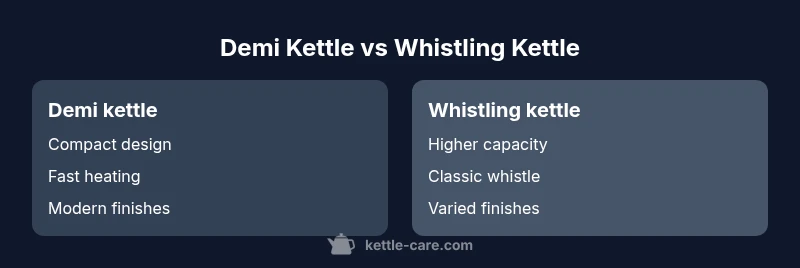
Demi kettle vs whistling kettle: the demi kettle is typically compact and fast for small-batch heating, while a whistling kettle is the classic, louder everyday option. If you value speed and minimal volume, a demi kettle shines; if you want a traditional cue and larger capacity, a whistling kettle may suit you. This quick view helps homeowners start their decision, then explore the details below.
What the Demi Kettle and Whistling Kettle Really Are
A demi kettle is a compact, purpose-built vessel designed for quick heating of modest water volumes. By contrast, a traditional whistling kettle is a larger, everyday boiler that signals boiling with a loud whistle. In this guide, we compare them not as categories of luxury but as practical tools for everyday cooking, tea rituals, and quick hot-water needs. According to Kettle Care Team analysis, the core differences come down to size, ease of use, and the audible cue. If your kitchen space is tight or you regularly prepare small cups of tea, a demi kettle often feels more responsive and flexible. For those who frequently boil larger amounts or enjoy the classic kettle sound, a whistling kettle remains a dependable workhorse for daily routines. This section sets the stage for deeper considerations in the sections that follow.
Design and Materials: What They Look Like and How They’re Built
Demi kettles emphasize compact form factors and contemporary finishes. You’ll typically see models in 0.8–1.2 liter range, with sleek handles and a short boil path for faster heating. Whistling kettles, on the other hand, emphasize capacity and tradition, commonly ranging from 1–2 liters with rounded bodies and long, curved spouts. Both styles leverage stainless steel as a common base material, though demi kettles frequently offer modern coatings, glass accents, or enamel finishes to suit minimalist or industrial kitchen aesthetics. Build quality matters, too: thicker walls retain heat more efficiently, while a well-sealed lid reduces steam leaks. The Kettle Care team notes that material choice influences longevity and descaling needs, particularly in areas with hard water. Regular inspection of the lid hinge and spout cap helps maintain performance over time.
Performance and Efficiency: Boiling Speed, Noise, and Energy Use
Boiling speed is the most obvious differentiator. Demi kettles shine in small-volume scenarios, especially when you want a quick burst of hot water for a cup of tea or instant oats. Their smaller mass generally means shorter heat-up times, provided the kettle is well insulated and the heating element (or flame) is appropriate. Whistling kettles trade some speed for capacity and a comforting ritual—the audible cue that water is ready. In busy households, the extra water volume can be advantageous, but the noise level may be a consideration in open-plan living spaces or offices. Energy efficiency correlates with volume and wall thickness; both kettle types benefit from proper descaling and avoiding boiling more water than you need. The takeaway: choose the demi for speed and space, the whistling for capacity and tradition, while optimizing usage to minimize energy waste.
Safety, Ergonomics, and Usability
User safety sits at the core of kettle design. Demi kettles tend to be lighter and easier to lift, which reduces the risk of accidental spills, especially for shorter users or kids in the kitchen. A snug handle, a balanced center of gravity, and a heat-resistant exterior are useful safety features across both styles. Whistling kettles often feature robust handles and pour spouts designed to minimize steam contact, but the larger body means more surface area to heat and more careful handling. Look for features like a secure lid, a vented lid to prevent pressure build-up, and a reliable whistle mechanism that isn’t prone to jamming. Regular cleaning of the spout and whistle vent helps prevent mineral buildup that can affect performance. According to the Kettle Care Team, consistent maintenance is essential for safety and longevity, particularly in households with hard water.
Practical Use Scenarios: Tea Lovers, Cooks, and Busy Households
If you’re a tea enthusiast who values precise temperature control and quick steeping, a demi kettle excels in small-batch rituals and compact kitchens. Home cooks who routinely boil water for pasta or soups may prefer the reliability and larger capacity of a whistling kettle. For households with shared spaces, the audible whistle provides a universal signal that water is ready, which can be convenient in multi-person routines. Consider your kitchen layout: a wall outlet near the stove favors electric demi kettles, while a stove-top whistling kettle can be a graceful accessory in a traditional kitchen. The decision also hinges on how often you descaled: demi kettles with thinner walls can show mineral deposits sooner, requiring more attentive maintenance.
Cleaning, Descaling, and Longevity: Maintaining Peak Performance
Descaling frequency depends on water hardness and kettle material. Stainless steel finishes are generally easy to clean and resistant to rust, but mineral deposits can obscure performance if ignored. Demi kettles often have smoother interiors with fewer seams, which helps with cleaning, while whistling kettles may have more joints and a larger interior to reach. A simple routine—wash with warm, soapy water after use, rinse, and periodically descale with a vinegar or lime-scale solution—extends life and preserves performance. Drying the exterior thoroughly prevents water spots and corrosion. The Kettle Care team emphasizes that drying the kettle after each use reduces mineral build-up and keeps the whistle mechanism (if present) functional for longer.
Price, Value, and Buying Guidance: Balancing Cost and Benefit
Price ranges vary by brand, finish, and included features. In general, demi kettles sit in the mid-range for modern designs, prized for space efficiency and speed. Whistling kettles span from modest to premium finishes, with some models emphasizing heritage aesthetics. Your choice should align with how often you boil water, the desired capacity, and how much you value design versus function. Don’t assume higher price guarantees better performance—compare heat-up times, material thickness, and maintenance requirements. The goal is durable construction that fits your routines, not just the sticker price. The Kettle Care team recommends reading reviews that focus on real-world boil times, whistle reliability, and ease of cleaning, then testing the model in your kitchen environment.
How to Decide: A Simple Framework for Your Kitchen
Start by asking: do I need quick, small-volume boils or larger batches? How noisy can my kitchen be, and does the design matter to me aesthetically? Consider materials, capacity, and ease of maintenance. If you value compact design and speed, lean toward a demi kettle; if you want a traditional, no-fuss option with ample capacity, a whistling kettle is practical. Finally, verify compatibility with your heating source—gas, electric, or induction—and verify warranty terms. A careful assessment using these criteria helps you make a confident choice that aligns with lifestyle, safety, and budget.
Comparison
| Feature | Demi kettle | Whistling kettle |
|---|---|---|
| Design intent | Compact, rapid heating for small batches | Classic, larger capacity with audible whistle |
| Material options | Stainless steel, glass, enamel | Stainless steel, copper, enamel |
| Boiling speed (relative) | Typically faster for small volumes | Often slower for larger volumes, varies by material |
| Audible cue | Usually no whistle (model-dependent) | Distinct whistle when boiling |
| Maintenance | Often easier to descale; modern finishes | Can require more attention to spout/vent; whistle mechanism can clog |
| Best use case | Small kitchens, tea in minutes | Everyday boiling, ambience, higher capacity |
| Price range | Mid-range (brand-dependent) | Mid-range to premium depending on finish |
| Care tips | Descale regularly; dry thoroughly | Descale as needed; clean spout and vent |
Strengths
- Faster heat-up for small batches
- Space-saving and modern aesthetics
- Easier storage and pouring control
- Lower risk of accidental burns due to compact size
What's Bad
- Limited capacity requiring more frequent refills
- Less traditional ambience for some kitchens
- Potentially higher price for premium finishes
- Whistle mechanism failure in some models (rare)
Demi kettle is best for speed in small batches; whistling kettle remains solid for capacity and a traditional cue.
Choose a demi kettle if your priority is quick boils and compact space. Opt for a whistling kettle when you need larger volumes and enjoy the familiar whistle signal. Both offer reliable performance when chosen with attention to materials, build, and maintenance.
Frequently Asked Questions
What is a demi kettle?
A demi kettle is a compact kettle designed for quick heating of small water volumes. It typically suits small households or spaces where speed and efficiency matter more than capacity.
A demi kettle is a small, fast-boiling kettle ideal for quick teas in compact kitchens.
Why would I choose a whistling kettle over a demi kettle?
Choose a whistling kettle if you regularly boil larger amounts of water and enjoy the traditional audible cue that signals when water is ready. It also tends to offer greater capacity.
Choose a whistling kettle for higher capacity and the classic boiling signal.
Are demi kettles as safe as whistling kettles?
Both types can be safe when used with standard kitchen precautions. Look for secure lids, sturdy handles, and good heat resistance. Regular maintenance reduces risk from buildup.
Both are safe when used properly and maintained.
How do I descale a kettle to keep it efficient?
Descale with a mild vinegar solution or a commercial descaler, following the manufacturer’s instructions. Rinse thoroughly and dry after each use to prevent mineral buildup.
Descale regularly and rinse well to keep performance optimal.
What should I consider about noise levels?
Whistling kettles are inherently noisier due to the whistle. If you need quiet operation, a demi kettle or a silent-model whistler may be preferable.
If noise matters, pick a demi kettle or choose a silent whistle model.
Do I need a specific heat source for these kettles?
Most demi and whistling kettles work on electric coils, gas, or induction if listed by the maker. Verify compatibility with your stove or outlet before buying.
Check compatibility with your stove before buying.
Highlights
- Choose demi for speed and space efficiency
- Prefer whistling for larger volume and traditional cues
- Prioritize materials and maintenance needs when buying
- Test boil times and whistle reliability in your kitchen
- Maintain descaling habits to maximize longevity