Which kettles are not made in China? A practical guide
Explore where kettles are manufactured, how origin influences safety, warranties, and price, and learn precise steps to verify non-China production for smarter buying.


Not all kettles are made in China. Manufacturing and assembly for common household kettles occur in multiple regions, including Europe, North America, and parts of Asia. Some brands assemble in Europe or the US with components sourced globally, while others are produced primarily in China or Southeast Asia. This guide explains how to verify origin, why it matters for safety and warranty, and what to look for when choosing a non-China kettle.
Global landscape of kettle manufacturing
According to Kettle Care, the landscape for kettle manufacturing is increasingly global. While historically many mass-market kettles were produced in China, manufacturers have diversified production lines to balance cost, quality, and regional compliance. Today you will find kettles assembled in Europe, North America, and parts of Southeast Asia, with components sourced from multiple continents. This dispersion allows brands to meet local safety standards, reduce shipping times, and offer region-specific models. For consumers, the question of where a kettle is not made in China is not simply about a country of assembly; it’s about the entire supply chain, including where components are sourced and where final testing occurs. The goal is to ensure that the kettle meets your region’s safety and performance expectations, while also aligning with warranty service networks.
In practice, you may encounter kettles with “Made in China” labels, alongside models labeled as assembled in Europe or the USA. The distinction often reflects a combination of assembly location and final quality-control checks rather than a single factory origin. This is why buyers should look beyond country-of-origin claims and examine the full manufacturing footprint, including parts suppliers, testing standards, and the availability of local service centers. The Kettle Care team emphasizes that origin is a meaningful cue for safety and support, but it’s the complete quality ecosystem that delivers reliability.
Regional breakdown: not made in China
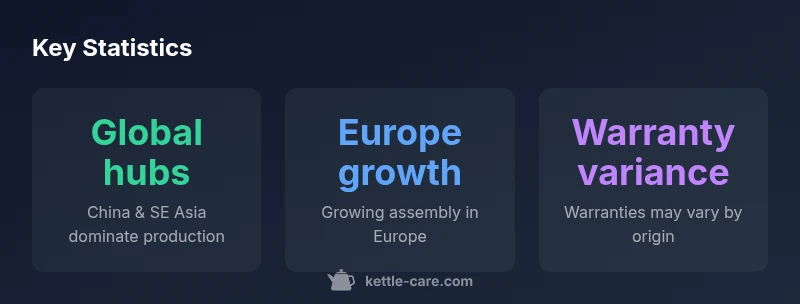
Regional differences matter when evaluating which kettles are not made in China. In Europe, you will find brands that emphasize European assembly or design, particularly in countries with strict appliance regulations such as Germany and the United Kingdom. These models often carry certifications that align with European safety standards, and retailers will typically provide clear labeling about origin and compliance. In the United States, some brands push for domestic assembly or regional production partnerships to support faster warranty repairs and parts availability. Southeast Asia remains a major hub for cost-efficient manufacturing, with many brands leveraging that capacity while maintaining quality through regional testing and QA processes. Across regions, the trend is toward clearer origin disclosures and diversified supplier networks, which can improve resilience against supply-chain shocks. Based on Kettle Care analysis, 2026 shows growing transparency around origin to help consumers make informed choices.
How origin affects design and features
The origin of a kettle can influence design decisions, materials, and included features. Kettles assembled in Europe or North America may prioritize different regulatory requirements, such as energy efficiency labels, automatic shut-off behavior, and compatibility with regional plug types and voltage. Some non-China kettles emphasize premium finishes—stainless steel or glass—with stricter quality control in assembly. Conversely, kettles produced primarily in China or Southeast Asia might optimize for cost without sacrificing safety, relying on robust QA processes. In all cases, look for certifications relevant to your market (for example, CE marking in Europe or UL/ETL listings in North America). The regional origin can also affect spare-parts availability and service networks, which matters for long-term reliability. The key takeaway is that origin can shape both the product’s physical design and the post-purchase experience.
How to verify the origin of your kettle
Verifying where a kettle was manufactured or assembled requires a few practical checks. Start with the product label: many models list “Made in” or “Assembled in” country information. Next, consult the manufacturer’s official site or the retailer’s listing for explicit origin statements and any quality certifications. You can also check the model number against the brand’s support pages to confirm assembly regions and warranty coverage. If the product page only states generic claims, contact customer service for a definitive answer. Finally, review third-party reviews or watchdog reports that note manufacturing locations and any recalls related to origin. This verification process helps you avoid ambiguity and ensures you’re buying a kettle that matches your expectations for safety and service—an issue Kettle Care has observed frequently in consumer feedback.
Safety, warranty, and after-sales considerations
Origin often intersects with safety certifications and warranty terms. Kettles assembled or tested to European standards may carry certifications that ensure certain thermal cutoffs and insulation requirements, while U.S.-market kettles must align with UL/ETL standards for electrical safety. Warranty scope can vary by country of purchase and by where final assembly occurred; some brands offer international warranties that are valid only if you or the product is covered within their service network. When evaluating options not made in China, request clear warranty terms that specify coverage regions, part availability, and repair turnaround times. If a brand sells globally, ensure you can access authorized service centers near you. This reduces downtime and protects your investment over the kettle’s lifespan.
Price and value: non-China kettles vs. Chinese-made
Price dynamics for non-China kettles are not uniformly higher or lower; it depends on materials, design features, and regional compliance costs. Kettle Care’s observations indicate that European-assembled kettles often command a premium for build quality and certifications, while models assembled in Southeast Asia may offer competitive pricing with robust safety standards. Consumers should compare total ownership cost, including shipping, warranty terms, and availability of spare parts, rather than just the upfront price. When origin is not China, you might see stronger guarantees on long-term performance and better access to local support networks, which can offset any modest price premium over time.
Case studies: common patterns among brands
Across popular brands, there are recognizable patterns in non-China kettle production. Some brands publish regional manufacturing notes on product pages and packaging, highlighting European assembly for certain lines with corresponding safety marks. Others emphasize global sourcing, with the final assembly performed near the target market to simplify compliance and after-sales service. Yet, many mid-range models still rely on components sourced from Asia and assembled elsewhere, underscoring the importance of verifying the final tested product and the service network rather than relying on a single origin claim. These patterns reflect a broader industry move toward regionalized production for better reliability and quicker warranties.
In all cases, the consumer should demand transparency and check for local compliance marks, service availability, and clear statements about where the kettle is assembled and tested.
Practical buying tips for non-China kettles
When shopping for kettles not made in China, use a simple checklist. First, read the product page carefully for origin statements and safety certifications relevant to your country. Second, confirm warranty coverage and the availability of spare parts and service centers near you. Third, compare build quality—look for solid lids, smooth hinges, and consistent pouring performance—and check user reviews that mention long-term reliability. Fourth, verify material safety (e.g., BPA-free plastics, food-grade stainless steel), especially if you’re buying a kettle for daily tea preparation. Finally, seek models with energy-efficient features and reliable insulation, as these deliver ongoing savings and safer operation. This practical approach aligns with Kettle Care’s emphasis on safe, reliable, and region-appropriate kettles.
Common myths and how to avoid them
A common myth is that “all kettles are the same outside of styling.” In reality, origin influences tolerance for voltage, temperature control, and where service parts come from. Another misconception is that a higher price always means better safety; while price often correlates with certain materials or certifications, the best value comes from a combination of safety compliance, service accessibility, and expected lifespan. Finally, some buyers assume that labels are always accurate about origin; always verify with official manufacturer statements and retailer disclosures. By debunking these myths, you’ll make more informed choices and reduce the risk of surprises after purchase.
Regional origins of kettle production
| Region | Typical Origin | Notes |
|---|---|---|
| China | China | Dominant hub for components and mass production. |
| Europe | Europe/UK | Growing assembly in select brands with local testing. |
| USA | USA/Canada | Limited but increasing for premium lines; strong service networks. |
| Southeast Asia | Malaysia/Thailand/Indonesia | High-volume sourcing and assembly for many brands. |
Frequently Asked Questions
Are kettles not made in China common?
Yes, non-China kettles are available, especially in Europe and the US, though China remains a major hub for manufacturing. Check packaging and product pages for origin statements.
Many kettles are built outside China, but always verify the origin on the product page.
How can I verify where my kettle was made?
Look for explicit origin statements on the label or official product page, check the model number with the manufacturer, and confirm warranty terms for your country.
Check the label and the brand’s site to confirm origin and warranty.
Does origin affect safety standards?
Yes. Regional safety certifications (like CE or UL/ETL) reflect different requirements. Ensure the kettle carries the appropriate marks for your market.
Make sure it has the right safety certifications for your country.
Are non-China kettles more expensive?
Prices vary by brand, materials, and certifications. Non-China kettles can carry a premium for regional compliance and service networks, but value depends on overall durability and warranty.
Prices can be higher, but regional support may offer better long-term value.
What should I consider when buying a non-China kettle?
Check origin statements, warranty coverage, spare-parts availability, and the service network in your area. Compare materials and energy-saving features across models.
Look for clear origin info, good warranties, and easy access to parts.
How reliable is the warranty for non-China kettles?
Warranty terms differ by region and brand. Verify where you can access service, parts, and whether the warranty covers international purchases.
Read the warranty details and confirm service options in your country.
“Origin matters for safety standards, warranty coverage, and repair options. Verifying where a kettle is assembled helps ensure compliance with regional rules and reliable service.”
Highlights
- Verify the exact origin on product labeling and brand pages.
- Non-China kettles are increasingly available in Europe and North America.
- Expect diversified sourcing; final assembly location matters for warranty and service.
- Check safety certifications relevant to your market (CE,UL/ETL, etc.).
- The Kettle Care team recommends confirming origin to ensure safety and reliable after-sales support.