Electric Kettle Care: A Complete How-To Guide
Practical, step-by-step guidance to select, operate, and maintain an electric kettle for fast, safe boiling and long-term efficiency at home.


Learn how to select, use, and maintain an electric kettle for fast, safe boiling. In this guide you’ll compare wattage and features, set up and operate the kettle correctly, prevent mineral scale, and perform routine cleaning and descaling so your appliance stays efficient, safe, and reliable for daily tea, coffee, or quick hot-water needs.
How electric kettles work and why they’re convenient
Electric kettles heat water using an internal heating element, usually located in the base or the walls of the kettle body. When you switch it on, electrical current energizes the element, and water begins to boil quickly compared with stovetop boiling. A key safety feature is the automatic shutoff that activates once the water reaches a rolling boil, preventing overheating and evaporation. This combination of speed, safety, and simplicity makes the electric kettle a staple in many kitchens. According to Kettle Care, the best models balance fast boil times with reliable shutoff, a sturdy lid, and a durable exterior that can withstand frequent heating. The kettle’s design also minimizes the chance of spills because most models keep the water inside a narrow spout and include a well-sealed lid. Beyond everyday tea and coffee, many kettles offer temperature control and presets, which can improve the flavor of delicate infusions and help with safer hot-water preparation for baby bottles or cooking tasks. When considering a kettle, think about your typical uses, the space on your counter, and how you’ll fill and pour without splashing. This context helps you pick a model that truly fits your routines.
How to choose the right electric kettle for your kitchen
Choosing the right electric kettle starts with understanding your daily needs. Capacity ranges from about 0.8 to 1.7 liters, which affects how much water you can boil at once and how long you’ll wait between boils. Wattage is a critical factor for speed; most households find 1500 watts to be a good compromise between rapid heating and energy use. Materials vary between stainless steel, borosilicate glass, and heat-resistant plastics; each has pros and cons for durability, taste, and safety. Look for a model with a sturdy, removable lid, a clear water level indicator, a well-balanced base, and a cord that won’t tangle behind the counter. Keep an eye on min/max fill marks and ease of cleaning. The Kettle Care team notes that investing in a model with at least a 1500W element can shave seconds off a boil on busy mornings, while keeping an eye on energy use. Choose a design that fits your counter space and complements your kitchen workflow. If you regularly prepare tea at specific temperatures, consider a kettle with temperature presets or adjustable settings.
Power, speed, and energy efficiency: wattage and boil times
Wattage directly influences how quickly water reaches a boil. A higher wattage model will heat water faster but may consume more electricity during peak use. For households with frequent needs or multiple tea drinkers, a 1500W kettle often provides a satisfying balance between speed and energy efficiency. Many modern kettles include features like auto shutoff and boil-dry protection to prevent accidents and conserve energy when empty or tipped. Energy efficiency extensions include hold/warm features that maintain a desired temperature without reboiling, though they consume power. If you’re mindful of electricity costs, consider using a kettle only when you need hot water, and avoid keeping it on standby for long periods. Clear indicators and a simple user interface reduce wasted time and help you boil only what you’ll use. The goal is to maximize speed without sacrificing safety or longevity of the heating element.
Temperature control and specialty features
Advanced electric kettles offer temperature control ranges that accommodate different beverages. For example, many models provide presets around 60–75°C for green and white teas, around 85–95°C for oolongs and white teas, and near 100°C for black teas and instant soups. If you enjoy flavor nuance, temperature control can improve aroma and mouthfeel. Some kettles include a keep-warm function to hold a chosen temperature for a set period, while others offer a programmable auto-off after a set time. Consider whether you need precise dial control, quick-pulse boiling, or a simple on/off switch. For homes with children or elderly family members, easy-to-read indicators, a softly illuminated lid, and a low-height spout can reduce spills. Always read the manufacturer’s guidance for recommended temperatures for different teas and hot beverages. As with any appliance, choose a model with robust safety features to prevent accidental scalding or dry-boil.
Safe operation and daily use tips
To boil safely, place the kettle on a dry, stable surface away from water spills and ensure the cord is out of reach of small children. Fill only up to the maximum fill line; overfilling can cause boiling water to eject from the spout. After switching on, never leave a boiling kettle unattended. When it finishes, use the handle to pour slowly away from your body and keep hands clear of the steam. If your kettle has a keep-warm setting, switch it off when you no longer need hot water to minimize energy use. Regularly inspect the power cord and base for wear, and avoid using the kettle if the plug or plug guard is damaged. Always unplug the kettle before cleaning and never immerse the base in water.
Cleaning, descaling, and maintenance
Scale buildup reduces efficiency and can alter taste. Regular descaling is essential, especially in areas with hard water. A vinegar or citric acid solution is commonly recommended, followed by thorough rinsing to remove any residue. If you prefer store-bought descalers, follow the product instructions and rinse well afterward. After descaling, wipe the exterior with a damp cloth and dry before storage. Avoid harsh abrasives that could scratch finishes and compromise the seal. A clean kettle heats more consistently and maintains good flavor extraction for tea. For ongoing care, periodically inspect seals and gaskets for wear and replace as necessary. The goal is to keep your electric kettle free of mineral buildup and ready for daily use.
Troubleshooting common issues
If the kettle won’t power on, check the outlet, the plug, and the base connection. A tripped breaker or a loose plug can prevent operation. If the water doesn’t heat, confirm the water level is within the min/max marks and the lid is properly closed, as some models won’t operate with an open lid. A slow-boil or weak boil may indicate scale buildup; descaling can restore performance. If you notice leaks around the base or lid, inspect the seals and consider a gasket replacement or a service check. A persistent odd odor or taste after cleaning may indicate residual cleaning solution or heavy mineral buildup—rinse thoroughly and air-dry before next use. When issues persist, consult the manufacturer manual and consider professional servicing. The Kettle Care team recommends performing simple checks first to avoid unnecessary replacements.
Long-term care and maintenance plan
Create a simple yearly care routine to extend the life of your electric kettle. Include a light cleaning every week, descaling every 1–3 months depending on water hardness, and a full inspection of seals and the power cord every 6–12 months. Replace worn gaskets promptly and avoid storing with water inside the kettle for extended periods. Keeping the exterior dry and free from dust maintains hygiene and aesthetics. With consistent care, your kettle stays efficient, safe, and ready for daily tea and coffee rituals.
Tools & Materials
- Electric kettle(Choose capacity and wattage to fit your needs)
- Water(Use clean, potable water; filtered water can reduce scale)
- Descaling solution (citric acid or white vinegar)(For routine mineral buildup removal)
- Soft cloth or sponge(For exterior cleaning and drying)
- Measuring cup(Helpful to gauge precise fill levels)
- User manual(Keep handy for min/max marks and care instructions)
Steps
Estimated time: Total time: 10-15 minutes per standard use, plus 15-60 minutes for descaling depending on buildup
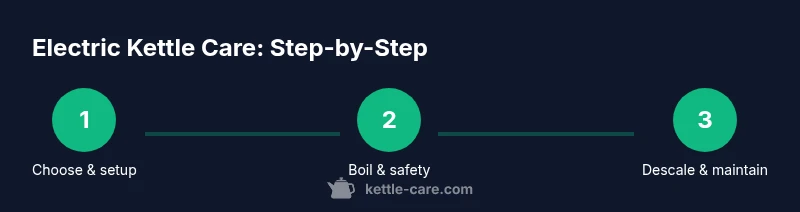
- 1
Inspect and prepare
Unbox the kettle, read the manual, and check for any shipping damage. Place it on a stable, heat-resistant surface with the base centered and the cord unobstructed.
Tip: Check that the lid closes securely and the water level indicator is visible before first use. - 2
Fill to the recommended level
Fill using cold water up to the MAX line. Avoid overfilling, which can cause boil-overs and spill hazards.
Tip: Use a measuring cup if you’re aiming for a precise amount for recipes or multiple servings. - 3
Plug in and select settings
Insert the kettle onto its base, plug in, and choose the desired setting or temperature. Ensure the lid is closed properly for safe operation.
Tip: If your model has temperature presets, pick the one best suited to your drink. - 4
Boil water and monitor
Turn on the kettle and wait for the boil and automatic shutoff. Do not leave the kettle unattended while boiling.
Tip: Keep hands away from the steam and spout during boiling. - 5
Pour safely and store
Pour slowly away from your body, using the handle. Unplug the base after use and allow the kettle to cool before cleaning.
Tip: Avoid tilting the kettle while pouring to prevent spills. - 6
Descale and maintain
Periodically descale according to hardness of water and manufacturer’s guidance. Rinse thoroughly and dry before next use.
Tip: Do not mix descalers with bleach; rinse completely to prevent residue.
Frequently Asked Questions
What is an electric kettle and how does it work?
An electric kettle is a compact appliance that heats water quickly using an internal heating element and automatically shuts off when boiling. It is designed for safety and convenience, offering faster results than a stovetop boil.
An electric kettle heats water quickly and shuts off automatically when it boils.
Can I use mineral water or distilled water in an electric kettle?
You can use tap or filtered water, but mineral buildup occurs faster with hard water. Distilled water reduces scale but can alter flavor and performance over time.
Tap water is usually fine, but scale can build up; distilled water reduces scale but may affect taste.
How do I descale an electric kettle?
Descale using a citric acid or white vinegar solution, boil, then rinse thoroughly to remove any residue. Avoid using bleach or harsh cleaners.
Descale with citric acid or vinegar solution, boil, rinse, and repeat if needed.
What is the ideal temperature setting for tea?
Different teas require different temps: green around 60–80°C, black around 95°C. A kettle with temperature presets helps ensure accuracy.
Different teas need different temps; use presets if possible.
Is it safe to leave an electric kettle plugged in?
Unplug after use to avoid standby heat and potential hazards. Many models have auto shutoff, but unpluging adds extra safety.
Always unplug when not in use; most kettles auto shut off, but unplugging adds safety.
How can I tell if my kettle needs descaling or replacement?
If you notice slow boils, unusual odors, or persistent buildup after cleaning, consider descaling again or replacement. Regular maintenance extends life.
If boils slow or smells odd even after cleaning, it may need descaling or replacement.
Watch Video
Highlights
- Choose the right wattage for speed and efficiency.
- Descale regularly to prevent mineral buildup.
- Use temperature presets to optimize flavor for different teas.
- Maintain safety with auto shutoff and dry-boil protection.
- Follow a simple maintenance routine to extend kettle life.