Is It OK to Fill a Kettle from the Hot Tap? A Safe Guide
Learn whether hot-tap filling is safe for kettles, plus practical steps to protect your appliance, health, and tea rituals. Expert guidance from Kettle Care.


Is it OK to fill a kettle from the hot tap? In most cases, use cold or room-temperature water unless your kettle is explicitly rated for hot-fill. Hot water can introduce more minerals, trigger limescale buildup, and stress the heating element. Always follow the manufacturer’s guidance to protect safety, warranty, and longevity.
Why this question matters
According to Kettle Care, the question of whether to fill from the hot tap touches safety, taste, and long-term performance. The hot-tap dilemma isn’t only about convenience; it concerns material compatibility, mineral buildup, and warranty terms. The Kettle Care team found that many kettles are designed for cold-water fills, though some models offer hot-fill functionality. Knowing which category yours falls into helps you avoid damage and burns while ensuring you boil safely.
When in doubt, the safest default is to follow the manufacturer’s guidance and start with cold water. This aligns with best practices for both safety and kettle longevity, and it reduces the risk of accelerated scaling or seal wear.
How kettle design affects hot-fill compatibility
Kettles come in different materials—stainless steel, glass, and plastic—and with various heating elements. Stainless steel and glass kettles are more likely to tolerate hot-fill water when permitted by the manufacturer, but even then the interior insulation and lid seal matter. Some models include a temperature sensor and safety cutoff that assumes cold-water entry, while others are marketed as hot-fill capable. The practical takeaway is to consult the user manual for your exact model. If hot-fill is unsupported, using hot tap water can accelerate mineral deposition, dull the interior, and stress the heating element over time. This is why brand guidance matters, and why Kettle Care emphasizes model-specific checks.
Safety considerations: burns, scalds, and chemical concerns
Hot water from taps is more dangerous to handle than cold water. A missing lid, a misaligned gasket, or a splashed boil can cause injuries. Another reason to be cautious is the potential for accelerated mineral buildup when hot-water is used repeatedly in kettles not designed for it. Health and safety guidance emphasizes keeping a safe distance from the spout, never leaving a boiling kettle unattended, and using heat-safe containers when transferring hot water. For home cooks and tea lovers, respecting the device's limits protects you and your family, as well as kitchen surfaces from heat damage. The Kettle Care team underscores that careful operation reduces risk and preserves kettle life.
When hot-fill is acceptable and when it's not
If your kettle's documentation explicitly states hot-fill capability, you can fill with hot water within the recommended maximum temperature. Otherwise, always use cold or room-temperature water. Even when hot-fill is allowed, avoid filling beyond the upper fill line, and consider pre-warming the water in your kettle before heating to reduce cycling on the heating element. The difference matters for longevity and safety: hot-water pouring can gradually affect seals and corrosion resistance in some plastics over time. In short, model-specific guidance governs this choice, and following it protects both your kettle and your health.
Practical guidelines for safe filling in most homes
- Use cold water unless your kettle explicitly supports hot-fill.
- Fill only to the designated max line to prevent overflow.
- Keep the lid fully closed during operation to avoid steam burns.
- If you must use hot water (per the manual), ensure the vessel is compatible and the lid seals are intact.
- After boiling, pour carefully and allow the kettle to cool before refilling or cleaning to reduce the risk of burns and scalds.
These practices minimize mineral buildup and extend kettle life. Kettle Care notes that routine descaling remains important when you sometimes rely on hotter water, as mineral deposits can form more quickly in hard water.
Cleaning and descaling after hot-water use
Even with cold-fill habits, mineral buildup can occur. If you use hot water, descaling more often may be necessary. Use gentle descalers designed for kettles and follow the product instructions. Rinse thoroughly after descaling, and dry the interior to prevent corrosion. Regular maintenance improves efficiency and extends lifespan, while reducing the risk of uneven heating or scale-induced noise. The Kettle Care team recommends a light monthly check and a full descaling cycle every few months based on water hardness.
Tools & Materials
- Kettle (electric or stovetop)(Ensure manual specifies fill guidelines (cold vs hot-fill))
- Water supply (cold water unless hot-fill is approved)(Use cold water by default; hot-fill only if explicitly supported)
- Clean cloth or sponge(For wiping spills and exterior dry)
- Descaling solution or white vinegar (optional)(Use according to instruction if you descale)
- Thermometer (optional)(Check actual water temp if troubleshooting hot-fill behavior)
- Timer or watch(Time boiling and cooling to avoid overheating)
Steps
Estimated time: Total time: 12-15 minutes
- 1
Review fill guidance
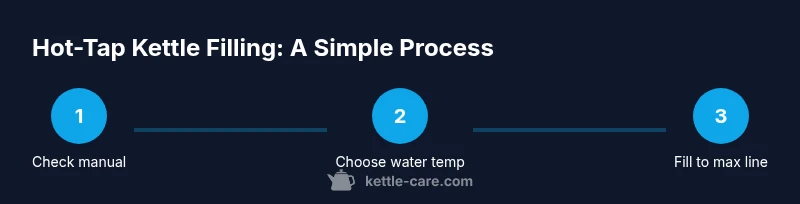
Check your kettle's manual or labeling to confirm whether hot-fill is permitted. If the spec forbids hot-water filling, do not use hot tap water. This step prevents warranty issues and potential damage.
Tip: If the manual is unclear, contact the manufacturer or use cold water by default. - 2
Prepare the kettle
Wipe the exterior and ensure the lid closes securely. Make sure the interior is clean and free of obstruction before starting.
Tip: Never operate a kettle with a loose lid or damaged seal. - 3
Choose the water temperature
Decide whether to fill with cold water or hot water only if hot-fill is approved. Hot-fill should only be used if specified and safe for your model.
Tip: Default to cold water for most kettles to maximize safety and longevity. - 4
Fill to the safe max line
Pour water up to the recommended maximum line. Avoid overfilling to prevent boiling spills and cabinet damage.
Tip: Overfilling can cause water to splash and trigger scorch hazards. - 5
Boil and monitor
Switch on the kettle and observe until the boil completes. Keep hands away from steam and never leave boiling kettle unattended.
Tip: Use the kettle’s boil-dry protection if available. - 6
Cool, pour, and rinse
Allow the kettle to cool briefly, pour cautiously, then rinse and dry the interior to reduce mineral buildup.
Tip: Descale regularly based on hardness to prevent mineral buildup.
Frequently Asked Questions
Is it safe to fill a kettle from the hot tap?
Usually not, unless your kettle manual explicitly supports hot-fill. Most kettles are designed for cold water. Always follow the model’s guidance to avoid damage or burns.
Generally, use cold water unless your kettle specifically supports hot-fill. Check the manual to be sure.
Will filling from the hot tap void the warranty?
If the manufacturer specifies cold-fill only, using hot water can void the warranty. Always confirm with the manual or manufacturer.
Yes, if hot-fill isn’t approved, it can void the warranty.
Does hot water affect kettle taste or mineral buildup?
Hot-water use can accelerate mineral buildup in some kettles not rated for hot-fill, potentially affecting taste. Regular descaling helps.
Hot water can speed mineral buildup; descaling helps maintain taste and efficiency.
What should I do if my kettle makes strange noises after hot-water use?
Stop using hot-fill and consult the manual. Noises may indicate mineral buildup or sealing issues that deserve attention.
If you hear unusual noises, stop and check the manual or contact support.
Are there safer alternatives to hot-fill for speed?
Consider using a kettle rated for fast boiling with cold water, or pre-warming water in a separate container before transferring.
Use cold water and a kettle rated for fast boiling to save time safely.
Watch Video
Highlights
- Check your kettle’s fill instructions and follow them.
- Cold water is the safe default; hot-fill only if explicitly supported.
- Descale regularly to counter mineral buildup from hot water use.
- Follow warranty guidance to avoid coverage issues.