Kettle to Go: The Complete Portable Kettle Care Guide
Learn how to choose, care for, and use a kettle to go for safe, fast boiling anywhere. Portable tips, safety, cleaning, and travel-ready maintenance.


Ready to boil anywhere? A kettle to go helps you safely bring hot water on trips or office days with compact, travel-friendly designs. This quick guide shows how to select a portable kettle, maintain safety, and optimize performance. Key requirements: choose BPA-free, check capacity, carry safety features, and follow descaling routines.
What is a kettle to go?
A kettle to go is a compact, travel-friendly electric kettle designed for safe, quick boiling away from home. It typically features a smaller capacity (often 0.5–1 liter), a secure lid, a stable base, and an auto shut-off or boil-dry protection. These design choices reduce weight, simplify packing, and lower the risk of spills during transit. When you’re traveling, at the campsite, or in a small office kitchen, a kettle to go can deliver hot water in minutes without taking over your counter. For safety and reliability, look for insulated handles, heat-resistant materials, and a robust seal on the lid. According to Kettle Care, choosing the right portable kettle involves matching your daily water needs with a model that prioritizes safety features and simple maintenance. In this guide, you’ll learn how to select, use, and care for your kettle to go so you can boil with confidence anywhere.
How to choose the right portable kettle
Choosing a kettle to go starts with balancing capacity, safety, and portability. Look for a model in the 0.5–1 liter range, so it heats efficiently without overloading your bag. Favor materials with BPA-free plastics or stainless steel for durability and food safety. Key safety features include auto shut-off, boil-dry protection, and a secure lid seal. Check the power compatibility for your travel region (voltage, frequency, and plug type). A compact, light design with a stable base and a well-insulated handle makes travel easier. Consider ease of cleaning and whether the kettle exposes your hands to steam during pouring. For regular travelers, a model with a detachable lid and wide mouth reduces cleaning time. As you compare, think about how often you’ll use the kettle on the go and whether you need a model that fits in your carry-on or backpack. Kettle Care emphasizes that the right portable kettle should meet your daily water needs while offering straightforward maintenance.
Safety and health considerations
Safety with a kettle to go starts with proper handling of hot water and stable placement. Always place the kettle on a flat, heat-resistant surface away from edges and kids. Use clean, cold water to reduce mineral buildup and avoid spilling hot water on yourself. Do not overfill beyond the max fill line; boiling water can splash and cause burns. If you’re using a shared kitchen, unplug when not actively boiling and keep the base dry. For travelers with limited outlets, ensure your power adapter is rated for the destination and that cords are not a tripping hazard. Regular descaling helps maintain safety features and prevents overheating. The Kettle Care team notes that maintaining a clean kettle reduces the risk of bacteria growth and ensures a safer boil every time.
Care, cleaning, and descaling on the go
Keep a kettle to go in good shape by performing quick cleans after each use and a deeper descale when mineral buildup appears. Wipe the exterior with a damp cloth and dry thoroughly to prevent corrosion. For descaling, mix a mild solution of citric acid or white vinegar with water and fill to the appropriate level; boil, then rinse several times with fresh water. Never submerge the base or electrical components in water. After boiling, discard the water safely and dry the interior with a clean cloth. If you travel frequently, consider carrying a small bottle of descaling solution and a soft brush to reach the spout and lid seams. Regular care extends the kettle’s life and keeps boiling performance consistent.
Performance tips for on-the-go boiling
To maximize efficiency while traveling, preheat the kettle with clean cold water, use filtered water to reduce scale, and keep the lid closed during boiling for faster heat retention. If you’re at altitude, expect a slightly longer boil time and plan accordingly. A well-insulated handle and a compact design reduce heat transfer to your hands, making pouring safer. Use the correct voltage and a compatible plug adapter to avoid circuit overloads. Lightweight, travel-friendly kettles heat quickly and perform reliably when you clean them regularly. The right on-the-go technique blends safety with speed for a smooth boiling experience.
Common mistakes and how to avoid them
Common mistakes include overfilling, using the kettle on an unstable surface, neglecting descaling, and ignoring the power compatibility of foreign outlets. Always check the fill line, verify the base is dry before plugging in, and unplug after boiling. Avoid using hot water for refilling immediately after boiling to reduce pressure build-up. Don’t carry a wet kettle in a bag where steam can cause dampness or burns. Finally, don’t neglect routine descaling: mineral buildup reduces efficiency and can shorten the kettle’s life. Following these practices helps you enjoy safe, reliable boiling on the go.
Tools & Materials
- Kettle to go (portable kettle)(Compact design; 0.5–1 L capacity; check safety features)
- Water (clean/filtered)(Use cold water; reduces mineral buildup)
- Descaling agent (citric acid or white vinegar)(For on-the-go descaling; optional for quick clean)
- Soft cloth or sponge(Wipe exterior; dry completely before storage)
- Small brush or cotton swabs(Clean spout and lid seams)
- Measuring cup(Helpful for precise water amounts)
- Travel power adapter (if needed)(Check voltage compatibility for your destination)
Steps
Estimated time: 15-25 minutes
- 1
Unpack and inspect
Remove the kettle to go from its packaging and inspect for any transport damage. Verify the lid seals and base contact are intact. If you notice gaps, cracks, or loose parts, do not use the kettle until it’s repaired or exchanged.
Tip: Check the power cord length and plug type before you travel. - 2
Check power compatibility
Confirm the voltage and frequency of your destination. If needed, attach a certified travel adapter with a secure connection. A poor contact can cause arcing or overheating.
Tip: Use a grounded outlet whenever available. - 3
Fill with water to the max line
Pour clean, cold water up to the indicated max fill line. Overfilling can cause water to spill during boiling and increase the risk of burns when opening the lid.
Tip: Avoid using hot water in the kettle for the next boil to prevent shell stress. - 4
Place on a flat surface and power on
Set the kettle on a heat-resistant, stable surface away from edges. Plug into a compatible outlet and switch on as directed by the manufacturer. Stand clear of the steam release path.
Tip: Keep cords away from sinks and spills. - 5
Boil and monitor
Allow the kettle to reach a full boil. Most models will auto shut off when the water boils. Do not lift the lid while boiling to avoid steam burns.
Tip: If your model has a boil-dry protection, ensure it remains clean so the sensor can function properly. - 6
Pour safely and cool
Pour slowly into your cup, keeping the kettle steady by the handle. Allow the water to cool enough for safe handling before storage.
Tip: Pour away from your body and use a heatproof cup. - 7
Clean and store after use
Unplug and let the kettle cool completely. Wipe the exterior dry and perform a quick internal rinse if needed. Store in a dry place to prevent mineral buildup.
Tip: Regular descaling every few uses keeps performance consistent.
Frequently Asked Questions
What is a kettle to go?
A kettle to go is a compact, travel-friendly electric kettle designed for safe, quick boiling away from home. It typically has a smaller capacity and safety features like auto shut-off. This makes it ideal for hotel rooms, offices, or campsites where space is limited.
A portable kettle is a compact, safe way to boil water when you’re away from home, perfect for hotels or camping.
What capacity should I look for in a kettle to go?
Most kettle-to-go models range from 0.5 to 1 liter. Choose based on your typical tea or coffee servings to avoid unnecessary weight.
Most travel kettles hold about half a liter to one liter; pick based on your usual drinks.
Is it safe to use a kettle to go in a hotel room or shared kitchen?
Yes, as long as you use a model with proper safety features, place it on a stable surface, and unplug after boiling. Keep water away from children and ensure cords are tidy.
It’s safe in hotels if you follow basic safety steps and unplug after use.
How do I descale a kettle to go when traveling?
Mix a mild descaling solution (citric acid or white vinegar) with water, boil, then rinse thoroughly with clean water. Do not skip rinsing; mineral residues can affect taste and performance.
Boil a gentle descaling mix, then rinse well before using again.
Can I use a kettle to go in a car or RV?
Yes, but use a compatible power source and secure placement to prevent spills during motion. Many travel kettles are designed for 120V or 240V, and some require a vehicle adapter.
You can, just ensure you have a safe, appropriate power source and secure placement.
Watch Video
Highlights
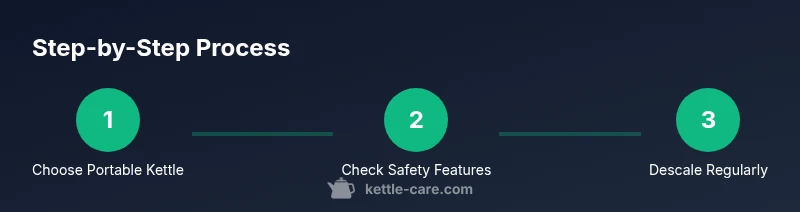
- Choose a 0.5–1 L kettle to balance portability and capacity
- Prioritize safety features: auto shut-off and boil-dry protection
- Descale regularly to maintain efficiency and longevity
- Keep the kettle clean and dry after each use