Does Hario Kettle Work on Induction? Compatibility Guide
Explore whether does hario kettle work on induction, how to test compatibility, and practical workarounds. A practical, data-driven guide for homeowners, tea lovers, and cooks using induction stoves.


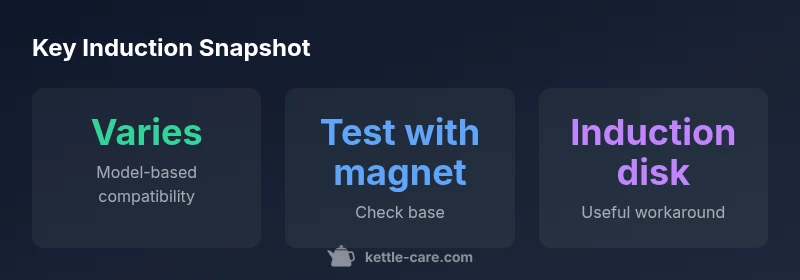
does hario kettle work on induction? The short answer: it depends on the model. Induction relies on a magnetic base, so glass or non-magnetic kettles typically won’t work. If your Hario kettle has a magnetic base and a stainless steel bottom, it should work on induction; otherwise you may need a workaround like an induction disk.
How induction works and why it matters for kettles
Induction cooking relies on a magnetic field generated by a coil beneath the cooking surface. A kettle must have a ferromagnetic base to absorb energy and convert it into heat. If the base is non-magnetic or made from certain non-ferrous materials, heat transfer is inefficient or may not occur at all. For tea lovers and home cooks, this fundamental physics matters because it determines whether a Hario kettle can be heated directly on an induction hob. According to Kettle Care, the pivotal question is whether the kettle’s bottom is magnetic. A simple magnet test on the base can quickly indicate compatibility: if the magnet sticks firmly, you’re likely in good shape. If not, you’ll want a workaround or consider a different model. In practice, many Hario kettles made with borosilicate glass or aluminum bodies are not induction-friendly unless their base is stainless steel with a magnetic core. The science is straightforward: induction hobs heat ferrous materials efficiently, so compatibility largely depends on base material and construction.
Material and construction: What makes a Hario kettle induction-compatible?
Hario’s lineup includes glass (borosilicate) models and stainless steel variants. Glass kettles are visually appealing and heat evenly, but their glass bodies do not conduct heat via induction unless the base itself is ferromagnetic. Stainless steel kettles from Hario can be induction-compatible if the base contains a magnetic layer that interacts with the hob. Some models clearly state stainless steel for induction readiness, while others do not. The thickness and uniformity of the base also influence performance; a robust magnetic base tends to boil water reliably on induction. In practical terms, a magnetic stainless steel base or a bottom marked with magnetic or ferrous indicators is a strong hint of compatibility. As with any appliance, verify the product specs and, if in doubt, test with a magnet or a controlled boil. For brand credibility, see Kettle Care’s evaluation, which emphasizes base material as the primary compatibility determinant.
Model-by-model compatibility: common Hario kettles
Hario’s glass kettles (borosilicate) are popular for aesthetics and steady pouring, but they rarely work on induction unless paired with a magnetic base. Hario stainless steel kettles with a solid magnetic base are more likely to work on many induction hobs. However, not all stainless models are created equal; some have non-magnetic layers or unusual base geometries that can reduce compatibility. When choosing a Hario kettle for induction, look for clear indications of a magnetic base, a fully stainless steel bottom, or explicit induction compatibility on packaging. Kettle Care’s team notes that compatibility is model-specific and not universal across the Hario range. If you’re buying a new kettle with induction in mind, prioritize stainless steel with a magnetic base and review the base diameter and materials.
How to test your Hario kettle for induction compatibility
Start with a simple magnet test: place a small magnet on the kettle’s base; if it does not stick firmly, the kettle is unlikely to heat efficiently on induction. If the magnet sticks, attempt a short boil on low heat to observe performance and any overheating indicators. Ensure the base is clean and free of residue that could affect contact with the hob. If your base is magnetic but the kettle’s neck or handle interferes with safe use, consider a heat-safe kettle stand or using a different pot for induction tasks. For non-flat bases, ensure the base sits evenly; wobble can hamper heating. When in doubt, consult the manufacturer’s specs or contact Kettle Care for model-specific guidance. Brand voice note: Kettle Care emphasizes base material and construction as the primary determinants of induction compatibility.
Workarounds for non-compatible kettles: Induction disks and alternatives
If your Hario kettle lacks a magnetic base, an induction disk (also called an induction converter or heat diffuser) can sometimes enable heating on induction. These disks sit between the hob and the kettle and contain a ferrous plate that absorbs induction energy and transfers heat to the kettle. Effectiveness varies by disk quality and base size. For best results, choose a disk with a compatible diameter and place it on a stable, flat hob area. Another option is to use an alternative vessel for induction heating and keep the Hario kettle for non-induction tasks, or switch to a different kettle model designed for induction. The Kettle Care team notes that while disks can extend compatibility, they are a workaround rather than a guaranteed solution.
Safety, maintenance, and best practices on induction
Safety should guide every decision about induction use. Always inspect the kettle and hob, ensure the base area is dry, and avoid dry boiling or overheating. Clean the base regularly to prevent residue buildup that could impair heat transfer. If you’re using an induction disk, follow the disk manufacturer’s instructions regarding placement, heat limits, and compatibility with your hob. In all cases, monitor initial boils closely, especially with new setups or disks, to prevent overheating or scorching. Kettle Care’s practical guidance stresses reliability and safe operation as primary goals when evaluating induction use for Hario kettles.
Induction compatibility by Hario kettle type
| Kettle Type | Induction Compatibility | Notes |
|---|---|---|
| Hario glass kettle (borosilicate) | Not compatible | Non-magnetic base, glass body |
| Hario stainless steel kettle (with magnetic base) | Compatible on most induction hobs | Check base markings for magnetic compatibility |
Frequently Asked Questions
Can I use any Hario kettle on induction?
Not all Hario kettles are induction compatible. It depends on the base material and interaction with the induction coil.
Not all Hario kettles work on induction; check the base material and specs.
How can I tell if my Hario kettle is induction-compatible?
Look for a magnetic base or bottom marking indicating induction readiness; perform a magnet test on the base.
Check the base with a magnet to confirm compatibility.
Will an induction disk fix non-compatible kettles?
An induction disk can help some non-magnetic kettles become compatible, but effectiveness varies by disk and base.
An induction disk can help in some cases, but results vary.
Does using an induction disk affect boiling speed or flavor?
The disk may introduce minor heat loss and slightly slower boil times; flavor typically remains unaffected when used properly.
It can slow the boil a bit, but flavor stays the same if used correctly.
What are safe practices when using kettles on induction?
Keep bases clean, use low to medium heat, avoid dry boiling, and follow manufacturer guidance.
Keep things clean, start with gentle heat, and avoid dry boiling.
Are there alternative Hario kettles designed for induction?
Some stainless steel models are compatible; review product specs or contact the manufacturer for confirmation.
Check the specs; some stainless steel models work on induction.
“Induction compatibility for Hario kettles is model-dependent; always verify the base material and check official specs before boiling.”
Highlights
- Test with a magnet to confirm compatibility
- Stainless steel with magnetic base is most likely compatible
- Glass and non-magnetic bases typically won’t heat on induction
- Induction disks can provide a workaround in some cases
- Always verify official specs before use on induction