Are kettlebells better than dumbbells: A practical comparison
A data-backed, practical comparison of kettlebells vs dumbbells for home workouts. Learn which tool fits your goals, space, and budget with clear guidance and examples.


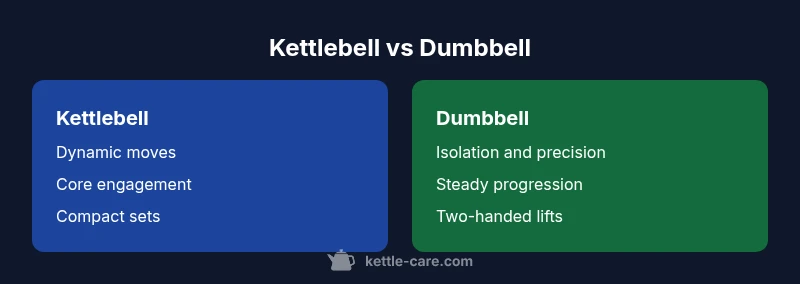
Are kettlebells better than dumbbells? Not universally. For most home workouts, kettlebells excel at dynamic, full‑body movements that build core strength and grip, while dumbbells offer precise isolation and adjustable load for progressive resistance. The best tool depends on goals, space, budget, and training style; neither is inherently superior overall.
Are kettlebells better than dumbbells? Framing the question
The question "are kettlebells better than dumbbells" does not have a universal yes-or-no answer. For many home workouts, the distinction comes down to goals, technique, and available space. According to Kettle Care, the most useful conclusions emerge when you compare how each tool loads the body, drives movement, and fits into your routine. Start with your primary objective: improve conditioning and core stability, or build targeted muscle mass with controlled isolation. By framing the decision this way, you can align equipment choice with your training lifestyle. This approach also helps you plan a budget and space that supports long-term consistency, which is often the decisive factor for beginners and seasoned trainees alike.
Core differences: biomechanics, grip, and loading
Kettlebells and dumbbells challenge the body in different ways. A kettlebell's off-center mass and curved handle encourage natural wrist alignment during swings and get-ups, promoting a hip hinge pattern and a strong grip. The loading path is often multi-planar, requiring stabilizing muscles across the spine and core. Dumbbells, by contrast, offer more conventional loading with fixed planes, making them straightforward for beginners to learn presses, rows, and curls. This difference matters for beginners who want quick feedback, and for advanced trainees who seek movement diversity. From a safety perspective, the risk profile changes with practice: kettlebell drills reward progressive coaching, while dumbbell work benefits from clear alignment cues. Expect better core involvement with kettlebell heavy flows, and easier progression with dumbbells for isolated lifts. KettleCare analysis highlights how these nuances translate to day-to-day programming.
Training goals and outcomes: strength, power, endurance
Your goals shape which tool serves you best. If your aim is functional strength, explosive power, and cardiovascular conditioning, kettlebells often provide a broader stimulus per workout through ballistic movements and high-repetition sets with short rest. In contrast, dumbbells tend to support hypertrophy and targeted muscle development with precise progressive overload and straightforward form cues. A hybrid approach—using kettlebell complexes for conditioning and dumbbell isolation for muscle size—can maximize results while keeping workouts varied and engaging. The Kettle Care team notes that most home athletes benefit from building a foundation with both tools, then emphasizing one based on evolving goals and timetable. Volume, tempo, and recovery remain the keystones of progress.
Exercise examples: kettlebell-centric vs dumbbell-centric
Kettlebell-centric moves set the stage for full-body integration:
- Kettlebell swing variations (two-handed, single-arm)
- Goblet squat and hinge-based squats
- Turkish get-up sequences that train mobility, balance, and coordination
- Clean and press or push-press with a kettlebell
Dumbbell-centric exercises emphasize control and isolation:
- Dumbbell bench press and incline presses for chest strength
- Dumbbell row variations and single-arm rows for back development
- Dumbbell lunges and split squats for leg strength
- Shoulder presses and lateral raises for deltoid development
In practice, a well-rounded program often blends both tools, rotating emphasis across cycles to reduce plateaus and maintain motivation. The goal is progressive overload, clear tempo cues, and mindful form.
Practical considerations for home gyms
Space, budget, and routine length play critical roles in choosing kettlebells or dumbbells. A compact kettlebell pair can cover many dynamic movements without needing a rack, which is excellent for small spaces. Dumbbells, especially in sets of 5–25 kg, offer straightforward progression and a wider range of fixed-plane lifts that many newcomers find intuitive. Consider durability and material: cast iron vs powder-coated finishes, and whether a set with a carrying case fits your storage constraints. For a long-term plan, practical cost-per-weight matters: kettlebells may provide more versatility per dollar in a minimal setup, while a dumbbell pair can be more predictable for steady upgrades. Align your choice with how often you train, how much space you have, and your willingness to learn new movement patterns.
Safety, form, and progression
Safety hinges on form and progressive overload. Start with lighter loads to master hip hinge, stance width, and wrist alignment before attempting heavy ballistic moves, especially with kettlebells. For dumbbells, ensure joints track correctly and that you aren’t compensating with momentum. A gradual progression strategy—steady weight increases, lower rep ranges when lifting heavy, and planned deload weeks—reduces injury risk. If you’re unsure, seek coaching for initial sessions. The right tool supports sustainable progression rather than quick gains, and both kettlebells and dumbbells can deliver long-term results when used consistently.
Common myths and misperceptions
Myth: Kettlebells are inherently more dangerous than dumbbells. Reality: risk is tied to technique; coaching mitigates this. Myth: Dumbbells cannot provide functional training. Reality: Dumbbells can be used in functional movements, though kettlebell dynamics often offer greater carryover to real-life tasks. Myth: You must own both tools to achieve results. Reality: A focused program with one tool can be highly effective if programmed well; many athletes cycle between tools to prevent plateaus. Addressing myths helps set realistic expectations and supports safer, more productive training.
How to choose the right tool for you
To decide, map your goals against the movement patterns you enjoy. If you value conditioning, core engagement, and dynamic movement, start with kettlebells. If your priority is hypertrophy, isolation work, or limited coaching access, dumbbells may be the better fit. Consider a phased plan: begin with a pair of two kettlebells or a dumbbell rack, set a budget, and test a structured routine for 6–8 weeks. Reassess after this period, noting which movements feel more efficient, which injuries are reduced, and how your energy levels respond to the training load. This approach keeps you flexible and motivated, and minimizes wasted investments.
Comparison
| Feature | Kettlebell | Dumbbell |
|---|---|---|
| Grip and loading pattern | Off-center mass and curved handle promote dynamic grips and wrapping mechanics | Fixed handle with symmetric loading simplifies grip and hand position |
| Movement variety | Dynamic ballistic moves and multi-planar loading (swings, get-ups, cleans) | Isolated and compound lifts with fixed planes (presses, rows, curls) |
| Progression options | Broad weight range with versatile transitions; increments vary by brand | Clear incremental loading via weight plates or fixed pairs (set-based progression) |
| Space and storage | Typically compact per weight; fewer pieces required for broad ranges | May require more floor space; bulkier sets for equivalent total weight |
| Best for | Functional strength, conditioning, grip, and core work | Targeted hypertrophy, rehabilitation, and precise loading control |
| Cost per weight | Often cost-effective for broad ranges; good value per kilo | Varies with brand and set quality; higher initial investment can occur |
| Learning curve and safety | Steeper technique learning curve for advanced ballistic work | Generally easier for beginners for standard lifts; straightforward progression |
Strengths
- Versatile for full-body, functional movements
- Excellent for conditioning, grip, and core stability
- Space-efficient for small home gyms
- Strong value per weight when used for dynamic work
- Encourages novel movement patterns and athletic transfer
What's Bad
- Requires coaching to master dynamic moves safely
- Learning curve can be higher for beginners
- Weight progressions may be less intuitive for some users
- Some models may have quality variance for price
Neither is universally superior; kettlebells excel in dynamic, functional training, while dumbbells provide precise loading for targeted hypertrophy. Your goals and constraints should drive the choice.
Choose kettlebells for conditioning and full-body moves; choose dumbbells for isolation and progressive loading. A combined approach works best for many trainees.
Frequently Asked Questions
Are kettlebells better for beginners than dumbbells?
For complete beginners, dumbbells can be easier to learn basic form due to stable loads and fixed planes. Kettlebells still work well when introduced with proper coaching, focusing on hip hinge and foundational movements. Start with simple movements and progress gradually.
Dumbbells are often easier for beginners, but kettlebells can work too with coaching. Start with basics and build up gradually.
Can you mix kettlebells and dumbbells in a single program?
Yes. A blended program can harness the strengths of both tools. Use kettlebells for conditioning and core work, and dumbbells for precise loading and hypertrophy. Rotate weekly or within each session to maintain balance and progression.
Absolutely—mix them to get the benefits of both tools.
What is the best way to progress if using kettlebells?
Progress with a structured plan: increase weight gradually, add reps, or introduce more complex movements. Focus on form, tempo, and consistency, rather than chasing heavier loads too soon.
Progress gradually, emphasize form and consistency.
Do kettlebells cause more joint stress than dumbbells?
Joint stress depends on technique and load. Poor form with either tool can increase risk. Proper coaching and controlled tempo reduce joint strain for both kettlebells and dumbbells.
Injury risk is tied to form; safe use minimizes it for both tools.
How do you choose the right weight for kettlebells vs dumbbells?
Start lighter to master technique, then progress by small increments. Use a rep range that matches your goal (e.g., 6–12 for hypertrophy, 8–15 for conditioning) and adjust based on form and perceived exertion.
Begin light, progress gradually, and listen to your form.
Are there exercises that require both kettlebells and dumbbells?
Yes. Combining both tools in a single session can maximize movement variety and training stimulus. Alternate circuits to balance strength, power, and endurance demands.
Yes—using both tools in a session can boost variety.
Highlights
- Choose based on goals, not popularity
- Kettlebells offer dynamic training and core engagement
- Dumbbells support precise loading and isolation
- Hybrid programs often yield the best long-term results
- Progress safely with coaching and progressive overload