Kettlebell vs Dumbbell: A Practical Comparison Guide
An analytical comparison of kettlebell vs dumbbell, exploring design, biomechanics, programming, and real-world use to help you choose the right tool for your goals.


Kettlebell vs dumbbell is a trade-off between dynamic, full-body conditioning and precise, isolated strength. Kettlebells excel in ballistic, time-efficient workouts that build functional power, core stability, and grip strength, while dumbbells offer controlled, progressive overload for targeted muscle groups and easier progression. Both tools can support robust fitness when paired with purpose-built programming.
Core Design and Training Philosophy
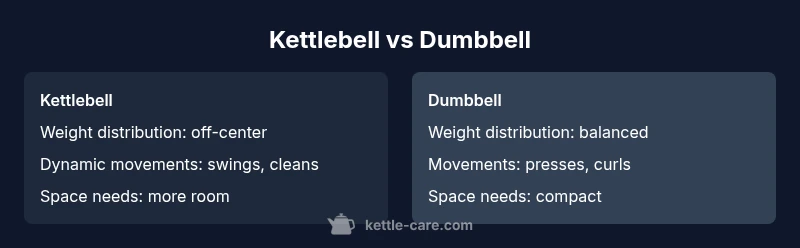
When evaluating kettlebell vs dumbbell, beginners and veterans alike must consider how the tool’s design shapes movement. A kettlebell features an off-center mass and a large, rounded handle that promotes hip hinge mechanics, rapid transitions, and momentum-based drills. A dumbbell, by contrast, provides a balanced load with a shorter grip, enabling stable wrists and precise control during isolation and compound lifts. From a training philosophy perspective, kettlebells encourage dynamic, time-efficient work and athletic conditioning, while dumbbells favor controlled strength development and progressive overload. According to Kettle Care, the choice between these tools should hinge on your training priorities, available space, and learning curve. This article uses kettlebell vs dumbbell as a framework to compare how each supports measurable goals like strength, endurance, and movement quality.
With the right plan, kettlebell and dumbbell workouts can complement each other. The kettlebell’s motion economy makes it ideal for short, intense sessions that spike heart rate and engage multiple joints. The dumbbell’s modular weight system supports precise loading increments, which is essential for gradual strength gains and target-muscle work. The Kettle Care team emphasizes that a well-rounded home gym may benefit from both tools, especially for balanced development and injury resilience. In practice, many routines blend ballistic sets with strict, form-focused lifts to maximize results over time.
Comparison
| Feature | kettlebell | dumbbell |
|---|---|---|
| Weight distribution | Off-center CG with a swinging arc | Balanced load with even weight on each end |
| Handle design | Thick, rounded handle optimized for grip and hip hinge | Shorter, more uniform grip designed for precision and wrist stability |
| Movement repertoire | Ballistic and dynamic movements (swings, cleans, snatches) | Isolation and compound movements (presses, rows, curls) |
| Space and setup | Needs room for swings and hip-hinge patterns | Compact footprint, easy to position in small spaces |
| Ease of learning | Steeper learning curve for safe ballistic work without coaching | Easier entry with basic presses and lifts; clearer progression |
| Durability and cost | Durable options; weight increments can be price-dependent | Often cheaper per pound; broad availability across brands |
| Best-use scenarios | Athletic conditioning, power development, full-body workouts | Targeted hypertrophy, strict strength work, technique-heavy lifts |
Strengths
- Offers full-body conditioning and functional strength potential
- Time-efficient workouts with high metabolic demand
- Versatile for ballistic and traditional lifts
- Compact equipment that fits small spaces
What's Bad
- Greater skill ceiling increases risk if form is ignored
- Dumbbells may offer more precise progressive overload for isolation
- Quality kettlebells vary by brand; cheap options can compromise safety
Both tools have valuable roles; choose based on goals, space, and learning readiness.
Kettlebells excel in dynamic, time-efficient conditioning and athletic development, while dumbbells shine for controlled strength progression and isolation. A balanced home gym often benefits from including both, aligned with your training goals.
Frequently Asked Questions
Is a kettlebell better than a dumbbell for fat loss?
Both can support fat loss when used in structured programming and proper nutrition. Kettlebell circuits often raise heart rate quickly, offering cardio-like stimulus, while dumbbell circuits can precisely pace work and monitor progression. The best approach is to pair a mix of modalities with consistent caloric balance.
Both tools can support fat loss when used with a solid plan; kettlebells may boost cardio-like effort, while dumbbells help with precise loading.
Can you replace dumbbells with kettlebells in a standard routine?
Yes, you can substitute kettlebell exercises for many dumbbell moves by selecting equivalents that match tempo, range of motion, and loading. Start with lighter weights to learn the kettlebell pattern, then progress as form improves.
You can swap most moves, just adjust for the kettlebell’s unique pattern and weight.
Are kettlebells safer for beginners than dumbbells?
Dumbbells are generally easier to learn with a focus on joint alignment and controlled movements. Kettlebell basics require coaching to master hip hinge, swing, and breathing. Start with a trainer or guided program to reduce risk.
Dumbbells are often simpler to start with; kettlebells can be safe too with proper instruction.
Which is more versatile for home workouts?
Dumbbells offer broad isolation and precision, while kettlebells provide whole-body, ballistic options. For many homes, a combination yields the best versatility, allowing gentle progression and variety in a single space.
Dumbbells give isolation, kettlebells give full-body variety; together they cover more bases.
What’s a good starter routine for kettlebell vs dumbbell users?
Begin with 2–3 days per week, pairing 1–2 kettlebell workouts focused on basic swings and goblet squats with 1–2 dumbbell days emphasizing presses and rows. Progress by increasing weight or reps every 1–2 weeks while maintaining form.
Start with simple swings and goblet squats for kettlebells, presses and rows for dumbbells, then progress gradually.
Do you need both tools to achieve goals?
Not always, but many trainees benefit from both. Use kettlebells for conditioning and mobility work, and dumbbells for strength-focused progression. Your goals and available space largely determine whether you need one or both.
You don’t always need both, but they complement each other well depending on goals.
Highlights
- Define primary goals before selecting tools
- Kettlebells favor ballistic, full-body conditioning
- Dumbbells support precise loading and muscle isolation
- Assess space, budget, and learning curve before buying
- Combine both tools for a comprehensive training plan