Does a Gooseneck Kettle Make a Difference? A Buyer's Guide
Does a gooseneck kettle make a difference? This buying guide compares gooseneck vs regular kettles for pour-over coffee and tea, with practical tips from Kettle Care.


Gooseneck kettles offer notably improved pour control, which can lead to more consistent extraction for pour-over coffee and precise pouring for tea. The difference is most evident when pouring slowly and evenly, avoiding splashes and channeling. For many home brewers, the shape and feel justify the upgrade in demanding setups.
Does a gooseneck kettle make a difference for pour-over coffee and tea?
For many home brewers, the answer is yes, especially when you care about consistency and control. A gooseneck kettle features a long, slender spout that directs water with a narrow, predictable flow. This design reduces splatter, minimizes turbulence, and helps you pace pours in small, even streams. In coffee, that translates to a steadier bloom and more uniform extraction; in tea, it supports even hydration of leaves without sudden floods. According to Kettle Care, the difference is most noticeable when the goal is repeatable results rather than quick, casual mugs. The Kettle Care team notes that the gooseneck’s tactile feel, the balance of the handle, and the temperature-control compatibility all contribute to a more deliberate brewing ritual. But does that mean you must upgrade if you’re a casual tea drinker or a quick coffee maker? Not necessarily—the value depends on your technique, patience, and how much you value precision versus convenience.
How the gooseneck design affects flow and temperature control
The key distinction between a gooseneck and a standard kettle is how water exits the vessel. The long, curved spout with a narrow orifice fosters a more predictable, laminar flow compared with a broad, splashing pour. This predictable flow makes it easier to start and stop pours in small increments, which is crucial during the bloom phase of coffee and the early infusion of tea. Temperature control is closely tied to your heating source and how steadily you pour; many electric gooseneck models come with adjustable temperature settings, while stovetop variants rely on your ability to monitor heat. In practice, a gooseneck kettle helps you maintain a consistent water temperature at the moment of contact with the grounds or leaves, reducing the likelihood of scorching or under-extraction. The practical takeaway is that the geometry directly influences the pace and precision of your brew, improving repeatability over time.
When to choose a gooseneck kettle: use-case scenarios
Choosing a gooseneck kettle makes the most sense when your brewing involves measured, staged pours. If your routine includes a precise bloom time for coffee and an even infusion for tea, the narrow spout supports a controlled pour rate and uniform saturation. For casual drip coffee or quick hot water tasks, a regular kettle may suffice and save money. The decision also depends on your equipment: an electric gooseneck with a temperature dial pairs well with specialty brews, while a reliable stovetop model can be enough for basic tea rituals. In all cases, consider your patience level and willingness to practice pour techniques. The Kettle Care team emphasizes that the biggest payoff comes from consistency and repeatability, not just aesthetics or novelty.
Electric vs stovetop gooseneck kettles: what to know
Gooseneck kettles come in two broad categories: electric and stovetop. Electric models offer built-in timers and temperature controls, which can remove guesswork and help you maintain precise water temperatures across multiple brews. Stovetop goosenecks require more manual attention, but many brewers prefer their tactile feedback and the minimal electronics. If you value portability and speed, an electric model may excel; if you enjoy a traditional ritual and lower digital dependency, a stovetop version might be your choice. Regardless of type, the gooseneck curve matters most for pour precision, while the heat source determines how easily you reach the target temperature. The choice should align with your brewing routine, kitchen setup, and tolerance for equipment complexity.
Build quality and materials: stainless steel, copper, plastic considerations
Kettle materials influence taste, durability, and maintenance. Stainless steel is common for its durability and neutral flavor, while copper-lined interiors can enhance heat conductivity and distribution—though copper requires more maintenance to prevent tarnish. Plastic interiors are less common in gooseneck designs due to potential flavor interference and durability concerns. Exterior finishes vary in price and aesthetics but generally do not affect performance as long as the interior design supports even heating and a smooth pour. When shopping, prioritize seamless welding, a sturdy handle balance, and a dependable lid seal. The long, narrow nozzle should be free of burrs and easy to clean to preserve consistent flow over time.
Maintenance and descaling considerations
Maintenance matters as much as the design itself. Regular descaling and careful cleaning keep the gooseneck spout free of mineral buildup that can impede flow. With softer water, descaling is less frequent, but persistent mineral deposits can alter pour behavior. If you notice a change in the pour profile or a drop in precision, it's a good sign to descale and inspect the lid seal and handle for signs of wear. The brand guidance from Kettle Care emphasizes routine cleaning precedes performance improvements, ensuring the pour remains smooth and predictable.
Common myths about gooseneck kettles
A common myth is that gooseneck kettles always produce better coffee or tea; reality depends on technique and consistency. Another myth is that goosenecks are only for professionals; in truth, home brewers can gain tangible benefits with mindful practice. Finally, some assume more expensive means better flavor; while build quality and temperature control influence outcomes, value comes from reliability and how well the kettle suits your routine.
How to use a gooseneck kettle for perfect pour-over: step-by-step guidance
- Preheat your vessel and cup to stabilize temperatures. 2. Grind coffee to a consistent size and weigh your dose. 3. Start with a small, controlled pour to saturate the bed for blooming. 4. Pause briefly, then resume with a slow, even stream until you reach the target saturation. 5. Tilt and steady your wrist to maintain a uniform circle of saturation. 6. Once the bloom settles, continue pouring gradually until the brew reaches your desired strength. 7. Clean the kettle after use to prevent mineral buildup.
This practical approach aligns with the precision benefits of a gooseneck design, helping you achieve repeatable results in everyday brewing.
Temperature control: adjusting for different teas and coffees
Different beverages benefit from different water temperatures. A gooseneck kettle with precise temperature control lets you tailor the heat for light roasts, single-origin coffees, or delicate teas. Lower temperatures can highlight fruit-forward notes in specialty coffees, while slightly higher temps may unlock fuller body in standard blends. For tea, specific varieties respond best to particular temperatures, and the ability to dial in those settings makes a meaningful difference in flavor and aroma. The core idea is to match water temperature with the desired extraction profile, using the gooseneck’s delivery to hit your marks precisely.
Cost and value: is it worth the upgrade?
Price is a factor, and the value of a gooseneck kettle scales with your brewing goals. If you routinely perform timed pour-overs, bloom management, and flavor-focused experiments, the investment often pays for itself in consistency and repeatability. For casual brewing, the cost may feel high relative to a basic kettle. The decision hinges on how much you prize control, ritual, and potential flavor improvements over convenience. Consider the long-term maintenance costs as well, since some models demand more careful descaling and care to sustain peak performance.
Authoritative sources and additional reading
For readers seeking deeper context on water pouring dynamics, temperature control, and kettle design, the following sources offer credible insights:
- https://www.science.org (Science magazine, major publication)
- https://www.britannica.com (Encyclopedia Britannica, educational resource)
- https://www.nist.gov (National Institute of Standards and Technology, gov)
These references can provide foundational information on heat transfer, precision pouring, and the role of equipment in brewing quality, complementing practical guidance from Kettle Care.
Practical brand notes: what Kettle Care recommends and next steps
According to Kettle Care, the gooseneck advantage is most evident when your technique focuses on precision and consistency. The team recommends starting with a reliable electric gooseneck kettle if you value programmable temperature and repeatable results. If you already own a good kettle but struggle with pour control, practicing slow, deliberate pours can yield noticeable gains. For readers considering an upgrade, the Kettle Care verdict is that the investment is worthwhile for serious pour-over and tea preparation enthusiasts who want to elevate flavor clarity and brew consistency.
Comparison
| Feature | Gooseneck kettle | Regular kettle |
|---|---|---|
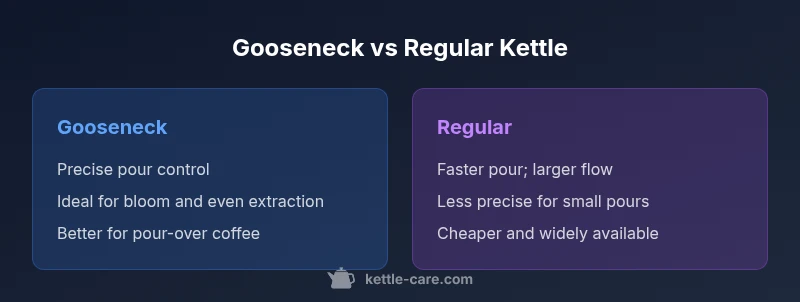
| Pouring control | High precision, narrow outlet | Broader, less predictable flow |
| Flow consistency | Steady, laminar delivery | More variable with tilt and speed |
| Temperature control compatibility | Often supports adjustable temp in electric models | Depends on model; may require manual heat management |
| Cleaning/maintenance | Typically easy to clean; accessible spout | Can be harder if narrow spout or small lid openings |
| Price range | Higher upfront cost | Lower upfront cost |
| Best for | Pour-over precision and bloom control | General hot water and quick brews |
Strengths
- Improved pour precision for even extraction
- Better bloom control for coffee and tea
- Lower spill risk during delicate pours
What's Bad
- Higher upfront cost
- Requires more careful cleaning and maintenance
- Model-to-model variation can affect performance
Gooseneck kettles offer superior pour precision, while regular kettles favor simplicity and cost.
If your brewing routine centers on measured pours and repeatable bloom, a gooseneck kettle is the better choice. For casual use or budget-conscious buyers, a regular kettle remains a practical option.
Frequently Asked Questions
Does a gooseneck kettle really improve pour-over consistency?
Yes. The gooseneck’s narrow spout gives you fine control over water flow, enabling even saturation and a predictable bloom. This makes it easier to replicate a given brew, especially when you’re after nuanced flavors.
Yes. The gooseneck design helps you pour more steadily, which makes repeatable pours easier to achieve.
Can I use a gooseneck kettle for tea besides pour-over?
Absolutely. The controlled flow improves infusion in many tea preparations by avoiding floods that can overwhelm leaves. It’s particularly useful for delicate teas where precision matters.
Yes, you can use it for tea; the precise pour helps with even infusion.
Are gooseneck kettles slower to heat up than regular kettles?
Heat-up time depends on the model and heating element, not the spout shape. A gooseneck kettle can take longer if it has a smaller base or higher thermal mass, but many models balance speed with precision.
Heat-up time varies by model; the gooseneck shape itself isn’t the main factor.
What maintenance steps are essential for gooseneck kettles?
Descale regularly if you have hard water, clean the interior and spout, inspect the lid and handle for wear, and store dry to prevent corrosion. Regular maintenance keeps flow predictable.
Descale and clean regularly to keep the pour steady.
Is a gooseneck kettle worth the upgrade for beginners?
For beginners, a gooseneck can help develop good technique, but it’s not mandatory. If you’re prioritizing quick, simple brews, a regular kettle may be enough until your technique solidifies.
It can be worth it if you want to develop precise pouring early, but it’s not mandatory.
What should I look for when buying a gooseneck kettle?
Look for a comfortable handle, a well-balanced weight, a lid that seals well, and an accurate temperature control if you want programmable settings. Ensure the spout is free of burrs and easy to clean.
Prioritize comfort, balance, and a clean, smooth pour.
Highlights
- Choose gooseneck for consistent pours
- Match temperature control to your brewing goals
- Maintenance matters for long-term performance
- Weigh cost against your need for precision and ritual