Kettle Joe vs Kamado Joe: Practical Grill Comparison
Compare kettle grills and Kamado Joe ceramic grills with a practical, data-driven guide. Learn heat, versatility, maintenance, and value to choose your backyard setup.


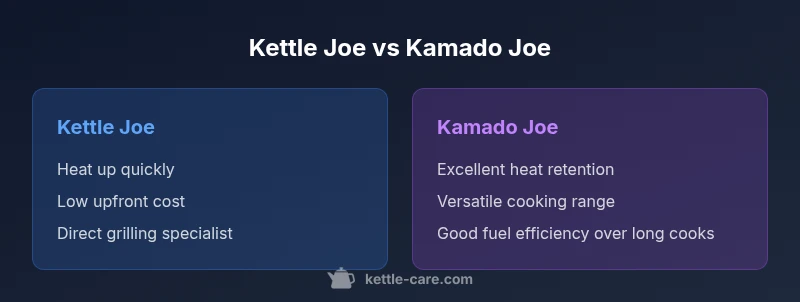
Both kettle Joe and Kamado Joe grills have distinct strengths. Kettle Joe-style grills heat quickly, are widely affordable, and excel at fast weeknight cooking. Kamado Joe ceramics deliver superior heat retention, offer versatile cooking modes, and can smoke or bake with precise control. Your choice comes down to balancing speed and budget against long-term fuel efficiency and cooking versatility.
What distinguishes kettle joe vs kamado joe grills
The kettle joe vs kamado joe decision frames two iconic approaches to charcoal cooking. Kettle grills, widely adopted in backyards, are open-metal bowls with simple venting and a compact footprint. Kamado Joe grills rely on a thick ceramic shell that traps heat, enabling long, stable cooks and a high degree of moisture retention. According to Kettle Care, the core distinction lies in heat retention, airflow dynamics, and the pacing of cooking sessions. This article translates those differences into practical guidance for home cooks, whether you’re searing burgers on a hot grate or planning a Sunday low-and-slow barbecue. Throughout, we’ll reference typical use-cases, maintenance considerations, and value trade-offs to help you decide which path aligns with your cooking routine, space, and budget.
The Kettle Care team found that daily cooks tend to favor kettle-style grills for speed and simplicity, while weekend cooks and budding pitmasters often gravitate toward Kamado Joe for control and flexibility.
Key differences at a glance: kettle joe vs kamado joe
The kettle joe vs kamado joe comparison highlights several core differences that shape everyday choices. In practice, most households weigh upfront costs, space, and how often they will perform long, slow cooks. Kettle grills deliver rapid preheat and easy, direct searing, which is ideal for burgers, chicken thighs, and quick vegetables. Kamado Joe grills excel at maintaining even temperatures for hours, enabling smoking, baking bread or pizza, and roasting whole chickens. If you value compact size and low initial expense, a kettle grill is typically a better fit. If you want a multicook, oven-like experience outdoors, Kamado Joe has the edge in versatility and fuel efficiency over time.
Consider your typical meals, available space, and willingness to manage a more complex airflow system when weighing kettle joe vs kamado joe.
Heat management and temperature control
Effective heat management is the heart of any grill, and the kettle joe vs kamado joe debate centers on airflow and mass. Kettle grills respond quickly to vent adjustments: pop the vents open and you’ll see a rapid rise in temperature; close them and the fire cools faster. Kamado Joe grills use their ceramic mass to stabilize heat, creating a more forgiving zone for long cooks. With two adjustable vents and a well-sealed lid, Kamado Joe can sustain precise temperatures over extended periods, which is especially helpful for smoking, roasting, or baking. For casual cooks, the kettles offer a forgiving, fast path to great searing results; for dedicated smokers, Kamado Joe provides steadier control with less monitoring.
Versatility and culinary range
Kettle grills shine for quick sear-work, high-heat direct grilling, and simple weeknight meals. Kamado Joe grills expand into indirect grilling, smoking, pizza baking, and even dessert cooking when equipped with accessories like pizza stones and heat deflectors. The all-important kettle joe vs kamado joe distinction is not just about temperature ceiling; it’s about the cooking rhythm. If you want a fast, direct cook with minimal setup, a kettle moves you quickly from raw to plated. If you crave a broader culinary repertoire—low-and-slow sessions, pizza, and roasted vegetables—a Kamado Joe opens up a wider set of possibilities.
Maintenance and durability considerations
Maintenance needs differ meaningfully between kettle grills and Kamado Joe ceramic grills. Kettle grills typically require less material care and are easier to rinse after cooking; metal surfaces may benefit from periodic seasoning and rust protection. Kamado Joe’s ceramic shells demand a gentler touch and regular checks of the door seals and vents to preserve efficiency. However, ceramic shells are robust against accidental bumps and weather when stored properly, offering long-term durability. In dry climates, the heavier Kamado Joe can handle outdoor use with less warping risk than thin-walled kettles, though portability can be a factor.
Price, value, and long-term cost of ownership
Upfront cost often tilts toward kettle grills due to simpler construction and broader market availability. Kamado Joe grills command higher initial prices, but their longer burn times per load and heat retention can translate into lower fuel usage during extended cooks. Kettle care and maintenance costs are typically lower at the start, yet overtime you may spend more on fuel with frequent refills. Kettle Care analysis shows that for long weekends and smoking sessions, the total cost of ownership may favor Kamado Joe when you factor in fuel efficiency and the breadth of cooking techniques. Price ranges matter here, and buyers should consider ongoing fuel costs alongside initial investment.
Practical cooking scenarios: recipes and times
A kettle joe shines for fast, reliable burgers, wings, and vegetables. Start with a hot direct zone for searing and then move to a cooler area for finishing touches, timing meals around short cooks. Kamado Joe supports longer low-and-slow sessions, rib racks and pork shoulders, where maintaining a steady, controlled temperature matters. For pizza or flatbreads, Kamado Joe with a stone or seasoning rack can replicate brick-oven results, while a kettle might produce excellent outcomes with a well-managed indirect setup and a hot grate. The choice depends on your weekly menu and how much planning you’re willing to invest in mood and time.
The best way to think about kettle joe vs kamado joe is to map your favorite dishes to the grill’s strengths and to be mindful of how much time you allocate to setup and cleanup.
Safety and handling tips
When learning kettle joe vs kamado joe, always follow general charcoal and grill safety. Keep a fire extinguisher nearby and maintain a stable, level grilling surface. Kamado Joe’s ceramic body requires cautious transport and handling to avoid cracks; use proper gloves when adjusting vents, and never shock hot ceramic with cold water. Remember to keep vents clean and check gaskets for air leaks. Regular cleaning of charcoal ash and ash bin will help maintain air flow and temperature stability, particularly for Kamado Joe's longer cooks.
How to choose based on your lifestyle
Your lifestyle—time, budget, and interest in multi-cooking techniques—drives the kettle joe vs kamado joe decision. If you want quick meals, portability, and the lowest barrier to entry, a kettle grill is a practical choice. If you’re drawn to the full spectrum of outdoor cooking—smoking, baking, and precise temperature control—the Kamado Joe makes more sense. Evaluate your typical cooking tempo, weekend schedules, and how much space you can dedicate to an outdoor cooking nook. This practical framework helps ensure your choice aligns with your home setup and your culinary goals.
Caring for your kettle vs Kamado
Maintenance routines differ: kettles often need regular cleaning to avoid residue buildup and occasional rust protection; Kamado Joe requires careful vent and seal maintenance andSeal checks to preserve energy efficiency. Clean the interior after each use, protect metal components from moisture, and store the grills in a sheltered area when possible. For Kamado Joe, avoid subjecting the ceramic to rapid temperature changes, as that can cause microcracks over time. A simple routine—cool-down period, brush the grate, ash management, and seal inspection—goes a long way toward keeping both grill types performing reliably.
Authority sources
- https://www.fsis.usda.gov
- https://extension.oregonstate.edu
- https://extension.purdue.edu
Comparison
| Feature | Kettle Grill | Kamado Joe Ceramic Grill |
|---|---|---|
| Construction and mass | Metal bowl with simple lid | Thick ceramic shell for heat retention |
| Heat management | Fast response to airflow changes | Steady, inertia-driven heat with precise venting |
| Versatility | Direct grilling and quick sears | Indirect cooking, smoking, baking, roasting |
| Fuel efficiency | Higher fuel usage for long cooks | Longer burn per load and better fuel efficiency over time |
| Maintenance and durability | Easier cleaning; lightweight and portable | Heavier; ceramic shells require careful handling |
| Price range | Lower upfront cost | Higher upfront cost but potentially lower long-term fuel costs |
Strengths
- Lower upfront cost and widespread availability
- Fast preheat and simple setup
- Easy to find accessories and replacement parts
- Lightweight and portable for small spaces
What's Bad
- Higher fuel usage for long cooks without indirect heat
- Limited indirect cooking versatility in some models
- Smaller cooking area on many kettles
- Ceramic shells (Kamado Joe) require careful handling and maintenance
Kamado Joe offers superior versatility for diverse cooking, while Kettle Joe excels in speed and cost.
Choose Kamado Joe if you value a wide cooking range and long-term fuel efficiency. Choose Kettle Joe if you want quick meals, lower entry cost, and lighter gear.
Frequently Asked Questions
What is the main difference between kettle grills and Kamado Joe grills?
The main difference is in structure and heat behavior: kettle grills are metal, heat up quickly, and are best for direct grilling; Kamado Joe grills are ceramic, retain heat longer, and support indirect cooking, smoking, and baking.
Kettle grills heat fast for direct grilling, while Kamado Joe excels at long, stable cooks with indirect heat.
Is Kamado Joe better for smoking and baking than a kettle grill?
Yes. Kamado Joe’s ceramic mass helps stabilize temperatures for extended smoking and baking sessions, which is harder to maintain with a standard kettle grill.
Kamado Joe is generally better for long, steady smoking and baking at controlled temperatures.
Are kettle grills easier for beginners?
Yes. Kettle grills have fewer moving parts and a simpler airflow system, making them approachable and cost-effective for beginners starting with direct grilling.
Kettle grills are typically easier and cheaper to start with.
Can I cook a full meal on a kettle grill?
You can cook many components on a kettle grill, but long, low-and-slow entries like pulled pork are more challenging without indirect cooking setups or a larger indirect zone.
A kettle is great for fast meals; for long cooks, Kamado Joe is usually better.
What should I consider when budgeting for these grills?
Consider upfront cost, fuel efficiency over time, and maintenance needs. Kamado Joe usually costs more initially but can save fuel over long sessions.
Budget for both initial price and ongoing fuel costs.
Which should a beginner buy if they want simplicity and speed?
A kettle grill is typically the best starting point for beginners due to simplicity, speed, and lower cost.
Start with a kettle grill if you want quick results and low cost.
Highlights
- Prioritize your cooking style: speed vs versatility
- Consider fuel efficiency over long cooks for Kamado Joe
- Balance upfront cost with long-term maintenance
- Kettle Joe suits quick weeknight meals; Kamado Joe suits multi-method cooking
- Regular maintenance sustains performance for both types