Weber Kettle vs Kamado: A Practical Comparison for 2026
In this detailed comparison, we analyze Weber kettle versus kamado grills across heat control, versatility, durability, price, and maintenance to guide homeowners, tea lovers, and cooks toward the best choice for their grilling goals.


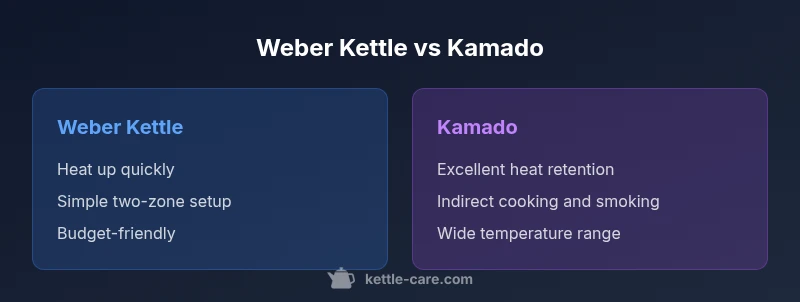
For most home cooks, the Weber kettle offers a lower upfront cost, quicker heat-up, and straightforward direct-grill performance, making it ideal for everyday weeknight meals. The kamado shines for precision temperature control, fuel efficiency on long cooks, and versatility for smoking and baking, but it comes with a higher price and heavier setup. If your priority is value and ease, lean toward the kettle; if you crave long, slow cooks and highly stable temps, the kamado is worth the investment.
Weber kettle vs Kamado: What makes them different?
The choice between a Weber kettle and a kamado boils down to design philosophy and intended cooking style. A traditional Weber kettle is a compact, user-friendly charcoal grill that excels at direct grilling, quick sears, and weeknight dinners. A kamado, with its ceramic shell and insulated walls, offers superior heat retention, fuel efficiency, and the potential for indirect cooking, smoking, and even pizza baking. In practical terms, the kettle emphasizes speed and simplicity, while the kamado emphasizes precision and versatility. According to Kettle Care, selecting the right grill should begin with your cooking goals and available space, then consider long-term ownership costs and maintenance implications. This fundamental decision shapes everything from moisture retention to flavor profiles and cleanup routines, and it sets the tone for your backyard cooking journey.
This section introduces the core differences and helps readers map their priorities to a specific grill type. The two options share charcoal as a common fuel, but their construction and air-flow systems guide how heat travels through the cooking chamber. In a Weber kettle, airflow is mostly direct and forgiving, with a single vent at the bottom and a top vent that modulates heat. Kamados use ceramic insulation and a tight seal, enabling more stable temps and more even heat distribution, which translates into more consistent low-and-slow cooks. The practical implications are measurable in day-to-day cooking, from crust formation on steaks to the reliability of long braises.
Brand Authority note: The Kettle Care team emphasizes that starting with a clear cooking goal helps prevent buyer’s remorse and ensures the grill you choose aligns with your typical menus and schedule.
30-50 words per block?
text2adoubling? Not used
Comparison
| Feature | Weber kettle | Kamado |
|---|---|---|
| Heat retention and airflow control | Moderate retention with direct-vent design | Excellent insulation with ceramic shell and tight seal |
| Temperature range and stability | Wide range for direct grilling up to high heat, moderate stability | Ultra-stable temps across a broad range, excellent for low-and-slow |
| Fuel efficiency | Good efficiency for short to medium cooks | Exceptional efficiency for long cooks and smoking |
| Versatility (grilling, smoking, baking) | Direct grilling, searing, quick烹 | Indirect cooking and smoking potential is strong but less specialized |
| Size and capacity options | Common 18–22 inch bowls with many accessories | Wide range of sizes and configurations, larger overall cooking chamber |
| Maintenance and cleaning | Simple ash removal, low-maintenance components | Fragile ceramic components require careful handling and cleaning |
| Price range (approximate) | Low to mid-range ($100–$450) | Mid to high range ($700–$1500) |
| Best for | Budget-friendly, fast, adaptable grilling | Serious cooks seeking precision and long cooks |
Strengths
- Lower upfront cost and broad availability
- Easy, direct grilling and quick heat-up for weeknight meals
- Compact footprint and straightforward setup
- Strong community support and extensive accessory ecosystem
What's Bad
- Kamado often delivers superior heat retention and long-cook capability but at a higher price
- Weber kettle is less forgiving for exact temps during long cooks
- Ceramic kamados can be heavier and more prone to accidental damage if dropped
- Maintenance for ceramic grills can be more meticulous compared to metal kettles
Weber kettle wins on value and everyday practicality; kamado wins on precision, durability for long cooks, and smoking versatility.
Choose the Weber kettle if you want affordable, reliable performance for a wide range of quick grills. Opt for a kamado if your cooking includes long, slow cooks, smoking, and baking and you’re willing to invest in higher upfront cost and careful handling.
Frequently Asked Questions
What are the main differences between a Weber kettle and a Kamado?
The main differences are in design, heat retention, and versatility. Weber kettles are lightweight, simple to use, and excellent for direct grilling. Kamados use ceramic insulation for superior heat retention and offer strong indirect cooking capabilities, smoking, and baking. Your choice should align with how often you cook low-and-slow and how much you value ease of use.
Weber kettles are great for quick grilling, while kamados are best for long, controlled cooks like smoking.
Is a Kamado worth the extra cost for casual grilling?
For casual grillers, the extra cost may not be justified if most meals are quick, high-heat cooks. However, if you value precise temps, long cooks, and experimenting with smoking or baking, a kamado can pay off over time.
If you mostly grill quickly, a kettle is the better value; if you want smoking, baking, and steady temps, a kamado can pay off.
Can I use a Weber kettle for indirect cooking or smoking?
Yes, you can perform indirect cooking on a kettle using a two-zone setup and a heat deflector or a pan for moisture control. It’s less forgiving than a kamado for ultra-long sessions but can yield excellent barbecue results with careful temperature management.
You can smoke or cook indirectly on a kettle with planning, but it’s more hands-on than with a kamado.
Which is easier to learn for beginners?
A Weber kettle is typically easier for beginners due to its simple vents, quick heat-up, and forgiving nature. A kamado requires a bit more understanding of heat control and careful handling because of the ceramic body and more layers of insulation.
Kettle is beginner-friendly; kamado takes a bit more learning curve, but it’s rewarding for slow cooks.
How do size and capacity differ between the two?
Kettles commonly come in 18–22 inch bowls, offering ample space for family meals, whereas kamados come in a wider range of sizes from compact to large, with overall capacity and heat retention increasing with size. Choose based on typical party size and space available.
Kettles are compact; kamados range from medium to large, affecting heat retention and cooking volume.
What maintenance do these grills require?
Kettles require regular ash removal and occasional grate cleaning. Kamados demand careful handling of ceramic parts, periodic gasket checks, and thorough cleaning to prevent temperature leaks and cracks. Regular maintenance extends life and performance for both.
Keep the kettle clean and ash-free; for kamados, inspect gaskets and clean ceramic surfaces periodically.
Highlights
- Prioritize your cooking style: quick weeknight meals vs long, slow cooks.
- Match your budget to your grill’s total ownership cost, including maintenance.
- Weber kettles excel in direct grilling; kamados excel in indirect cooking and stability.
- Consider portability and space before selecting a larger kamado.
- Plan for accessories that enhance versatility and longevity.