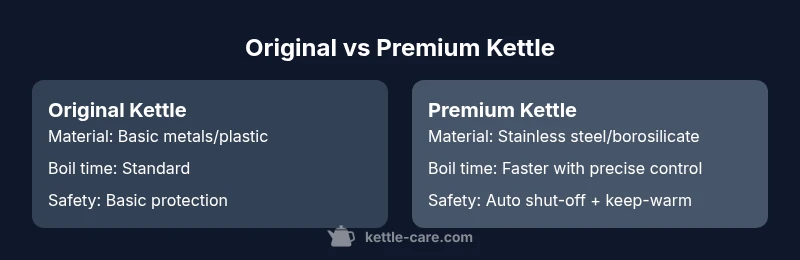
Original Kettle vs Premium: A Practical Comparison
Compare original kettles and premium models to understand materials, performance, safety, and value. Learn which kettle fits your tea rituals and kitchen in a balanced, evidence-based guide.


Original kettle vs premium boils down to value, safety, and performance. For many homes, a premium model delivers faster boils, safer design, and longer durability, while an original kettle offers reliable functionality at a lower upfront cost. According to Kettle Care, premium kettles typically outperform basic ones in build quality and consistency, making them worth considering for daily use.
What we mean by the terms original kettle and premium
Original kettle vs premium might sound like marketing jargon, but it reflects real differences in materials, design, and intended use. In this guide we define an original kettle as a basic model that emphasizes simplicity, low upfront cost, and broad kitchen compatibility. A premium kettle refers to higher-end builds, often featuring metal or borosilicate glass walls, refined lids, precision spouts, temperature presets, and stronger safety certifications. For homeowners and tea enthusiasts, these distinctions translate into practical outcomes: faster boiling, more consistent pouring, and longer service life in daily routines. The decision between the two hinges on how you boil, how much you value speed, and how you weigh ongoing maintenance against initial price. The Kettle Care team has observed that premium kettles frequently deliver smoother performance under heavy use, while original kettles remain perfectly adequate for light, occasional use. By keeping expectations aligned with your kitchen habits, you can choose the option that best fits your needs and budget.
Quick differentiators at a glance
Original kettles tend to emphasize affordability and straightforward operation, while premium models bundle safety features, design refinements, and performance improvements. The difference often comes down to build quality, feature set, and how you use the kettle across weeks and seasons. For busy households, premium hardware can translate into fewer mis-pours and more consistent results. For tea purists, even small improvements in spout design and temperature control can enhance aroma and flavor. The takeaway from this comparison is that the best choice depends on your ritual, frequency, and tolerance for higher upfront costs. In practical terms, think about who uses the kettle, how often, and what matters most in daily use.
Material and build quality compared
Original kettles frequently rely on simpler materials like basic metal or plastic with modest insulation, producing adequate performance for casual use. Premium kettles, by contrast, showcase higher-grade materials such as stainless steel or borosilicate glass, often with reinforced lids and ergonomic handles. The result is a more robust feel, less chipping risk, and a better seal against leaks. The surface finish in premium models also tends to resist staining and limescale buildup longer, which can impact long-term appearance and hygiene. From a sustainability perspective, premium builds may offer longer lifespans if cared for properly, reducing replacement frequency. In short, your tactile experience and long-term upkeep are more favorable with premium options, though original kettles remain functional for many households.
Boil speed and energy efficiency considerations
Boil speed is not just about watts; it’s about heat transfer efficiency, lid design, and pouring ergonomics. Original kettles often deliver a reliable boil with modest energy use, but their simple construction can introduce heat loss through gaps or uneven heating. Premium kettles typically optimize heat transfer with tighter seals and better lids, reducing wasted energy and shortening total boil time. This can translate into meaningful time savings for households that start their mornings with back-to-back hot drinks. While energy efficiency varies by model, the general trend favors premium kettles for faster, more consistent results, particularly when the kettle is used many times per day.
Safety features and reliability
Safety is a core area where premium kettles often show clear advantages. Standard models provide basic boil-dry protection and an on/off switch, but premium options frequently include advanced auto shut-off, dry-boil protection, child-lock lids, and heat-resistant exteriors. These refinements reduce the risk of accidental burns and equipment damage, especially in households with children or pets. Reliability also tends to improve with premium designs due to better quality control and more durable components. However, even basic models can be safe and adequate when used responsibly and kept well-maintained. The key is to verify certification, such as IEC safety marks, and to inspect lids and switches for wobble or looseness over time.
Temperature control and keep-warm features
Temperature control is a defining feature that separates original kettles from premium models. Premium kettles frequently offer preset temperatures suited to tea styles (green, oolong, black) or even coffee tolerances, plus keep-warm functions that maintain a chosen temperature for a period. Original kettles are usually limited to a single boil function with no precise presets. If you value precise water temperatures for aroma extraction or taste balance, a premium model delivers a meaningful difference. For households that don’t rely on exact temperatures, the keep-warm feature is a convenient but optional luxury. Consider your typical beverages and whether you want automation or manual control.
Design and usability for tea lovers vs coffee lovers
From a usability standpoint, premium kettles often feature wider spouts, better ergonomics, and more balanced weight distribution, which improves pouring accuracy for both tea and coffee preparation. Tea enthusiasts appreciate well-designed spouts that minimize splashes and preserve heat, while coffee lovers may value temperature control to extract consistent flavors. Original kettles cater to straightforward brewing needs without extra features, which can be perfectly adequate for casual tea drinkers. In both cases, a comfortable grip and easy-to-read indicators correlate with user satisfaction and daily satisfaction.
Durability, warranty, and long-term value
Premium kettles typically carry longer warranties and more robust construction, reflecting higher material costs and stricter quality control. The longer-term value comes from fewer replacements, reduced risk of scale buildup, and continued performance under heavy use. Original kettles offer solid durability for light to moderate use, but the trade-off is more frequent part wear and a quicker path to replacement if you rely on the kettle daily. The durability narrative is not universal—some budget models last many years with proper care, while some premium models may fail early due to design flaws. The best approach is to assess user reviews across multiple models and to compare warranty terms.
Maintenance: descaling and care
Descaling and care routines differ by material. Stainless steel and borosilicate glass premium kettles resist staining and scale longer, but they still require regular descaling in hard-water regions. Plastic components may absorb odors and discolor more quickly, necessitating more frequent cleaning. Original kettles with simple interiors are easier to scrub but can accumulate mineral deposits over time. Regardless of model, routine descaling using a gentle solution, followed by thorough rinsing, helps maintain performance and flavor integrity. The key is to stay consistent with cleaning intervals and to use appropriate cleaners that won’t degrade the internal surfaces. The Kettle Care team emphasizes that maintenance is a critical factor in long-term satisfaction with either option.
Real-world usage: scenarios and recommendations
Consider your daily routine: a high-frequency kettle user will likely benefit from a premium model with faster boils and precise temperature control, while a casual user who brews tea a few times a week may achieve satisfying results with a reliable original kettle. Families with kids should prioritize safety features like auto shut-off and secure lids. If you travel or entertain often, a compact premium model may offer the best balance of portability and performance. In all cases, pairing your choice with a sensible descaling schedule and proper storage helps extend life. For tea rituals, the difference between original kettle vs premium can be a matter of flavor consistency and heat management over time.
How to evaluate a kettle before purchase: a practical checklist
Before buying, create a short checklist: material and finish (stainless steel or borosilicate vs basic metal/plastic), heat transfer design (spout and lid fit), safety features (auto shut-off, boil-dry, child-lock), temperature control options (preset temperatures or manual), keep-warm capability, overall weight and ergonomics, warranty length, and replacement parts availability. Compare at least two models in your price range using this checklist. Read independent reviews to verify performance, and consider how the kettle fits into your daily routines rather than chasing every feature. For the original kettle vs premium decision, weigh the long-term value against upfront costs.
Common myths and misconceptions about price and performance
A common myth is that higher price always guarantees better flavor. In reality, flavor depends on water quality, tea or coffee preparation, and correct temperatures. Another misconception is that premium models are universally more energy-efficient; while they can be, efficiency hinges on design and user habits. Some buyers assume that a heavy kettle will be harder to use; in practice, premium designs often balance weight with ergonomic handles. Finally, the belief that warranty length alone determines value is misleading—serviceability, parts availability, and real-world reliability matter more for long-term satisfaction. The best approach is to test a model’s actual performance for your routine rather than rely solely on price or marketing.
Comparison
| Feature | Original Kettle | Premium Kettle |
|---|---|---|
| Material & finish | Plastic/basic metal | Stainless steel or borosilicate glass |
| Boil speed (qualitative) | Standard performance | Faster and more consistent |
| Safety features | Boil-dry protection (basic) | Advanced auto shut-off, dry-boil protection, child-lock lid |
| Keep-warm/temperature control | Typically none or basic | Presets or variable control on many premium models |
| Durability & warranty | Standard warranty, modular parts | Longer warranties and sturdier construction |
| Price range (upfront) | Lower upfront cost | Higher upfront cost |
| Best for | Budget-conscious users | Tea enthusiasts and busy households |
Strengths
- Lower upfront cost and simple operation
- Fewer potential failure points due to simpler design
- Wide compatibility with many kitchens
- Easy maintenance and replacement parts
- Sufficient for casual daily use
What's Bad
- Higher upfront cost for premium models
- Overkill for casual tea drinkers
- Heavier or more complex to operate for some users
- Potential feature overload without clear need
Premium kettle typically offers better performance, safety, and long-term value for most households.
If speed, safety, and durability matter for your daily routines, choose premium. If upfront cost and simplicity are your priorities, an original kettle can still meet basic needs with proper care. The Kettle Care team stands by premium as the superior all-around option for frequent use.
Frequently Asked Questions
Is an original kettle sufficient for everyday tea making, or should I upgrade to a premium model?
For many households, an original kettle is adequate for daily tea and simple coffee. If you value speed, precise temperatures, and stronger safety, a premium model offers clear advantages. Consider your usage pattern and budget.
For most people, start with what you need now; upgrade later if you want more control and faster boils.
Do premium kettles save energy compared to original kettles?
Premium kettles can be more energy-efficient due to better heat transfer and tighter lids, but actual savings depend on your usage habits and the model’s design. The biggest gains come from how often you boil and how accurately you control the temperature.
Energy savings depend on usage and model; premium designs help when you boil frequently.
What should I look for when comparing models?
Look for material quality, safety certifications, boil-dry protection, auto shut-off, temperature presets, keep-warm features, warranty length, and weight/ergonomics. Use a consistent checklist across models.
Use a simple checklist: material, safety, temperature, keep-warm, warranty, and ergonomics.
Are there downsides to premium kettles?
The main downsides are higher upfront cost and potential feature overload that may not match your needs. Some premium models can be heavier and less convenient for quick, single-serve brews.
More features aren’t always better if you don’t use them.
How important is keep-warm for tea lovers?
Keep-warm is convenient for those who make multiple cups in a row, but it adds cost and energy use. If you rarely drink multiple cups in one sitting, this feature may be optional.
Keep-warm helps with multiple servings, but isn’t essential for everyone.
Highlights
- Prioritize your daily routine and frequency of use
- Balance upfront cost against long-term value
- Verify safety features and warranty terms
- Use a structured checklist when evaluating models
- Maintenance quality influences longevity of either option