What Kettlebell to Use: A Practical Beginner's Guide
Discover how to choose the right kettlebell for your strength and goals. This practical guide from Kettle Care covers starting weight, grip options, and safe progression to train effectively.


To start, you should choose a kettlebell that aligns with your strength and goals. Beginners typically start with a lighter weight to master form, then progress gradually. This guide will help you estimate weight ranges, select grip styles, and create a safe progression plan so you train effectively and reduce injury risk.
What kettlebell to use: key factors
Choosing the right kettlebell to use starts with a clear sense of your goals, current strength, and training space. According to Kettle Care, the most effective approach is to match weight to your ability to perform the hinge and related drills with control. The Kettle Care team found that beginners should prioritize form over chasing heavier loads, since solid technique is the foundation of safe, long-term progress. In practice, this means selecting a kettlebell you can move with a safe hip hinge, braced core, and a neutral spine through reps that challenge you but never compromise alignment. By prioritizing technique first, you’ll build strength more efficiently and reduce the risk of injury as you advance to more complex movements. Throughout this guide, you’ll learn how to estimate starting weight, consider grip and handle factors, and design a progression that keeps you progressing safely.
How to estimate starting weight
Starting weight should be light enough to master form during fundamental moves like the hinge (hips), goblet squat, and overhead press. Begin with a weight that does not cause your spine to lose neutral alignment or force you to round your shoulders. A practical method is to perform a controlled set of hinge patterns and a basic squat with a brace, stopping when you reach a rep range where fatigue threatens form rather than muscle failure. If you can perform several quality reps with a single kettlebell while maintaining a strong, quiet torso and a consistent hip drive, you’ve likely chosen a sensible starting point. Remember, you’re buying time for practice, not chasing massive numbers. Reassess as you gain control, not immediately after your first session. The aim is sustainable technique, not maximal effort. If you’re unsure, choose a lighter option and test again after a short rest.
Movement-specific weight considerations
Different movements place different demands on your grip, core, and hips. For many beginners, lighter weights suit ballistic and hinge-based movements such as swings and cleans, while slightly heavier weights may be used for controlled goblet squats or presses once form is solid. The goal is to select a weight that allows you to perform the key movement patterns with controlled tempo, full range of motion, and stable shoulders. Consider your available training space, time under tension, and your willingness to progress gradually. In all cases, avoid sacrificing form for a heavier load, as improper technique can create compensations that persist over time.
Grip, handle size, and build quality
Grip comfort matters as much as weight. A handle that feels balanced in the hand reduces grip fatigue and helps you maintain a neutral wrist position during swings and carries. The diameter of the handle should fit your hand so you can wrap fingers comfortably without cramping, and the bell should rest securely against the forearm during the hip hinge. Metal finishes, coatings, and knurling influence grip and control. If you have smaller hands or limited wrist mobility, you may prefer a lighterbell with a smoother handle to start. Always check that the safety of the equipment is intact: no cracks, loose fitting parts, or sharp edges.
Progressive plan and safety basics
A safe progression plan starts with frequent, low-load sessions focused on technique first. Structure workouts to alternate between skill work and strength work, with ample rest between sets to maintain form. Increase weight only after you can complete your current sets with consistent technique and a controlled tempo. Safety considerations include keeping your spine neutral, engaging the lats, bracing the core, and avoiding any end-range hyperextension. If you experience pain or loss of control, pause and reassess your setup before continuing.
Common mistakes and how to avoid them
Many beginners rush to heavier bells or try to speed through reps, which compromises form and increases injury risk. Avoid rounding the back during hinges and swings, keep the ribs braced, and maintain a tall chest. Common grip problems include gripping too tightly, which tires the forearms quickly, and letting the elbow flare, which shifts stress to the shoulder. Regular form checks, a slower tempo, and progressive loading help you stay on track. As you improve, you can safely step up to more complex movements and heavier weights without sacrificing technique.
When to reassess and upgrade
Reassess weight decisions every few training cycles or when you notice a plateau in strength or form. If you can perform the current movements with ease, maintain the same weight for a few sessions while refining tempo and control, then consider a small increase. The Kettle Care team recommends documenting your form cues, tracking reps and sets, and scheduling a technique check with a coach if available. Reassessment should focus on technique integrity first, followed by load progression.
Quick test to confirm your pick
A practical final check is to perform a short circuit of hinge, goblet squat, and press with your chosen weight. If you can maintain neutral spine, hips driving back, and a controlled tempo through all reps, you’ve likely found a solid starting point. If any movement feels unstable or painful, step down to a lighter option and reevaluate your setup. The goal is reliable technique that translates into a longer, safer training journey.
Tools & Materials
- Kettlebell(Choose a weight you can control for multiple reps while maintaining form; start light and progress gradually.)
- Mirror or camera for form feedback(Optional but helpful to check posture and hinge alignment.)
- Workout mat(Useful for floor-based movements and comfort during goblet squats.)
- Timer or stopwatch(Pace sets and track rest periods to maintain tempo.)
- Water bottle(Stay hydrated between sets.)
- Notebook or app for tracking(Record weights, reps, and perceived exertion for progression.)
- Flat, safe training space(Clear area with enough room to swing without hitting objects or walls.)
Steps
Estimated time: 60-90 minutes for initial assessment and setup; ongoing weeks for progression
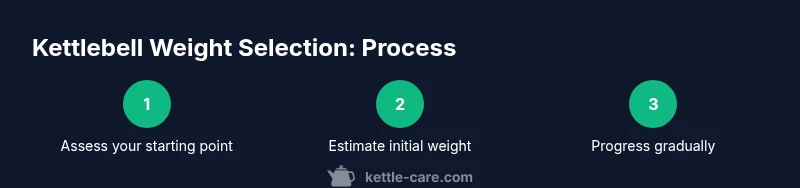
- 1
Assess your starting point
Identify your current strength and mobility by testing basic hinges and goblet squats with a light bell. Observe whether you can maintain neutral spine, brace the core, and keep shoulders down during the movement. This baseline helps tailor weight and progression safely.
Tip: Document any discomfort or asymmetries to guide future choices. - 2
Test a weight safely
Pick a bell you can control for multiple reps with good form. Perform a short set of hinges, goblet squats, and light presses, ensuring controlled tempo and full range of motion. If you lose form, choose a lighter weight and revisit technique.
Tip: Use a slower tempo (pause briefly at the top and bottom) to confirm control. - 3
Learn form before adding load
Master the hip hinge, locking the spine in a neutral position and engaging the lats. Practice the goblet squat with a tall chest and seated hips, then progress to a strict press with a braced core. Prioritize technique over volume.
Tip: Record your session and compare to a coaching cue sheet. - 4
Build a progressive plan
Plan gradual weight increases after several sessions of solid technique. Schedule 2–3 training days per week focused on kettlebell work, with each session including a warm-up, skill work, and a short finisher. Use a simple progression model, adding small increments on weeks you feel strong.
Tip: Keep a progression journal to visualize steady gains. - 5
Reassess and adjust
Every 4–6 weeks, reassess weight and form. If you encounter a plateau or form drift, scale back or reset with a lighter weight to rebuild technique. This ensures ongoing gains without compromising safety.
Tip: Schedule a quick technique check with a trainer if possible.
Frequently Asked Questions
What is the best starting kettlebell weight for a complete beginner?
There isn't a universal weight; begin with a light bell to learn the hinge and goblet squat with proper form. Increase only when technique is solid and controlled. If unsure, test again after a short rest.
Start with a light kettlebell to learn the basics; increase only after mastering form.
Should I switch weights as I improve?
Yes. When you can perform the movements with ease and control, gradually increase the weight while maintaining form. Avoid adding load before technique is stable.
Yes—progress gradually as your form improves.
Can I use a dumbbell instead of a kettlebell while learning?
Dumbbells can help with some aspects of strength and mobility, but kettlebells offer unique ballistic benefits and grip options. Adapt your program if you substitute and monitor form closely.
Dumbbells can help early on, but kettlebells bring unique benefits.
How do I know if my weight is too heavy?
If your form breaks, you feel strain on the spine, or you cannot control the movement, the weight is too heavy. Stop, reset, and choose a lighter option.
If form breaks or you can't control it, lower the weight.
How often should I reassess my kettlebell choice?
Reassess every several weeks or when you notice a plateau or form drift. Use technique quality as your primary signal to progress or regress rather than chasing heavier loads.
Reassess every few weeks based on your form and progression.
Watch Video
Highlights
- Start light and master form before adding weight
- Progress gradually based on technique, not reps
- Choose weight you can control with a neutral spine
- Reassess every few weeks and adjust as needed