How to Determine Kettlebell Weight
Learn how to choose the right kettlebell weight for safety and progress. This step-by-step guide explains testing methods, progression, and practical tips from Kettle Care to build strength with confidence.


In this guide, you will learn how to determine the right kettlebell weight for your goals and experience. We'll cover safe starting weights, how to test form and grip, and simple progression methods to avoid injury. By the end, you'll be able to choose a weight confidently for swings, snaps, and carries.
What weight means and why it matters
Choosing the right kettlebell weight is a balance between your current strength, technique, and training goals. The correct weight lets you perform movements with full range of motion, maintain a neutral spine, and develop consistent tempo. According to Kettle Care, weight selection should prioritize form over ego, and you should never push through reps that compromise technique. In practice, beginners often benefit from starting with a weight that enables controlled reps rather than maximal effort, while more experienced lifters look for a weight that challenges without breaking form. The relationship between weight, tempo, and fatigue guides every training cycle: if you can’t maintain braced core, neutral spine, and smooth hip hinge, the weight is too heavy. If you can complete reps with ease and perfect form, it’s likely time to increase. This section helps you translate those ideas into a practical starting point and a plan for progression.
What weight means and why it matters
Choosing the right kettlebell weight is a balance between your current strength, technique, and training goals. The correct weight lets you perform movements with full range of motion, maintain a neutral spine, and develop consistent tempo. The right weight reduces risk of injury while improving technique, power, and endurance. In practice, beginners should favor a weight that allows controlled reps and clean form over ego-driven loads, while seasoned lifters use weight to match the target rep range and movement quality. Observing how weight interacts with tempo and fatigue helps you plan safe progressions. Remember, the goal is sustainable technique that supports long-term gains.
How weight interacts with different movements
Different kettlebell exercises demand different loading. For ballistic or power-based moves like swings, a weight that lets you maintain hip hinge and ribcage stability through the eccentric phase is ideal. For mobility-focused or gradual-load moves like goblet squats or Turkish get-ups, a lighter weight that allows precise posture and breathing control tends to yield better skill development. This distinction matters because choosing one universal weight often undermines technique across multiple moves. The core idea is to pair weight with the movement’s tempo, range of motion, and required core stiffness to keep the spine protected and the movement efficient.
How to talk about weight with safety in mind
Always prioritize safety and technique over lifting heavier. When in doubt, opt for smaller increments and verify form with a mirror or video. If a movement causes compensations—rounding the back, shrugging the shoulders, or grinding through the neck—reduce the weight and reset your tempo. The emphasis should be on quality reps, not maximal effort. This mindset reduces injury risk and builds a reliable foundation for progressive overload.
Accountability and how to document your choices
Keep a simple training log that records the starting weight for each exercise, the number of clean reps completed, and any cues that helped or hindered performance. Tracking form cues (neutral spine, rib cage over pelvis, shoulder position) alongside weight creates a data trail you can refer back to when planning progression. Over time you’ll notice patterns—perhaps you perform better with a slightly lighter load on get-ups, or you can push a bit more on swings after improving hip drive. This documentation is a practical tool to support consistent, safe progress.
Tools & Materials
- Kettlebell(s) in at least two different weights(Have a light option for technique work and a heavier option for progression testing.)
- Exercise mat(Provides a comfortable surface for kneeling, lying, and push-off movements.)
- Mirror or camera for form feedback(Use to observe spinal alignment and hip hinge during tests.)
- Timer or stopwatch(Helps maintain consistent tempo and rest periods during testing.)
- Notebook or mobile notes app(Record reps, feel, and any adjustments you used during testing.)
- Water and towel(Stay hydrated; wipe sweat to prevent slipping.)
Steps
Estimated time: 25-40 minutes
- 1
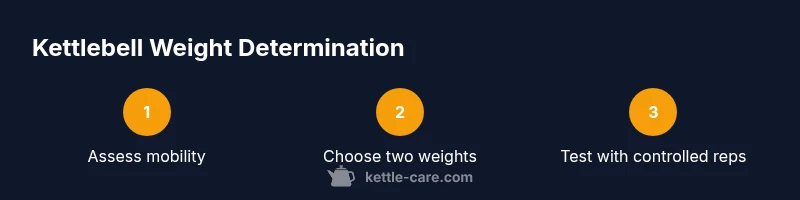
Warm up and mobility
Begin with 5–10 minutes of dynamic movement focusing on hips, thoracic spine, shoulders, and wrists. A targeted warm-up reduces injury risk and helps you assess grip and control before loading.
Tip: If you feel joint pain or sharp discomfort, stop and reassess technique or choose a lighter weight. - 2
Gather two weights for comparison
Select a light and a heavier kettlebell to compare how form and tempo change with load. Ensure both weights allow a full range of motion without compensations.
Tip: Record a quick check of posture in a mirror during the comparison. - 3
Establish baseline test weight
Choose a starting weight that you can lift with controlled tempo for 5–6 reps while maintaining neutral spine and braced core. Do not push to failure on this first pass.
Tip: Keep tempo deliberate: 2 seconds on the lift, 2 seconds on the descent. - 4
Test form with controlled reps
Perform 4–6 controlled reps per exercise (e.g., swing, goblet squat) keeping form cues in mind. If form breaks, lower the weight and try again.
Tip: If you cannot complete a rep with safe form, stop and switch to the lighter weight. - 5
Decide on your end weight and plan progression
Choose the weight you can maintain consistent technique for the target rep range with room to progress. Plan to increase weight gradually in small steps after 2–4 weeks of consistent training.
Tip: Progression should be gradual; avoid large jumps that compromise form.
Frequently Asked Questions
What is the best way to start determining kettlebell weight?
Start with a weight that allows you to perform 5–6 controlled reps with good form. Use a mirror or video to verify alignment, and avoid pushing to failure on the initial test. Gradually move up as technique remains solid.
Begin with a weight that you can lift with control. Check your form in a mirror, and increase weight slowly once you can perform sticks reliably.
How many reps should I use when testing weight?
Aim for 4–6 controlled reps per set while focusing on form. Reps beyond this can alter technique and mask issues. If you lose alignment, switch to a lighter weight.
Use 4 to 6 controlled reps and watch your form closely; stop if your technique slips.
Can I train with multiple weights at once?
Yes, using two weights for different movements can help you optimize technique. Test each movement with the weight that supports clean form and controlled tempo, then adjust per exercise.
Using two weights can help you maintain proper form across different moves; adjust by exercise.
How often should I re-evaluate my kettlebell weight?
Re-evaluate weight when you notice a drop in form quality, an increase in fatigue, or after consistent training blocks. Regular checks every 4–8 weeks are common for many athletes.
Check your form and pace every few weeks to see if you should adjust the weight.
Is there a safe weight progression for beginners?
Progress gradually by small increments and only after you can maintain consistent technique for the target reps. Prioritize control and breathing over jumping to heavier weights.
Yes. Increase weight slowly only when you can keep technique steady and breathing controlled.
Watch Video
Highlights
- Start with form over weight to build a solid foundation
- Use controlled reps and tempo to assess readiness
- Progress weights gradually after consistent technique
- Document your testing results to guide decisions