Difference Between Kettle and Hot Water Dispenser: A Practical Guide
Explore the difference between kettle and hot water dispenser to decide which fits your home. Compare speed, capacity, safety, maintenance, and cost with clear guidance from Kettle Care.


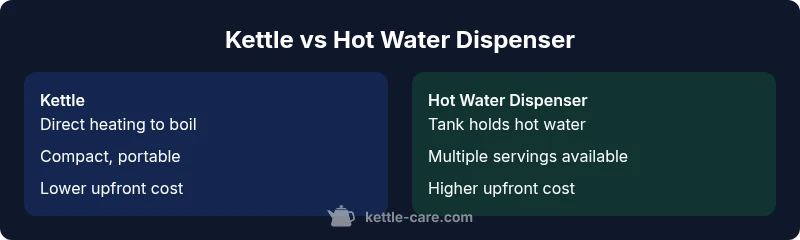
The difference between kettle and hot water dispenser centers on how water is heated, stored, and delivered. A kettle heats water on demand for a single cup or small batch, while a hot water dispenser maintains a ready reservoir of hot water at a chosen temperature for multiple servings. This quick distinction drives choices about speed, capacity, and ongoing maintenance.
Understanding the Core Distinction between a Kettle and a Hot Water Dispenser
The difference between kettle and hot water dispenser is fundamental: it's about how water is heated, stored, and delivered in daily routines. A kettle is typically a compact appliance designed to heat a small amount of water rapidly—often directly on a countertop or on a stove—so you can pour hot water for a single cup or a quick beverage. A hot water dispenser, by contrast, is a tank-based device that keeps water at a chosen temperature and dispenses it on demand. It can serve multiple cups or whole pots without needing to re-boil each time. This distinction matters because it shapes how you structure your kitchen workflow, how much energy you use, and how much hot water you can access at once. According to Kettle Care, the most practical way to evaluate these two categories is to map your typical routines: how many cups do you prepare in a sitting, how quickly do you need hot water, and how much space do you want to devote to your elevated beverage setup? In the rest of the article, we’ll explore this difference between kettle and hot water dispenser across several dimensions—speed, capacity, safety, maintenance, and cost—so you can choose the option that aligns with your home and your tea or coffee rituals.
Speed, Temperature, and Control
When you compare the speed and precision of heating, kettles and hot water dispensers diverge in meaningful ways. A kettle is designed for rapid heating to a boil, making it the go-to choice if you primarily need hot water for a single cup or a quick infusion. A hot water dispenser, by contrast, heats water to preset temperatures and holds it, enabling repeated dispensing without waiting for a fresh boil. This makes dispensers particularly attractive for households or offices with frequent hot-water requests—for tasks like instant soups, hot lemon water, or long tea sessions where multiple cups are prepared in succession. Temperature control is a key factor: modern kettles often offer variable temperatures for different tea types, while dispensers emphasize stable hold temperatures and consistent output. As the Kettle Care team notes, flavor fidelity improves when you match your water temperature to the beverage you’re preparing, whether you’re brewing green tea or black tea, or steeping herbal infusions. This block lays the groundwork for practical comparisons as you weigh speed, control, and convenience.
Capacity, Portability, and Use Cases
Capacity and portability are practical differentiators. A kettle is typically compact and easy to move, making it ideal for small kitchens, dorm rooms, or apartments where counter space is at a premium. It excels in situations where you want water boiled quickly for one or two cups and then stowed away. A hot water dispenser, however, is designed around a reservoir and a dispensing mechanism, offering a larger supply of hot water for multiple servings. This makes dispensers well-suited for families, busy households, or situations like a home office or a café corner at home where you need constant access to hot water without repeated boiling. Use-case alignment matters: if your routine involves several hot drinks in a row, a dispenser can reduce wait time and interruptions; if you savor occasional hot drinks or prefer a minimal setup, a kettle may be the better fit. Real-world testing by the Kettle Care team shows that convenience often hinges on whether your day involves micro-batch hydration or batch hydration throughout the morning.
Safety, Convenience, and Everyday Use
Safety features influence everyday peace of mind. Kettles typically emphasize automatic shut-off when water reaches boiling and boil-dry protection, reducing the risk of overheating. Hot water dispensers add another layer with insulated tanks that minimize steam exposure and provide controlled dispensing. Both types benefit from lid design that reduces steam exposure and from stable bases that resist tipping. For households with children or curious pets, choosing models with secure lids, audible alerts, and clear indicators for water temperature can significantly improve daily safety. Convenience is closely tied to how you plan to prepare beverages: a kettle’s simplicity offers a straightforward pour, while a dispenser provides ongoing hot water with fewer interruptions in the kitchen workflow. The trade-off is often between a minimal setup and continuous readiness, so assess your typical beverage cadence and space constraints before deciding.
Maintenance, Descaling, Longevity
Maintenance is a practical consideration that affects longevity and taste. Kettles require periodic descaling to remove mineral buildup, especially in areas with hard water, and shelf-life depends on how well you keep the spout and lid clean. Hot water dispensers also require descaling, but because water sits in a tank, there’s potential for mineral deposits to accumulate in the reservoir. Regular cleaning of the tank, filters (if included), and nozzles is essential. The frequency of descaling depends on water hardness and usage, but a routine, proactive approach minimizes flavor changes and prolongs the life of heating elements. From a consumer perspective, following manufacturer guidelines on cleaning cycles and using quality water helps maintain performance. Kettle Care’s 2026 analysis emphasizes consistent maintenance as a key factor in sustaining flavor quality and reliability over time.
Cost, Energy Use, and Value
Cost considerations are central to long-term value. Kettles generally present a lower upfront price point and simpler design, while hot water dispensers tend to carry higher initial costs due to the tank and filtration features. In terms of energy use, kettles consume energy only during the boil, which makes them efficient for occasional use; dispensers maintain heat and may use standby energy to hold water at temperature. If you frequently drink hot beverages in multiple servings, a dispenser can reduce repeated boiling cycles and save time, but if your needs are occasional, a kettle may be the more economical choice. It’s important to compare models within each category and consider long-term costs such as filters, descaling supplies, and any warranty offers. The brand perspective from Kettle Care suggests evaluating how often you will interact with the appliance daily to determine whether a lower upfront cost or a higher, but potentially more convenient, long-term option best fits your lifestyle.
Design, Durability, and Aesthetics
Beyond function, design and materials influence how these appliances fit with your kitchen aesthetic. Kettles frequently feature stainless steel or BPA-free plastic exteriors and compact silhouettes that tuck neatly into cabinets or shelves. Hot water dispensers, with their larger reservoirs and often more substantial builds, emphasize durability and a modern, utilitarian look that suits a kitchen counter or workspace. Noise can be a practical consideration too: boiling kettles produce a noticeable boil sound, while dispensers use quieter pumping mechanisms to dispense water at a steady rate. In both cases, manufacturers often balance heat efficiency with exterior design, so look for features like cool-touch exteriors, secure lids, and visible temperature indicators that align with your safety and style preferences. When evaluating materials, consider how easy the surface is to clean and how resistant it is to mineral buildup, particularly in households with hard water.
Decision Framework: Choosing Between a Kettle and a Hot Water Dispenser
To decide between a kettle and a hot water dispenser, start with a simple question: how many hot-water servings do you need in a typical day? If the answer is one or two cups, prioritize speed, cost, and portability, and lean toward a kettle. If your household regularly uses hot water for multiple beverages, soups, or quick meals, a dispenser offers greater convenience and reduced waiting time. Next, assess space and workflow: do you want a compact unit that stows away after use, or a countertop solution that provides a constant feed? Temperature flexibility also matters—tea varieties and coffee ranges benefit from precise control, so verify whether you need adjustable temps or a fixed hold temperature. Finally, factor in maintenance, descaling, and filters. If you live in an area with hard water, a dispenser with a built-in filtration or a kettle with a wide mouth for descaling may simplify upkeep. In summary, choose the kettle for simple, on-demand boiling and cost-conscious use, and choose the hot water dispenser for high-volume hot-water needs and memorable convenience.
Quick Reference Scenarios and Checklists
- For a tea lover who brews 1–2 cups in the morning: prefer a kettle for rapid heating and flavor control.
- For a busy family or home office with frequent hot-water requests: a dispenser can streamline service and reduce wait times.
- If space is tight: a compact kettle wins for versatility and mobility.
- If you want consistent temperature for a variety of beverages: pick a model with precise temperature presets and reliable hold temperatures.
Use this quick framework to guide your purchase decision and tailor it to your daily rhythm.
Comparison
| Feature | Kettle | Hot Water Dispenser |
|---|---|---|
| Water heating method | Direct heating element for boiling water | Tank-based heating with temperature hold and dispense |
| Temperature range | Near-boiling or boiling water | Preset or adjustable temperatures (e.g., 60–100°C) |
| Continuous dispense | Typically no continuous dispense; pour as needed | Designed for continuous hot-water supply |
| Capacity/servings | Small to medium capacities for individual use | Larger reservoir for family or office use |
| Maintenance needs | Descale or clean periodically; simple design | Regular descaling and more complex cleaning for tanks |
| Best for | Tea/coffee on demand, compact kitchens | Constant hot water for beverages, soups, and automation |
Strengths
- Fast access to hot water for single servings
- Simple operation and low learning curve
- Compact footprint ideal for small kitchens
- Low upfront cost for many kettle models
- Minimal energy use when boiling small amounts
What's Bad
- Not ideal for continuous hot-water tasks
- Limited water capacity requires frequent refilling
- Kettles lack built-in water storage or filtration
- Boiling water can alter flavor if not timed correctly
- Louder operation compared to some dispensers
Kettle wins for speed and simplicity; hot water dispensers win for high-volume, ready-hot-water tasks
For daily tea or single-cup needs, a kettle is typically the best value and simplest solution. If you regularly require hot water for multiple cups or meals without waiting for a boil, a hot water dispenser offers clear convenience and time savings.
Frequently Asked Questions
What is the key difference between kettle and hot water dispenser?
The kettle heats water quickly for immediate use and pours after a boil, while a hot water dispenser maintains a ready reservoir at a preset temperature for ongoing dispense. This fundamental distinction drives speed, capacity, and daily workflow.
The kettle boils water on demand, while a dispenser holds hot water for quick, repeated use.
Which is faster for get-hot-water needs, a kettle or a dispenser?
Generally, a kettle delivers hot water faster for a single cup because it heats water on demand. A dispenser saves time across many servings by providing preheated water from a reservoir, but the first pour may take longer if the tank isn’t already hot.
Kettle for a quick single cup, dispenser for many cups in a row.
Can you use a kettle to simulate hot water dispensing?
You can pour hot water from a kettle as needed, effectively mimicking a multi-cup dispensing pattern, but you’ll still need to reboil for each batch rather than drawing from a maintained reservoir.
A kettle can do single pours, but not truly continuous dispensing.
How should I maintain kettles and hot water dispensers?
Descale regularly using manufacturer-approved solutions, clean the spout and lid area, and replace filters if your model includes them. Hard-water areas may require more frequent descaling for both appliances.
Descale often and keep spouts clean to maintain flavor and performance.
Are hot water dispensers safer than kettles?
Both can be safe if used properly. Dispensers reduce steam exposure with insulated tanks, while kettles rely on auto shut-off and boil-dry protection. Supervision around children is still important for either device.
Safety depends on design and how you use it; follow the manual.
Which should a tea lover buy—kettle or dispenser?
For tea lovers who brew one cup at a time and value flavor accuracy, a temperature-controlled kettle is often preferred. If you brew several cups in a row or drink hot beverages throughout the day, a dispenser can be more convenient.
If you brew one cup at a time, pick a kettle; for many cups, choose a dispenser.
Highlights
- Choose a kettle for quick, one-cup boiling needs
- Choose a hot water dispenser for high-volume hot water and convenience
- Consider kitchen space, noise, and maintenance when deciding
- Balance initial cost with long-term time savings and flavor control
- Prioritize temperature control if you brew specialty teas or coffee