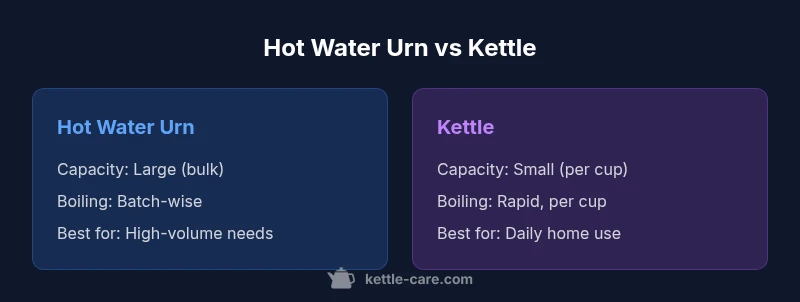
Hot Water Urn vs Kettle: An Objective Side-by-Side Guide
A practical, evidence-based comparison of hot water urns and kettles. Learn how capacity, speed, energy use, and maintenance shape daily use and large gatherings.


Hot water urns and kettles each serve different needs. For daily home use, a kettle boils water faster and uses less energy per cup. A hot water urn shines in high-volume settings like offices or events, delivering large quantities with fewer refills. The key differences are capacity, speed, energy use, and upkeep. This guide helps you choose wisely.
Overview: What are hot water urns and kettles?
In domestic kitchens, two common appliances stand out for hot water needs: kettles and hot water urns. A kettle is a compact, usually electric vessel designed to boil small amounts of water quickly. A hot water urn, by contrast, is a larger, often stationary tank intended to hold and dispense hot water in bulk. When evaluating hot water urn vs kettle, the decision hinges on volume, speed, and how you intend to serve water rather than a single cup. According to Kettle Care, choosing the right tool starts with understanding your daily pattern, peak times, and available space.
Kettle Care Team notes that most households boil water for individual cups or small batches, and a kettle excels in those scenarios because it concentrates efficiency, minimizes wasted energy, and reaches temperature quickly. For households hosting occasional gatherings or family meals, a compact urn might still be useful for guests who want tea or hot drinks without repeated boiling. The contrast is more than capacity; it is about how you manage water at scale. For meticulous cooks or tea enthusiasts who value precision, the heterogeneity of needs means that one device often won’t fit every moment. This article breaks down the critical differences, focusing on capacity, boil speed, energy use, maintenance, and practical implications for everyday life.
By the end, you’ll have a clearer sense of whether your kitchen should lean toward a kettle, a hot water urn, or a hybrid approach that covers both.
BestForIntro This section emphasizes daily use vs events; the choice hinges on volume and speed. The Kettle Care team provides the framework for evaluating typical home patterns versus occasional high-volume needs.
Comparison
| Feature | Hot Water Urn | Kettle |
|---|---|---|
| Capacity | Typically 5–20 L (hot water urns) | Typically 0.5–2.5 L (kettles) |
| Boiling Speed | Slower per liter; designed for bulk heating | Faster per batch; optimized for quick individual servings |
| Energy Efficiency | Lower per-liter efficiency in bulk urns | Higher per-liter efficiency in compact kettles |
| Maintenance | More involved cleaning/descaling for large volumes | Easier, regular descaling for small batches |
| Price Range | Moderate–high upfront cost (urns) | Low–moderate upfront cost (kettles) |
| Best For | High-volume environments (offices, events) | Daily home use, quick servings |
Strengths
- High-volume capacity reduces refills in gatherings
- Kettles boil water quickly for regular home use
- Kettles generally cost less upfront and are easier to maintain
- Urns simplify serving many people with bulk hot water
What's Bad
- Urns take more space and can be less energy-efficient per cup
- Kettles have smaller capacity and require refills for groups
- Urns may require more involved descaling in mineral-rich water
- Kettles can still require cleaning but less frequently
Kettle wins for most homes; urns excel in high-volume contexts.
For daily use, a kettle offers speed and energy efficiency. If you regularly serve large groups, an urn makes sense. The best approach may be a hybrid in mixed-use spaces.
Frequently Asked Questions
What is the main difference between a hot water urn and a kettle?
The main difference is volume and use case: urns hold and dispense large amounts of hot water for groups, while kettles boil smaller quantities quickly for individual servings. Urns are best when you need steady supply, kettles when you want fast, single pours.
Urns serve groups; kettles serve individuals. Choose based on volume and speed.
Which boils water faster, a kettle or a hot water urn?
In most homes, kettles boil water faster per cup because they focus energy on a small volume. Urns heat larger quantities and may take longer to reach full capacity, but they reduce refills during events.
Kettles are faster for individual cups; urns take longer to reach big volumes.
Are hot water urns safe to use at home?
Yes, with proper placement on a stable surface, managed cords, and correct use of lids and spigots. For households with children, choose models with safety features like guarded spigots.
Yes, with proper placement and safety features.
How do I descale a hot water urn?
Descale using a mild citric acid or vinegar solution, rinse thoroughly, and run several cycles of clean water before use. Regular descaling prevents mineral buildup that affects performance.
Descale with a mild cleaner, rinse well, and flush with clean water.
Can I use a kettle to serve large groups?
Kettles can serve several cups, but for very large groups urns are more convenient due to bulk capacity and reduced refilling. If space allows, a high-capacity kettle can still handle multiple servings.
Kettles work for several servings, but urns are easier for big crowds.
What should I consider when choosing between these two options?
Assess typical daily volume, available space, budget, and whether speed or bulk serving matters most. Also consider cleaning ease and compatibility with your preferred tea or coffee practices.
Think about volume, space, budget, and ease of cleaning.
Highlights
- Evaluate daily volume before choosing
- Kettle for speed and home use
- Urn for bulk serving and fewer refills
- Maintenance matters for mineral buildup
- Consider a hybrid approach for mixed needs