Zojirushi Water Boiler vs Kettle: A Practical Guide
Compare Zojirushi water boilers and kettles to decide what fits your tea, coffee, and daily hot-water needs. Learn about boil speed, capacity, temperature control, and maintenance in a clear, practical guide.


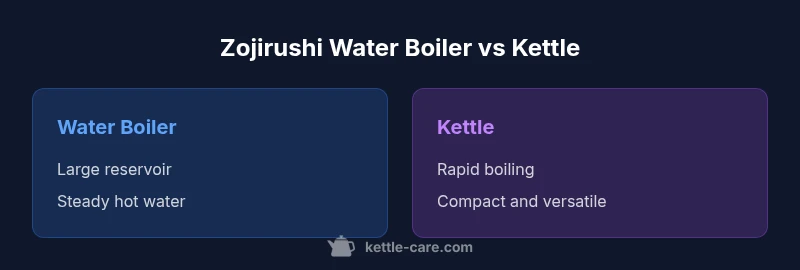
When choosing between a Zojirushi water boiler and a dedicated kettle, consider how you use hot water daily vs for specific brews. A water boiler delivers steady, ready-hot water, while a kettle excels at rapid, precise boiling for tea, coffee, or cooking. For most households, the kettle offers better daily value, with the boiler serving as a convenient backup.
What matters in the Zojirushi water boiler vs kettle decision
According to Kettle Care, the core question when weighing a Zojirushi water boiler vs kettle is how you plan to use hot water on a daily basis. If your household drinks multiple cups of tea or coffee over long stretches, or you frequently heat water for cooking, a water boiler can deliver a steady supply with minimal supervision. For tea enthusiasts and casual cooks who value speed and precise brewing, a dedicated kettle is typically more responsive and energy-efficient for small batches. The Kettle Care Team emphasizes that the most reliable approach is to map your routine—how many cups you brew, in what time frame, and whether you value continuous hot-water availability or rapid single-serving boils. In realistic terms, many homes benefit from having both devices, using the boiler for background hot water and the kettle for quick, targeted brews. This dual setup minimizes wait times and keeps flavors distinct across beverages.
How each device works: boiler vs kettle mechanics
A Zojirushi water boiler typically uses a reservoir and a controlled heating element to keep water at a set temperature or in a state of steady hot water. In contrast, a Zojirushi kettle heats a specific amount of water quickly and then shuts off. The boiler excels at ready-hot water for multiple servings, while the kettle shines for speed and precision. When evaluating the two, look at how you interact with hot water: do you refill often, or do you rely on a preheated reservoir? The Kettle Care Team notes that reliability and ease of use are often more important than marginal efficiency gains if you frequently need hot water for family meals or beverages.
Speed, capacity, and daily practicality
Capacity and standby readiness are two big differentiators between a water boiler and a kettle. A boiler’s larger reservoir reduces the need to boil water repeatedly throughout the day, which can be helpful for households with early mornings or long tea/wake-up rituals. A kettle’s compact footprint and on-demand heating make it ideal for quick, single-serve brews with minimal waste. The practical takeaway is to map your daily rhythm: do you brew dozens of cups across the day, or do you prefer quick, spontaneous needs? This direct assessment helps decide whether constant hot water availability or rapid, portion-controlled boiling matters more to your routine.
Temperature control and brewing precision
Temperature control matters when brewing tea or coffee, and Zojirushi models often offer multiple preset temperatures or precise adjustable temps. A water boiler may provide stable holds at a given temperature, which is convenient for cottage-style schedules or infusions that benefit from a fixed heat. A kettle with accurate temperature control gives you the flexibility to tailor heat to each brew—green tea, oolong, or black tea have different ideal ranges. The upshot: kettles generally deliver finer brewing control for a broader range of beverages, while boilers emphasize steady performance over extended periods.
Tea and coffee brewing outcomes
For tea purists, the ability to dial in exact temperatures can influence aroma, sweetness, and mouthfeel. A water boiler’s consistent hot water can support long infusion rituals and multiple infusions, especially when you’re serving a group. On the other hand, a kettle gives you rapid access to water at precise temperatures for a single cup or small batch, which is excellent for tasting sessions or morning routines. In practical terms, if your goal is to maximize flavor consistency across various teas or coffees, a kettle with adjustable temperature tends to yield the best overall brewing outcomes. The boiler remains advantageous when you want hands-off hot water for French press pre-warming, cooking, or quick refills.
Safety, durability, and maintenance
Safety features like auto shutoff, boil-dry protection, and insulated walls are common in both Zojirushi products. Regular maintenance involves descaling to combat mineral buildup, especially in areas with hard water. A boiler’s larger system requires careful cleaning of the reservoir and spout to prevent mineral deposits, while a kettle focuses on the heating element and lid seal. The Kettle Care guidance suggests establishing a simple descaling and cleaning routine that fits your household’s water hardness and beverage habits. Regular upkeep helps extend the device’s life and keeps hot water tasting clean.
Real-world scenarios and buying tips
If you entertain guests often or have a busy family morning, a water boiler can reduce wait times by providing a steady supply of hot water. If your priority is speed and brew precision for tea or coffee, a high-quality kettle is usually the better choice. For many households, a hybrid approach—using a water boiler for standby hot water and a kettle for daily brewing—delivers the best balance of convenience, flavor control, and energy efficiency. When shopping, compare models by capacity, temperature presets, and the ease of descaling; read user reviews about operational noise and reliability, and consider how much counter or cabinet space you can allocate for two devices.
Brand considerations: Zojirushi lineup and alternatives
Zojirushi offers a range of water boilers and kettles with varying capacities and features. If you’re deciding between a boiler and a kettle, evaluate whether a single model can meet your needs or if a pair would serve you better. For tea enthusiasts, look for models with adjustable temperature profiles and safe spout designs. For families or busy kitchens, a boiler with robust insulation and easy cleaning is advantageous. When comparing against other brands, consider build quality, warranty, and replacement part availability. The Kettle Care Team notes that while brand names matter, user experience and ongoing maintenance are often the deciding factors.
Shopping tips and decision flow
Create a quick decision flow: 1) List your daily hot-water use, 2) Estimate peak times for your household, 3) Decide if a continuous reservoir or rapid brew matters more, 4) Check temperature control options, 5) Review descaling guidance and warranty terms. A practical approach is to choose a kettle for most daily brewing needs and add a boiler if you regularly require a steady hot-water supply for cooking or large gatherings. This strategy emphasizes flexibility and long-term value.
Authority sources
For further reading, consult reputable sources on appliance design and consumer guidance:
- U.S. Department of Energy guidance on energy use by household appliances
- Harvard Sustainability and Energy Efficiency research on home appliances
- Consumer Reports reviews on countertop kettles and hot-water dispensers
Comparison
| Feature | Zojirushi Water Boiler | Zojirushi Kettle |
|---|---|---|
| Capacity and standby water | Large reservoir with constant hot water | Compact, smaller capacity |
| Boil speed | Steady heating for ongoing use | Rapid boiling for single servings |
| Temperature control | Preset temps and hold functions | Precise temp settings per brew |
| Energy features | Standby energy with auto shutoff | Efficient, on-demand heating |
| Maintenance | Descaling and regular cleaning | Descaling and occasional component checks |
| Best for | Families needing constant hot water | Tea and coffee lovers wanting speed |
Strengths
- Provides steady availability of hot water
- Large capacity suitable for family use or entertaining
- Durable build quality and reliable performance
- Good for reducing frequent boiling cycles
What's Bad
- Higher upfront cost and larger footprint
- Longer boil times for smaller amounts
- More complex maintenance due to additional features
- Potential for energy waste if left in standby
Kettle generally offers better daily value for most households; the water boiler is ideal when you need uninterrupted hot water supply.
Opt for a kettle if you mainly brew tea or coffee in small batches and value speed. Choose a water boiler if you want constant hot water for multiple beverages and cooking, or you lack space for frequent refills.
Frequently Asked Questions
What is the main difference between a Zojirushi water boiler and a kettle?
The water boiler maintains a reservoir of hot water for convenient, continuous use, while a kettle heats water quickly for a single cup or small batch. Both may include temperature controls, but their core functions differ in how they manage fresh vs ready-hot water.
A water boiler keeps hot water on hand; a kettle boils water quickly for a single use.
Which is more energy-efficient for daily use?
For small, frequent brews, a kettle tends to be more energy-efficient since you heat only what you need. A water boiler can be convenient but may consume more energy if left in standby with a full reservoir.
Kettles usually use energy more efficiently for small servings.
Can I use a Zojirushi water boiler for tea brewing?
Yes, but if you want precise flavor control across different teas, a kettle with adjustable temperature often yields better results. Use the boiler for hot water in a pinch or when you need multiple servings quickly.
You can brew tea with it, but you may get better flavor with a kettle that supports precise temps.
What maintenance do these devices require?
Both require regular descaling to remove mineral buildup and periodic cleaning of the spout and lid. Follow the manufacturer’s guidelines for safe cleaning and avoid harsh chemicals on metal surfaces.
Descale regularly and keep the spout clean.
Which should I buy if I drink tea twice a day?
If you brew tea routinely, a kettle is typically the better choice for speed and temperature control. A boiler can serve as a secondary hot-water source for other needs.
For two daily brews, a kettle often makes the most sense.
Are Zojirushi water boilers compatible with soft water?
Soft water helps reduce scale buildup, but all hot-water appliances benefit from regular descaling. Check the manual for your model’s recommended descaling interval.
Soft water can help, but keep up with descaling.
Highlights
- Choose kettle for quick, precise brewing
- Choose boiler for steady hot-water accessibility
- Consider pairing both for flexibility
- Prioritize energy use by daily drinking patterns
- Keep descaling routine simple and consistent