Kettle vs Microwave Water: Practical Boiling Guide
A data-driven comparison of kettle vs microwave water boiling, analyzing speed, energy use, safety, and maintenance for tea, coffee, and hot beverages. Learn which method suits small batches, multitasking, and everyday kitchen routines.


Choosing between kettle and microwave water boiling comes down to speed, energy, and convenience. For small amounts, a kettle usually boils faster and uses less energy per cup. A microwave is handy when you’re multitasking or heating water alongside food, though heating can be uneven and less predictable. This guide breaks down the differences.
The kettle vs microwave water: A diagnostic look
When you compare kettle vs microwave water for everyday boiling, you’re weighing speed, energy efficiency, and how you’ll actually use hot water in a real kitchen. The kettle is purpose-built for rapid, repeatable boiling, while the microwave shines when you want to heat water in the same moment you heat food. In the kettle vs microwave water debate, the decision often comes down to volume, timing, and the kinds of beverages you routinely prepare. According to Kettle Care, kettles typically offer more predictable performance for small batches, supported by built-in safety features and easy maintenance. This section lays the groundwork for understanding why the two methods diverge in practical home use.
The kettle vs microwave water decision hinges on three core factors
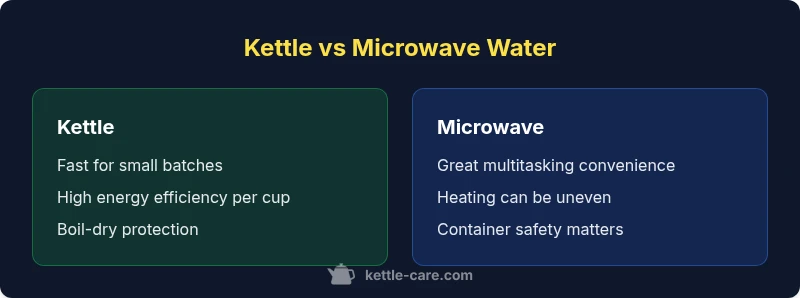
- Speed for small volumes: Electric kettles are designed to bring water to a rolling boil quickly for 1–4 cups, whereas microwaves heat water unevenly due to standing wave patterns and container geometry.
- Energy perspective: For tiny servings, kettles often use less energy per cup, thanks to direct heating and efficient elements. Microwaves depend heavily on wattage and the chosen container, which can lead to higher energy use per cup if you’re heating just a small amount.
- Safety and ease of use: Kettles typically include boil-dry protection and insulated handles, reducing burn risk. In a microwave, the risk shifts toward hot liquids and containers that aren’t microwave-safe. The kettle vs microwave water choice should factor in your kitchen layout and safety habits.
In this analysis, the takeaway is clear: for most households boiling small amounts of water, a kettle offers speed and energy efficiency, while a microwave serves as a flexible backup when multitasking is essential.
Comparison
| Feature | Kettle | Microwave |
|---|---|---|
| Boiling Speed | Typically faster for small amounts (direct heating in a kettle) | Often slower with small amounts due to uneven heating and container dynamics |
| Energy Efficiency | High efficiency per cup for small volumes | Efficiency depends on wattage and load; can be less optimal per cup for tiny portions |
| Even Heating | Very even heating up to boiling | Potential hotspots; temperature distribution can vary by container |
| Safety Features | Boil-dry protection, insulated handle, and automatic shutoff | No dedicated boil-dry protection; safety relies on container choice |
| Maintenance | Descale regularly; exterior easy to wipe | Interior cleaning optional; careful with plastics and metals |
| Best For | Multiple cups, tea, coffee prep, quick routine boiling | Single-cup or multitasking scenarios with food heating |
Strengths
- Faster and more energy-efficient for small batches
- Clear boil-off indicators and safer handling with insulated designs
- Predictable performance and easy maintenance
- Compact options fit into small kitchens
What's Bad
- Requires dedicated space and an extra appliance
- Microwave can heat unevenly; container type matters
- Not ideal for large volumes or multi-drink tasks at once
- Containers not microwave-safe can cause safety issues
Kettle wins for most everyday boiling tasks; microwave is a convenient backup for quick, single-cup water heating.
For typical daily use, a kettle delivers faster, more reliable boiling with better energy efficiency per cup. Use a microwave when you need versatility or you’re already multitasking and heat water alongside other foods.
Frequently Asked Questions
Is it safer to boil water in a kettle or a microwave?
Kettles with boil-dry protection offer predictable safety; microwaving water requires attention to containers and potential hotspots. Always use microwave-safe vessels and avoid metal.
Kettles with built-in safety features are generally safer for boiling water; microwaves require careful container choice to avoid hazards.
Can I boil water for tea in a microwave?
Yes, you can heat water in a microwave for tea, but uneven heating may affect flavor. A kettle provides more consistent, controllable temperatures for steeping.
Yes, you can, but a kettle gives more consistent results for tea.
Does water quality affect which method is better?
Hard water can cause limescale buildup in kettles, whereas microwaves aren’t affected by mineral deposits in the same way. Regular descaling helps either method.
Hard water can cause scale in kettles; microwaves don’t have this issue, but container care matters.
Is microwaving water more energy-intensive?
Energy use depends on wattage and volume. In many typical home scenarios, kettles are more energy-efficient per cup when heating small amounts.
Energy use varies with wattage; kettles usually win on energy per cup for small amounts.
What containers are safe for microwaving water?
Use microwave-safe glass or ceramic; avoid metals and certain plastics that may leach chemicals or warp.
Use microwave-safe glass or ceramic; avoid metal.
Can I use a microwave to heat boiling water for various drinks?
Yes, but the heat distribution can vary; for consistent temperature control, a kettle is preferred.
You can, but a kettle is usually better for consistent temperature control.
Highlights
- Choose a kettle for fast, efficient boiling in small batches
- Use the microwave when multitasking or heating water with other foods
- Prioritize boiler safety features and container compatibility
- Descale kettles regularly to maintain performance