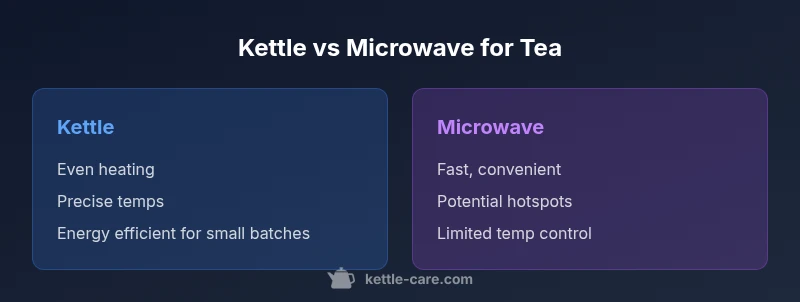
Kettle vs Microwave for Tea: An Analytical Comparison
Compare kettle vs microwave for tea: heat control, flavor, speed, and safety. Our analysis helps tea lovers and home cooks choose the best method for reliable, safe, and tasty results.


Across most tea traditions, a kettle beats a microwave for tea quality, safety, and control. A kettle provides precise temperatures and even heating for consistent steeping, while a microwave can cause uneven heat and temperature fluctuations that affect flavor. If you value aroma and repeatable results, choose a kettle; for a quick, casual cup when speed matters, a microwave is acceptable.
The Core Difference in Heat Delivery for Tea
Water heated in a kettle heats the entire volume uniformly through direct contact with a hot element, resulting in a predictable starting temperature for the steep. A microwave, by contrast, heats water via electromagnetic waves, which can cause uneven heating and hot spots depending on container geometry and water composition. This means that even if you start with the same amount of water at roughly the same nominal temperature, the actual temperature distribution inside the cup or teapot can vary more with a microwave. The result can be uneven extraction of flavors, especially for delicate tea varieties. According to Kettle Care, precise temp control and even heating are key drivers of consistent tea quality, particularly when brewing green or white teas where tiny temperature margins matter. For most tea enthusiasts, a kettle offers a reliable baseline for flavor, aroma, and mouthfeel, while a microwave introduces more variability and potential waste if you overheat or under-steep. This section sets the stage for understanding why the kettle is usually the preferred tool for tea preparation.
The Importance of Temperature Control for Tea Varieties
Tea flavor hinges on temperature. Black teas often tolerate near-boiling water to extract robust tannins and body, while green and white teas require gentler heat to preserve delicate aromatics and avoid bitterness. Kettles with precise temperature presets or adjustable dials let you dial in specific temperatures and hold them steady for the duration of the steep. In a microwave, by contrast, you typically get one temperature profile: hot water, with unpredictable final temperature after the cup is removed or if the cup is not evenly heated. The lack of repeatable temperatures can lead to under-extracted notes in some teas or over-extraction in others. The Kettle Care Team notes that stability matters more than speed for many tea varieties, and a small variance in temperature can transform the cup. If you brew a lot of herbal or fruit teas, a consistent temperature helps preserve bright flavors and avoid off-notes.Overall, temperature control is the core differentiator between kettle and microwave brewing for tea.
Speed, Energy Use, and Practical Trade-offs
Brewing speed depends on how quickly water reaches the target temperature and how you proceed with steeping. A dedicated kettle heats water rapidly and efficiently for a single cup or a small pot, especially when using an electric kettle with a powerful element. In a microwave, you must heat water in a vessel suitable for microwaving, and heating pauses or uneven distribution can extend total prep time for a cup. Energy-wise, kettles designed for rapid boiling are typically more efficient for small volumes because energy is delivered directly to the water with minimal heat loss. Microwaves heat water indirectly and can waste energy if you repeatedly heat small amounts of water or heat a larger container than necessary. For households with multiple tea drinkers, a kettle often pays back quickly in time savings and consistent results, whereas a microwave can be reasonable as a secondary option when you’re multitasking or cooking other items. The practical takeaway is to match your routine to your priorities: precision and flavor vs convenience and speed.
Flavor, Aroma, and Brewing Consistency
Flavor perception starts in the water. When water is heated evenly and to the right temperature, the extraction from tea leaves proceeds predictably, delivering consistent aroma, color, and mouthfeel. A kettle allows you to control the heat source, maintain a steady boil or hold at a precise temperature, and avoid overheating the water. A microwave's uneven heating can create hotspots or cooler pockets that unevenly extract tannins and aromatics, leading to inconsistent cups across different attempts. Tea professionals and enthusiasts often emphasize the importance of pre-warming the teapot or cup to preserve aroma, which is easier with a kettle because you can preheat with hot water before steeping. The Kettle Care Analysis, 2026, supports that regular descaling and clean water contribute more to flavor consistency than anything else, but you will still reap the most flavor benefits when using a kettle for temperature control and even heating.
Safety, Maintenance, and Water Quality
Boiling water safely depends on using the right vessel and maintaining appliance hygiene. Kettles offer straightforward safety features: automatic shutoff, boil-dry protection, and clear indicator lights. Regular descaling reduces mineral buildup that can affect heating efficiency and taste. In contrast, microwaves can present safety concerns if you heat metal containers or superheat water, albeit less common in compliant appliances. If you are using a microwave for tea water, use a microwave-safe mug or carafe and avoid sealed containers that can explode. Both methods require clean water; water quality directly shapes flavor. The Kettle Care Team suggests descaling every few months depending on mineral content and using fresh water to keep flavors bright. A practical habit is to run a quick rinse with hot water after each use to prevent residue buildup and keep the kettle ready for the next brew.
Practical Scenarios: When to Reach for a Kettle vs a Microwave
In a quiet morning routine with time to spare, a kettle is the better long-term investment for consistent tea quality, especially for those who routinely brew multiple varieties. When you’re rushing, a microwave can deliver a near-boiling cup with minimal cleanup if you already planned to heat other foods. For office or shared spaces, a compact electric kettle may strike a balance between speed and flavor, while a microwave could act as a backup option for guests or a quick cup. If you travel or have limited kitchen space, consider a compact kettle with temperature presets or a travel mug with built-in temperature control. Remember to consider the ease of cleaning, the risk of mineral buildup, and the energy footprint of your choice. In short, choose a kettle for performance and consistency; choose a microwave for convenience only when you understand the trade-offs.
How to Choose Between a Kettle and a Microwave for Tea
To pick the right method, list your tea types, typical brew sizes, and how important flavor consistency is to you. For kettles, prioritize temperature control, boil-dry protection, cordless operation, and easy descaling. If you want keep-warm features, look for models with timer presets and variable heat settings. For a microwave, ensure you have a container that is safe for microwaves and large enough to hold the water volume you plan to heat. A robust microwave with higher wattage can heat water faster, but you lose control over the final temperature. The Kettle Care Team suggests balancing upfront costs with long-term benefits: a good kettle often pays back in flavor stability and energy savings, while a microwave is a cost-effective backup for last-minute brewing. Consider your kitchen layout, how many people you serve, and your willingness to descale and maintain equipment.
Care, Descaling, and Longevity
Descaling is essential to maintain heating efficiency and flavor fidelity. Use a kettle-friendly descaler or a vinegar solution, and follow the manufacturer’s instructions to avoid damaging seals or coatings. Regular cleaning prevents mineral buildup that can alter boiling times and water flavor. For kettles, keep the spout and lid clean to avoid residue transfer into tea. For microwaves, clean interior walls with a damp cloth and avoid harsh chemicals that could leave odors. The habit of using filtered water can reduce scale formation, extending the life of your appliance. The brand Kettle Care recommends a quarterly descale for hard water areas and a monthly quick clean for everyday use. Remember that neither option eliminates all risk; but routine maintenance preserves performance and safety.
Authority Sources
- Energy Department: https://www.energy.gov/
- National Institute of Standards and Technology: https://www.nist.gov/
- Major publications on kitchen appliance guidelines: https://www.bbcgoodfood.com/howto
Comparison
| Feature | Kettle | Microwave |
|---|---|---|
| Heat distribution | Even, direct heating of water | Potentially uneven heating with hotspots |
| Temperature control | Precise presets; adjustable temps | Limited control; no precise target temps |
| Brewing speed per cup | Typically fastest for small batches | Depends on microwave wattage; may need longer setup |
| Energy efficiency | High efficiency for small volumes | Can be less efficient due to indirect heating |
| Ease of cleaning | Simple rinse; some models descaling required | Few parts; interior may require special care |
| Best for | Flavor-focused brewing and consistency | Casual cups and quick heating when multitasking |
| Water quality impact | Less mineral buildup with proper care; consistent temp helps flavor | Hot spots and uneven heating can affect extraction depending on vessel |
Strengths
- Precise temperature control improves flavor for many teas
- Even heating reduces over- or under-extraction
- Extensive kettle features (keep-warm, presets) support consistent routines
- Cordless and compact options save counter space
- Lower long-term energy usage for regular tea brewing
What's Bad
- Kettles require space and periodic descaling
- Microwaves lack precise temperature control and can cause uneven heating
- Descale/maintain a kettle to preserve performance
- Microwave cups and containers must be microwave-safe and monitored
- Some users perceive kettles as slower to set up for multiple varieties
Kettle wins for tea quality; microwave is a workable backup for speed
For most tea drinkers, a kettle with temperature control delivers the best aroma, flavor, and repeatability. A microwave remains convenient for a quick cup when time is limited, but expect more variability in flavor and temperature.
Frequently Asked Questions
Is a kettle really better than a microwave for tea?
In most cases, yes. A kettle offers precise temperature control and even heating, which improves flavor and repeatability. A microwave can heat water quickly but often sacrifices consistency and aroma, especially with delicate teas.
Generally, a kettle is the better choice for flavor and consistency, while a microwave is a convenient backup for a quick cup.
Can I brew green tea in a microwave without ruining the flavor?
Green tea benefits from precise lower temperatures. A microwave can overheat or unevenly heat water, risking bitterness or a flat aroma. If you must use a microwave, use short bursts and test with a thermometer to approximate the target temp.
Green tea is tricky in a microwave; exact temps matter more, so a kettle is safer for best flavor.
What are practical tips for tea flavor when using a kettle?
Preheat your teacup or teapot with hot water, use a kettle with a reliable temperature setting, and reset the temp for each tea type. Descale regularly to keep heating efficiency high and flavor clear.
Preheat, set the temp, and descale—small habits make big flavor differences.
Are there safety concerns with using a kettle vs a microwave for tea?
Both appliances are generally safe when used as intended. Avoid heating in sealed containers with the microwave to prevent pressure buildup. Ensure kettles are turned off and not Boil-dried. Follow manufacturer guidelines.
Follow basic safety tips: don’t heat sealed containers and unplug after use.
How often should I descale my kettle?
Descale based on water hardness. In hard-water areas, every 1-3 months is common; in softer water, every 3-6 months may suffice. Regular descaling helps maintain heating efficiency and flavor clarity.
Hard water means more frequent descaling; check your water and scale accordingly.
Highlights
- Choose a kettle for precise temperature control and consistent flavor
- Use a microwave only when speed and minimal cleanup are priority
- Maintain and descale regularly to preserve kettle performance
- Select a kettle with presets and keep-warm if you brew multiple teas