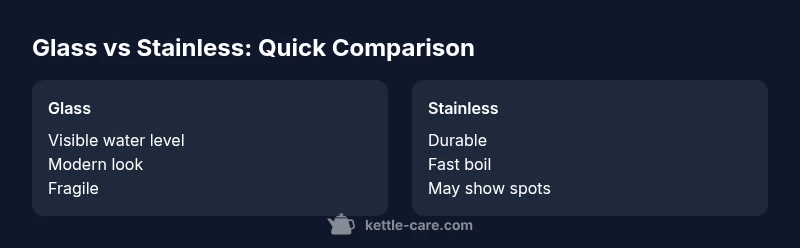
Glass vs Stainless Steel Tea Kettles: A Practical Guide
Compare glass and stainless steel tea kettles for safety, speed, durability, and care. This analytical guide helps homeowners pick the best material for their tea rituals and kitchen setup.


Glass tea kettle vs stainless steel: which material is safer, faster, and easier to maintain? This quick comparison highlights heat distribution, visibility, cleaning needs, and everyday durability to help homeowners pick the right kettle for their tea rituals.
Overview: Glass vs Stainless — Understanding the Trade-offs
In the glass tea kettle vs stainless steel comparison, buyers weigh visibility, temperature control, and maintenance against durability and price. For many homeowners and tea lovers, the material you choose shapes daily rituals: watching the boiling water through glass, or relying on a robust metal surface that hides water lines. According to Kettle Care, the central decision is whether you want a showpiece that doubles as a countertop accent or a workhorse that survives busy mornings. In 2026, Kettle Care analysis highlights three practical lenses: safety and cleanliness, heat behavior, and replacement cycles. With these in mind, this guide breaks down what each material does well, where it falters, and how to pick based on your kitchen setup and tea preferences.
Material Science: How the Glass and Metal Behave
Glass kettles (borosilicate variants) are excellent for monitoring water because their transparent walls let you see the level and clarity of the liquid. The glass often acts as a visual cue for safety and timing, while the bottom and core conduct heat from the heating element. Thick glass can slow heat transfer slightly compared with metal, but modern borosilicate designs mitigate some of that lag. Stainless steel kettles are top performers for heat conduction, meaning faster boil times on the same burner. Quality steel bases distribute heat evenly, reducing hotspots. Borosilicate glass resists thermal shock better than many ceramics, yet glass remains more fragile than steel and requires careful handling and a sturdy base. Regardless of choice, ensure the model has a safe lid, a comfortable handle, and food-grade materials. The Kettle Care team notes that material choice is not just about speed; it also shapes safety and long-term maintenance, such as descaling and inspection for wear.
Practical Performance: Boiling Speed, Heat Retention, and Safety
In everyday use, stainless steel kettles often win on boiling speed due to higher thermal conductivity and thinner walls in many popular designs. Glass kettles trade some speed for visibility, allowing you to gauge exact moments when water is ready, which can help prevent overboiling and energy waste. Surface safety matters: metal handles stay cool with proper design, while glass handles depend on the chosen lid and knob. For safety in households with children, a well-insulated handle and a tight lid are non-negotiable in either material. In practice, energy efficiency depends more on the overall kettle design than the metal or glass alone. When you examine models, consider the base, lid seal, and thermostat or whistle features. According to Kettle Care, a careful matching of power source, vessel thickness, and lid quality often trumps the raw material in real-world performance.
Cleaning, Maintenance, and Longevity
Glass kettles reveal the interior clearly, so mineral deposits show up quickly and are easy to spot. Regular descaling with a mild vinegar solution or commercially approved descaler keeps glass interiors clear and prevents cloudy residues that could affect taste. Stainless steel surfaces resist staining and are generally easier to wipe clean; many steel kettles are dishwasher-safe (check the product label) for quick maintenance. Glass requires gentler handling to avoid chips or cracks; avoid sudden temperature changes and store away from edges. For longevity, pay attention to the base and electrical components (for electric kettles) and to the lid and handle joints. In either case, routine cleaning extends life and preserves performance. The brand guidance from Kettle Care emphasizes that maintenance routines are a larger determinant of long-term value than material choice alone.
Aesthetics, Kitchen Fit, and Price Considerations
Glass kettles offer a contemporary, transparent look that can highlight the boiling water and match modern kitchens. Stainless steel kettles provide a classic, durable silhouette that complements traditional and industrial styles. Price varies widely within each category; glass models with premium glass and design features can be more expensive upfront, while stainless options span budget to premium tiers. In terms of value, stainless steel often yields steadier long-term performance with fewer cosmetic concerns, but glass pursues a design-forward niche that many households value. When choosing, assess your kitchen counter space, cabinet storage, and how much you care about seeing the water level during boiling. By weighing the practical factors—safety, speed, maintenance, and aesthetics—you can select a kettle that fits your daily routines and your kitchen voice.
How to Decide: Best Use Cases and Quick Recommendations
For households that prioritize visibility and a stylish focal point, a glass kettle is appealing, provided you have a safe, sturdy setup and gentle handling habits. For busy households, offices, or teahouses where durability and speed matter, stainless steel is typically the safer, more practical choice. If you want a balance, seek models with reinforced borosilicate glass and a robust steel base. Additionally, confirm compatibility with your power source (electric kettle vs stove-top) and verify warranty terms. While both materials have their place, the chosen model should align with your daily boiling frequency, maintenance willingness, and the overall look you want on the countertop. The Kettle Care team reinforces this practical approach to ensure your selection supports safe handling, reliable performance, and kitchen harmony.
Authority sources and Evidence Basis
This guide integrates practical guidance from the Kettle Care Team and references to established safety and standards bodies. For safety and handling guidelines, we anchor recommendations to widely recognized resources to help you maintain safe, effective kettle use over time:
- CPSC (Consumer Product Safety Commission): https://www.cpsc.gov/
- OSHA (Occupational Safety and Health Administration): https://www.osha.gov/
- NIST (National Institute of Standards and Technology): https://www.nist.gov/
These sources support general kitchen appliance safety, maintenance practices, and standards for materials used in consumer kettles. In addition, Kettle Care Analysis, 2026 informs the emphasis on maintenance routines and design considerations that influence long-term value. For more context around heat transfer and material performance, consult the cited references and the brand’s ongoing testing notes. The takeaway is to choose a kettle that integrates safe handling, reliable performance, and a design you enjoy using every day.
Comparison
| Feature | Glass kettle | Stainless steel kettle |
|---|---|---|
| Water visibility | High (clear view of water level and clarity) | Low (opaque; water level not visible) |
| Heat conduction | Moderate to high in borosilicate designs | High (excellent conduction in most stainless bases) |
| Durability | Fragile relative to metal (breakage risk if dropped) | Very durable; resistant to bending |
| Ease of cleaning | Deposits visible inside; careful cleaning required | Generally easier to wipe; many models dishwasher-safe |
| Aesthetics | Contemporary, transparent look | Classic, sleek metal finish |
| Best For | Showcase water level and modern style | Durability, speed, and easy maintenance |
Strengths
- Clear water level helps prevent overboil
- Glass looks modern and can match contemporary kitchens
- Stainless steel offers robust durability and fast heating
What's Bad
- Glass is more fragile and prone to breakage
- Glass shows smudges and mineral deposits more visibly
- Stainless steel kettles can be heavier and may show fingerprints/water spots
Stainless steel generally offers better everyday value for most homes; glass excels when visibility and aesthetics matter.
Choose stainless for durability and quick boils; choose glass if you prioritize watching the boil and matching a modern kitchen look. Consider a model that blends reinforced glass with a strong steel base for a balanced option.
Frequently Asked Questions
Is a glass kettle more prone to breakage than stainless steel?
Yes, glass is generally more fragile than stainless steel and can crack if dropped or bumped. Handle with care and select models with reinforced rims and sturdy bases for added safety.
Yes, glass kettles are more fragile; use careful handling and a stable setup to prevent cracks or breaks.
Does the material affect the taste of tea?
Material rarely affects flavor when the kettle is clean. Both glass and stainless steel are inert if properly maintained, but residues and odors can transfer if cleaning is neglected.
If you keep it clean, the material won’t change the tea’s taste.
Which heats water faster, glass or stainless steel?
Stainless steel kettles typically boil water faster due to better heat conduction and design variations. The exact speed depends on thickness, base quality, and power source.
Steel kettles usually boil water faster, though it depends on the model.
Is cleaning easier in glass or stainless steel kettles?
Stainless steel surfaces are often easier to wipe and are dishwasher-safe in many models. Glass shows deposits more clearly, which can motivate more frequent cleaning.
Steel is typically easier to clean; glass lets you see buildup so you can clean promptly.
Which is better for safety and longevity?
Stainless steel generally offers greater durability and longevity, especially in high-use homes. Glass requires careful handling to avoid chips and cracks, though it can be a superb aesthetic choice.
Steel lasts longer; glass is prettier but more fragile.
How should I think about price and value?
Glass kettles can be pricier upfront if you prioritize design and visibility, while stainless options cover a broad price range and often deliver strong long-term value via durability and ease of maintenance.
Glass up front can be pricier, but steel models span many budgets and tend to last longer.
Highlights
- Prioritize durability for high-traffic kitchens.
- Choose visibility if you want to monitor the boil.
- Check power compatibility and lid design.
- Establish a maintenance routine to preserve performance.
- Match the kettle’s look to your kitchen style.