How to Tell When Your Electric Kettle Is Done
Learn precise signals to know when your electric kettle has finished boiling, plus safe tests, model variations, and maintenance tips from Kettle Care to boost safety and speed at home.


Learn how to tell when your electric kettle has finished boiling and is safely ready to use. This quick guide covers reliable signals, quick tests, and essential safety checks to avoid overboiling. Before you start, have a timer and a kettle with a clear indicator. We’ll explain model differences and practical cues from Kettle Care to improve precision and speed.
Signals your kettle has finished boiling
When the water reaches a full rolling boil, most electric kettles emit a clear cue. Depending on the model, you may see a labeled indicator light, hear a beep, or notice the lid latch or handle feeling slightly warmer due to heat transfer. In practice, you’ll want to combine visual signals with your kettle’s built-in cues to confirm readiness. Remember that different materials—stainless steel, glass, or plastic—can interact with heat differently, so you may notice small variations between models. By paying attention to these cues, you won’t need to guess whether the kettle has finished boiling or if it’s still simmering on a low flame. A consistent approach will save time and reduce the chance of overboiling.
Visual cues: lights, steam, and beeps
Most modern electric kettles use an indicator light that turns off or changes color when boiling ends. Some models beep once or twice; others rely on a specific steam pattern or a crisp click from the lid mechanism. Observe how your kettle behaves for several boils so you can recognize the normal end-of-cycle signal. Steam should be steady and rising, not clouding the room; excessive steam can indicate overfilling or an aggressive boil. If your kettle lacks audible cues, rely on the extinguished indicator and the appearance of a steady flow of steam to signal completion. Consistency across boils is your best friend here, especially when you’re preparing multiple beverages in a row, or when you’re using a model with a subtle cue.
Temperature cues and safe testing
If your kettle provides a temperature readout or you’re comfortable using a food thermometer, you can validate doneness by targeting near-boiling temperatures. In most cases, water at or near 100°C is appropriate for tea, hot chocolate, or hot water needs. However, tea brewing guidelines vary: some teas prefer slightly cooler water to preserve delicate flavors. When no thermometer is available, rely on the model’s end-of-boil cue and your experience from prior boils. In all cases, avoid leaning over the spout or lid while testing, and never attempt to insert objects into the kettle while it’s hot. If you use a thermometer, wait for the kettle to cool slightly after boiling before taking a reading to prevent burns. This cautious approach helps you confirm accuracy without injury.
How model design changes doneness cues
Different kettle designs use different end cues: some models rely on an electrical cutoff that engages after reaching a target temperature, others rely on a floating switch that senses vapor pressure, and a few use sound cues combined with a visual light. If you often switch between models, map the cues you see for each one, so you know what to expect. For example, a glass kettle may show a rapid rise in steam with a visible bubble pattern, while a stainless-steel model often has less dramatic steam but a distinct beep. Understanding the underlying mechanism helps you interpret signals more reliably across brands and generations.
When to stop boiling for tea vs water
Even if you simply need hot water, letting water boil for longer than necessary wastes energy and can degrade some flavors. For most teas, pours should occur just after a gentle, consistent boil or even at a precise lower temperature, depending on the tea type. For hot water for instant soups or cocoa, a stronger boil may be acceptable, but you still want to minimize energy use and avoid over-extraction. If you’re making multiple cups, try to batch your boil so you’re not overheating the kettle between batches. A consistent routine reduces waste and improves flavor control in the kitchen.
Avoiding common mistakes and overboiling
Common mistakes include waiting for a dramatic boil to signal doneness, ignoring the indicator when you’re in a hurry, and refilling mid-boil, which can confuse signals. Don’t assume steam equals completion; some kettles produce visible steam while the water continues to rise. Always listen for the model’s end-beep and observe the indicator as a double-check. If your signals drift over time, it may be a sign of mineral buildup that reduces sensor accuracy. Regular cleaning helps keep cues honest.
Maintenance and calibration tips that keep cues reliable
Regular descaling and cleaning ensure signals stay accurate. Mineral deposits can insulate sensors, delaying or camouflaging doneness cues. Follow your model’s instructions for descaling every few months, depending on water hardness. If signals feel inconsistent, run the kettle through several cycles with just water and observe whether the end cues stabilize. Keeping the kettle clean reduces false positives and helps your cues stay reliable for daily use. According to Kettle Care Analysis, 2026, routine maintenance improves predictive cues across most electric kettles.
Quick-start setup for accurate doneness every time
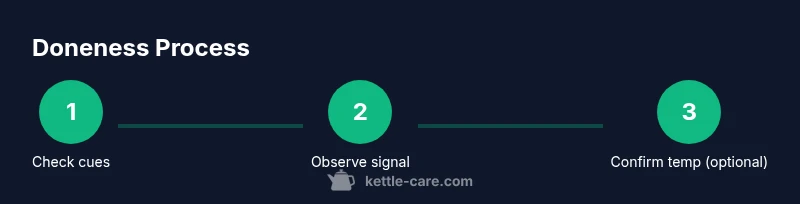
Set up a simple, repeatable routine: 1) fill to your usual level, 2) start the kettle and watch the end cue, 3) perform a quick water temperature check if available, 4) pour and log your result. Keeping a short log helps you adjust your expectations for your specific model and water quality. If you brew tea, incorporate the water temperature guidelines for your tea type to further refine the doneness signal. A small, repeatable ritual saves time and reinforces safety.
Troubleshooting unusual signals or faulty indicators
If your kettle’s end signal fails or becomes inconsistent, troubleshoot methodically. Start with power and the power indicator; verify there’s no debris blocking the lid seal or spout. Check for physical damage to the sensor or switch and test with a different power outlet. If the problem persists, consult the manual or contact customer support. In the meantime, rely on timer-based testing or a temporary test with a thermometer while avoiding risky experiments with hot water.
Tools & Materials
- Electric kettle with clear boil indicator(Model should show indicator light or beep when done)
- Timer (kitchen timer or smartphone)(To track boil duration and test times)
- Cup or mug for testing(For quick volume test or to pour small sample)
- Thermometer (optional)(Use if your kettle supports temperature testing or for verification with water near 100°C)
- Notebook or app for logging results(Optional to track doneness cues by model)
Steps
Estimated time: 8-12 minutes
- 1
Prepare workspace and tools
Clear your counter, place the kettle on a stable surface, and connect to power. Check that the lid closes securely and there’s no debris in the spout. Gather a timer, a cup, and any optional thermometer you might use for verification.
Tip: A tidy setup reduces guesswork and speeds up the process. - 2
Check your kettle’s end cues
Inspect the indicator light or audible signal your model uses to signal doneness. If you know your kettle’s normal end signal from previous boils, you’ll identify the cue faster. Confirm the beeper or light is functioning by performing a quick dry-run with water.
Tip: If the cue seems weak, perform a quick test with a small amount of water first. - 3
Fill to the target water level
Pour water up to the recommended max or your usual level. Avoid overfilling, as extra water requires longer to reach the end cue and can obscure signals. This step also reduces the risk of splashing during the boil.
Tip: Filling to the lower range often yields clearer end cues for quick brewing. - 4
Turn on the kettle and observe first cues
Start heating and watch for the first signs: steam buildup, a change in sound, or a transition in the indicator light. Keep your face away from the steam path and wait for the kettle’s standard end signal.
Tip: Don’t lean over the spout; steam can cause burns. - 5
Identify the final doneness cue
Look for the model’s definitive end signal: a steady boil, a switch flip, or a beep. If you’re using a temperature readout, verify the readout approaches about 100°C. Use these cues together for a reliable conclusion.
Tip: If your signals don’t align, rely on the most conservative cue and proceed with caution. - 6
Optional: verify with temperature (where supported)
If your kettle or setup includes a temp readout or you’re comfortable using a thermometer, confirm the water is near the target range without exceeding it. Allow water to settle briefly before measuring to avoid skewed readings.
Tip: Temperature checks are optional but helpful for precise brewing needs. - 7
Turn off, pour, and log results
Switch off the kettle, pour carefully into a cup, and note the doneness cue and temperature if you tested it. This log helps you refine your routine for your specific model and water quality over time.
Tip: A short log improves future accuracy and consistency.
Frequently Asked Questions
What signals show my kettle is done?
Most kettles use an indicator light, a beep, or a specific steam pattern to signal completion. Some models combine multiple cues. Learn your model’s normal end signal from user guides and practice a few boils to confirm.
Most kettles signal done with a light, a beep, or steam pattern. Check your model’s guide and test a few boils to confirm the cue.
Is steam alone a reliable indicator?
Steam can indicate that boiling is underway, but it’s not always a reliable cue by itself. Use the indicator or beep in combination with steam for a more accurate read.
Steam helps, but don’t rely on it alone—use the built-in cue and any sound the kettle makes.
How can I test doneness safely without opening the lid?
Rely on the end-of-boil signal and, if available, a temperature readout. Avoid opening or poking into the kettle while it’s hot to prevent burns.
Use the kettle’s end cue or temperature readout and avoid opening the lid while it’s hot.
What if the indicator doesn’t change color?
Check power and water level, ensure the lid seal is intact, and inspect for any debris. If signals are still inconsistent, consult the manual or contact support. Until fixed, use a timer as a backup cue.
If the indicator won’t change, check power and lid, clean if needed, and use a timer as a backup cue.
Do different water volumes affect doneness signals?
Yes. Higher volumes require more time to reach cues like the end signal or a temperature threshold, while smaller volumes may end sooner. Always calibrate using your typical water level.
Volume changes how cues appear; calibrate with the amount you usually boil.
Can I calibrate or reset my kettle’s signals?
Some models offer reset or calibration options in settings or the manual. If your signals drift, check for descaling needs and consider a reset if available.
Some kettles allow reset or calibration; check your manual and maintain descaling.
Watch Video
Highlights
- Use multiple cues, not steam alone, to confirm done.
- Map cues by model to improve consistency.
- Keep a simple log to refine your routine.
- Regular cleaning keeps signals reliable.