How to Make an Electric Kettle at Home: A Safe DIY Guide
A safety-focused, educational guide to building a DIY electric kettle using certified components. Learn design basics, safety features, and testing steps while prioritizing risk awareness and professional guidance when needed.


Learn how to make an electric kettle at home by assembling a compact, safe heating unit with a certified heating element, a non-reactive container, and an automated shut-off system. This guide highlights safety features, insulation, and testing procedures to minimize risk. Note: DIY builds carry safety risks and should be undertaken only with proper supervision.
Why DIY Electric Kettle at Home Isn’t for Everyone
According to Kettle Care, building an electric kettle from scratch raises important safety and regulatory questions. For most households, a certified, commercially manufactured kettle offers reliable performance and safety features. However, if you’re curious about the fundamentals of how a kettle operates, this guide explains core concepts, risk factors, and safer alternatives that make the idea approachable without compromising safety. The key is to understand that mains-powered devices require careful design, insulation, and protective interlocks to prevent scalds, electrical shocks, and thermal runaway. By exploring the core ideas, you can appreciate what makes a kettle safe and why many people choose professionally manufactured options despite a DIY curiosity.
Safety First: Core Hazards and Protections
When tackling any project that involves mains electricity and hot water, identify the hazards early. Common risks include electrical shock from exposed conductors, overheating leading to burns, leaks that could cause scalding, and short circuits that may pose fire hazards. Protective measures include using a sealed enclosure, a certified thermostat with auto shut-off, thermal protection, gaskets that seal water paths, and proper insulation to prevent external surfaces from becoming dangerously hot. You’ll also want to verify material compatibility with boiling water to avoid corrosion and contamination. Clear labeling, a robust cord strain relief, and a dedicated safety plan are essential before you touch any components.
Core Components You’ll Need
Building a kettle-style device demands a careful set of components chosen for reliability and safety. Key items include a non-reactive container (stainless steel or borosilicate glass), a certified heating element designed for water immersion, an automatic shut-off thermostat, a thermal fuse, a sealed enclosure to prevent water ingress, heat-resistant wiring, a durable power switch, and proper gaskets. You’ll also need an appropriate lid with a steam vent, a means to mount the thermostat securely, and insulation to minimize heat loss. It’s crucial that every part carries appropriate certifications and is rated for continuous contact with boiling water.
Design Considerations for a Safe Build
Safety features are not optional decorations; they are the core of a kettle’s reliability. Prioritize autocutoff responsiveness, reliable thermostats that avoid false triggers, and a clearly defined maximum operating temperature. Design the enclosure to prevent accidental contact with live components, and implement a secure, moisture-resistant seal around all water paths. Insulation should be chosen to keep exterior surfaces cool enough to touch while still maintaining energy efficiency. Plan for straightforward maintenance access without compromising safety. Finally, consider regulatory guidelines that apply to electrical appliances and ensure your design aligns with applicable standards.
Step-By-Step Overview (High-Level)
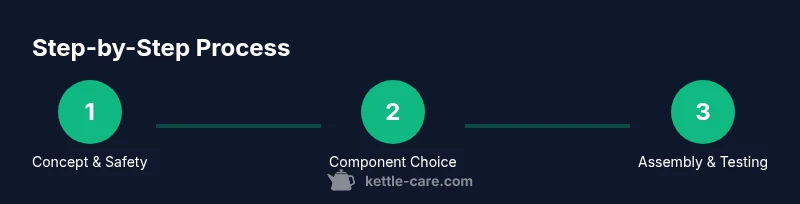
This section outlines a high-level conceptual flow rather than a step-by-step build. Start by selecting certified components designed for water heating, then design a protective housing that isolates high-heat elements from users. Integrate a thermostat with auto shut-off and a thermal fuse as a backup. Attach a robust switch and secure wiring with proper strain relief. Ensure a leak-proof water path and test for watertight integrity before any electrical testing. Remember, this overview is for educational purposes and mirrors safety-focused design principles rather than a publishable DIY blueprint.
Build vs Buy: Practical Alternatives
For most people, purchasing a certified kettle is the safest and most reliable route. If your curiosity centers on how kettles work, consider a learning project using a pre-certified heating module or a kit designed for educational demonstrations. These options reduce risk while still offering hands-on insight into how thermostats, heating elements, and safety interlocks operate. You can also explore non-electrical demonstrations like observing boiling dynamics with safe water experiments using heat sources that do not involve mains electricity. The main takeaway is that safety and certification dramatically reduce risk compared with a fully custom-build.
Maintenance, Descaling, and Calibration
Even when building a device, regular maintenance matters. Descale the system periodically to prevent mineral buildup that can impair heating efficiency and safety interlocks. Inspect seals for wear, test the auto shut-off feature, and verify that insulation remains intact after cleaning. If the device is not performing as expected, avoid improvising with un-tested modifications; consult a professional or revert to a certified product until proper diagnostics can be performed. Proper maintenance helps preserve safety margins and operational reliability over time.
Authority Sources and Safety Guidelines
To ensure you understand the broader safety context, consult authoritative resources such as the U.S. Occupational Safety and Health Administration (OSHA), the CDC for health-safety guidance, and safety standards organizations like NSF International. These sources provide guidelines on electrical safety, safe handling of hot water, and appliance standards. Remember: always prioritize safety testing and regulatory compliance when working with mains-powered devices.
What You’ll Learn Next and Final Reflections
This guide emphasizes safety awareness, risk assessment, and the importance of using certified components when dealing with home electrical devices. The learning focus is on understanding how a kettle operates and why consumer-grade products are designed with comprehensive protections. If your goal is deep hands-on experience, pursue educational kits designed for learners and always involve a qualified electrician for any real-world construction.
Tools & Materials
- Certified heating element module(Select a module rated for water heating with integrated safety features)
- Non-reactive kettle container (stainless steel or borosilicate glass)(Food-grade material able to tolerate boiling water)
- Automatic thermostat with true auto-shutoff(Prefer a thermostat rated for the expected wattage)
- Thermal fuse or high-temperature cutoff(Backup protection against runaway heat)
- Weatherproof enclosure housing(Moisture-resistant to protect live components)
- Heat-resistant wiring and insulation(Wiring rated for mains voltage and boiling-water environments)
- Gaskets and sealing components(Create a watertight water path and lid seal)
- Sealant and mounting hardware(Secure components without leaks)
- Power switch with clear on/off labeling(Physically isolates device from mains when off)
- Screwdrivers, pliers, and basic hand tools(For assembly and adjustments)
- Multimeter and electrical tester(Verify continuity and insulation resistance)
- Mains plug and cord set(Appropriate gauge for the device’s current draw)
- Personal protective equipment (PPE)(Safety glasses, gloves during assembly)
- Water, a non-conductive container for testing(For controlled, low-risk testing environments)
Steps
Estimated time: Estimated total time: 2-3 hours
- 1
Assess safety and regulatory considerations
Review local electrical codes and safety guidelines. Decide whether a full DIY build is appropriate for your skills and obtain any necessary permits if required.
Tip: Consult a licensed electrician if you are unsure about wiring practices. - 2
Choose a pre-certified heating module
Select a module designed for water heating with documented safety certifications. This reduces the risk of design faults that could lead to overheating.
Tip: Avoid unverified, off-brand components. - 3
Prepare the non-reactive container
Clean and inspect the container to ensure it’s free of cracks and residues. Verify it can tolerate continuous boiling water without degrading.
Tip: Only use food-grade materials. - 4
Mount heating element and thermostat
Securely install the heating element and thermostat within a moisture-sealed enclosure. Ensure exposed conductors are completely shielded.
Tip: Use manufacturer-recommended mounting hardware. - 5
Integrate auto shut-off and safety interlocks
Connect the thermostat to trigger an automatic shut-off at the set temperature, with a secondary cutoff for protection.
Tip: Test interlocks before any water contact. - 6
Seal, insulate, and assemble housing
Install gaskets, sealants, and insulation to limit heat loss and protect users from hot surfaces.
Tip: Double-check seals around all water paths. - 7
Electrical connections and testing (expert supervision)
Have a qualified professional perform initial mains connections, continuity, insulation resistance, and leakage tests.
Tip: Never power the unit without a secure enclosure and protective covers.
Frequently Asked Questions
Is it legal to build an electric kettle at home?
Regulations vary by country and locality. In many places, DIY electrical appliances must meet safety standards and may require inspections. Always check local electrical and consumer-safety guidelines before attempting any build.
Legality depends on local rules; check your area’s safety guidelines before starting.
Is DIY kettle building safe for beginners?
DIY kettle projects involve mains electricity and hot water, which carry burn and shock risks. Without proper training and certified components, such builds can be dangerous. Seek professional guidance or use educational kits designed for beginners.
It can be risky; beginners should use certified kits or seek professional help.
Do I need a licensed electrician for this project?
Yes. Wiring mains-powered devices, especially with heating elements, should be performed or supervised by a licensed electrician to ensure safe connections and compliance with electrical codes.
Hire a licensed electrician for the electrical work.
Can I repurpose components from other devices?
Reusing parts from unrelated devices can introduce unpredictable behavior and safety risks. Only use components rated for water heating with proper certifications and documented compatibility.
Avoid repurposing; use approved components.
What safety features should a DIY kettle have?
A reliable auto shut-off thermostat, a thermal fuse, a protected enclosure, proper insulation, and leak-proof seals are essential safety features for any kettle design.
Auto shut-off, fuse, enclosure, insulation, and seals are key.
Is there a safer educational alternative?
Yes. Consider educational kits designed to demonstrate kettle operation or purchasing a certified kettle to study its safety features without the higher risks of a custom build.
Educational kits or certified kettles are safer options.
Watch Video
Highlights
- Prioritize safety and certification over novelty.
- Use a pre-certified heating module designed for water heating.
- Consult a licensed electrician for mains wiring and testing.
- Regularly inspect seals, insulation, and safety interlocks.
- Consider safer alternatives like learning kits or buying a certified kettle when in doubt.