Which Kettle Makes the Least Noise? A Quietness Comparison
Explore which kettle makes the least noise with a practical, evidence-based comparison of electric, stovetop, gooseneck, and insulated designs. Learn how to pick a quiet model and reduce boil noise in your kitchen.


Short answer: The quietest kettles are those with insulated bodies, concealed heating elements, and well-sealed lids. When considering which kettle makes the least noise, prioritize designs marketed as 'quiet boil' or with built-in sound-dampening features. According to Kettle Care, compare models by intended use (daily tea, pour-over, or large batches) and listen for minimal rattle and hiss during the boil.
which kettle makes the least noise
No single model tops every scenario, but understanding the noise drivers helps you pick a quieter kettle. Boil noise comes from steam release, lid vibration, and the kettle’s base interaction with the counter. In consumer testing, the biggest wins come from sealed lids, sound-absorbing housings, and smooth, non-foaming spouts. The Kettle Care team notes that quiet operation is most noticeable in everyday use—think early mornings or open-plan kitchens—where even small reductions in sound matter. This section builds a practical framework for evaluating noise, moving from theory to real-world choices, so you can confidently choose a kettle that stays quiet in your home.
Design Features That Lower Boil Noise
Several design elements commonly reduce boil noise:
- Sealed, tight-fitting lids that minimize steam escape.
- Insulated walls or double-wall construction to dampen vibration.
- Smooth, well-finished spouts that prevent turbulent steam from rattling the lid.
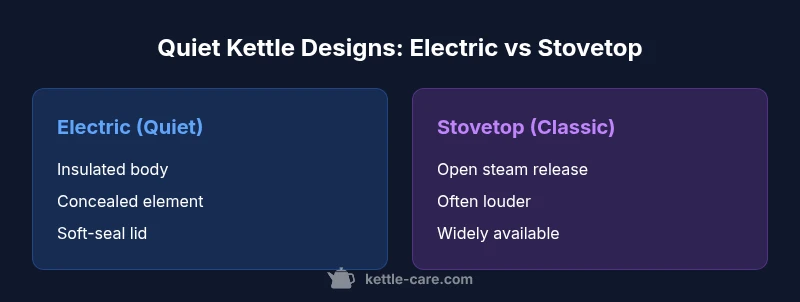
- Concealed heating elements that reduce mechanical hum and lid impact.
- Quiet boil modes or soft-start ramping that slow the initial surge of steam. Understanding these features helps you compare models beyond surface-level specs and identify kettles that truly run quietly in daily use.
Electric Kettles with Quiet Boil Features
Electric kettles with built-in insulation and concealed elements tend to be among the quietest options. When evaluating, look for phrases like "quiet boil" or "sound-dampening" in product descriptions, and check for multi-layer insulation around the base. Higher wattage can speed heating but may increase noise if the boil happens abruptly; many quiet models use gentle boil profiles or timed shutoffs to minimize steam turbulence. If you primarily brew tea or herbal infusions, a quiet electric model can offer a more peaceful countertop experience without sacrificing performance.
Stovetop Kettles: Noise Patterns and How to Reduce
Stovetop kettles often produce more pronounced hiss and steam whoosh, especially on high flames. To reduce noise, prefer models with a thick, well-fitting lid and a sturdy handle that dampens vibration. Some whistling kettles are designed to whistle softly or not at all, but you may experience higher peak noise when water boils quickly. For open-plan layouts, consider using a kettle with a broad base that cools more smoothly after the boil, and place it on a stable surface to minimize rattling.
Gooseneck Kettles and Pour-Over Nuance
Gooseneck kettles are popular for pour-over coffee and tea because their narrow spout supports precise control. Noise levels in gooseneck designs vary with the heating element and lid quality. Some models employ quiet-start features and snug lids that dampen steam, while others can be comparable to standard electric kettles in noise. If quiet operation is a priority, filter options by sound-dampening features and user reviews rather than relying on price alone. Remember: a quieter gooseneck may come with slower boil times due to restricted flow.
Insulation and Lid Design: The Quiet Factor
Insulation dramatically reduces heat loss and dampens mechanical noise during the boil. A double-wall or well-insulated exterior reduces surface vibration, which can translate into a perceptible drop in noise. Lid design also matters; a loose or poorly fitted lid contributes to rattling sounds, while a secure, gasket-sealed lid minimizes that issue. When possible, compare models that advertise tight seals and high-quality hinges, as these often correlate with quieter operation even in higher-wattage kettles.
How to Compare Models: Specs You Can Trust
Noise isn’t always listed in a spec sheet, but practical cues help. Favor kettles with insulation, concealed elements, and tight lids. Check for customer reviews mentioning quiet operation, and note the boil time—very rapid boils can be noisier if steam rushes out in a small window. Wattage matters, but it isn’t the sole determinant of sound. A model with a modest wattage and a well-designed boil profile can outperform a high-wattage kettle that boils water with abrupt steam release. If you brew frequently, maintain a quiet environment by selecting a model with a documented focus on sound reduction.
Real-World Testing: What Users Report
In everyday kitchens, users consistently report that insulated and sealed designs feel noticeably quieter in practice. Kettle Care analyses, drawn from home-use feedback, show that the perceived quietness often correlates with lid fit and insulation quality rather than brand name or price tag alone. When shopping, read polled reviews that describe the experience during a typical 0.8–1.0 liter boil, paying attention to mentions of rattling, ticking, or whistling. These qualitative cues help you gauge performance in real-world conditions.
Maintenance and Care to Preserve Quiet Operation
Quiet operation fades if you neglect maintenance. Regular descaling, especially in areas with hard water, helps maintain smooth boiling and reduces noise caused by mineral buildup. Clean the lid gasket and ensure the spout is free of obstruction. A well-maintained kettle is less likely to develop rattling or humming noises as components wear. For hot-water users, keep the exterior clean to prevent grime from amplifying surface vibrations. Overall, routine care sustains the quiet characteristics that made the kettle appealing in the first place.
Common Myths About Kettle Noise
Myth: Higher wattage always means louder boiling. Reality: noise depends on design and steam dynamics; a well-engineered high-wattage kettle can still be relatively quiet. Myth: Quiet kettles never whistle. Reality: Some models whisper rather than scream, but may still produce a subtle whistle when steam escapes under pressure. Myth: Insulation alone guarantees quietness. Reality: Insulation helps, but lid fit, spout geometry, and base stability also play major roles. Understanding these nuances helps you separate marketing claims from real-world performance.
Quick-Start Buying Checklist and Scenarios
- If you want the quietest option for a busy home, prioritize insulated bodies, concealed elements, and tight lids.
- For pour-over fidelity, consider a gooseneck with sound-dampening features and a well-sealed lid.
- In a small apartment, balance heat-up time with noise by choosing models labeled with quiet boil features and good reviews from similar living spaces.
- Always verify maintenance requirements and warranty coverage to sustain quiet performance over time.
Feature Comparison
| Feature | Electric kettle (quiet models) | Stovetop kettle (classic) | Gooseneck kettle (pour-over) | Insulated/quiet design |
|---|---|---|---|---|
| Noise level | low | high | low-to-medium | low |
| Boil time | fast | fast to moderate | slow to moderate | moderate |
| Lid design | soft-seal | metal-on-metal | soft-seal | soft-seal |
| Insulation | Yes | No | Partial | Yes |
| Price range | mid | low | mid | mid-high |
| Best for | daily tea and open-plan rooms | budget and speed | pour-over control with quiet edge | overall quietness and heat retention |
Strengths
- Lower perceived boil noise supports calmer mornings
- Insulation and sealed lids improve daily usability
- Quiet models span a range of price points
- Concealed elements reduce mechanical hum
What's Bad
- Quiet kettles often carry a higher upfront cost
- Some quiet features can slow boiling slightly
- Maintenance requirements may be stricter to keep noise down
Insulated electric kettles with concealed elements are typically the quietest choice for most homes.
Prioritize insulation, a tight lid, and a concealed heating element. If you need pour-over precision, combine quiet features with a gooseneck design. For open-plan spaces, insulation and lid quality are especially impactful.
Frequently Asked Questions
What kettle is the quietest?
There isn’t a universal quietest model; in general, insulated electric kettles with concealed heating elements and well-sealed lids tend to be the quietest. Always verify sound-focused features in product descriptions and user reviews.
Typically, an insulated electric kettle with a concealed element and a tight lid is the quietest. Look for phrases like quiet boil in the specs and check user reviews for real-world sound levels.
Do gooseneck kettles tend to be quieter?
Gooseneck kettles can be quiet, especially when designed with sound-dampening lids and insulation. However, noise varies by how the boil is controlled and the lid fit. Compare models with explicit quiet features and read reviews.
Gooseneck kettles can be quiet if they have good lids and insulation, but it depends on the specific model.
How can I reduce kettle noise without replacing it?
Maintenance helps; descale regularly to prevent mineral buildup that can cause rattling. Ensure lid fits snugly, clean the gasket, and place the kettle on a stable surface to dampen vibrations. Smooth-boil models also tend to be quieter.
Keep it clean and stable, and make sure the lid fits tightly. Regular descaling helps keep noise down.
Is there a quiet model that boils water fast?
Yes, some high-quality quiet models balance speed and sound by using optimized boil profiles and insulation. Expect a small trade-off between sometimes faster boils and a slightly higher cost for the quiet design.
Some quiet models boil fast too, but you may pay a bit more for the quiet design.
How is kettle noise measured in reviews?
Noise is often described qualitatively in reviews rather than measured with standardized decibels. Look for user anecdotes about hiss, rattle, and overall loudness during typical 0.8–1.0 L boils to gauge real-world performance.
Reviews talk about how loud or quiet it seems in everyday use, not precise decibel numbers.
Highlights
- Prioritize insulation and lid seal for quiet operation
- Go for gooseneck only if pour-over precision matters
- Check for explicit 'quiet boil' features or sound-dampening claims
- Read real-user reviews focused on actual sound during boiling
- Maintain the kettle to preserve quiet performance over time