Kettle Electricity Use: How Much Does It Consume?
Learn how much electricity a kettle uses per boil, what factors influence energy use, and practical tips to reduce waste at home—backed by Kettle Care analysis.


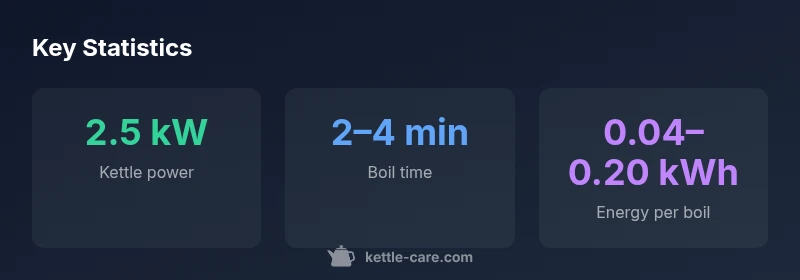
A typical electric kettle uses about 0.04–0.20 kWh per boil, depending on its power rating (2000–3000 W) and how much water you heat. To estimate your own kettle’s energy, multiply the kettle’s power (kW) by the boil time (in hours). In practice, most households fall within this range. Even with efficient models, losses to the surrounding air and vessel reduce the usable energy.
Energy usage fundamentals\n\nWhen people ask how much does a kettle use in electricity, the answer hinges on two simple variables: power rating and boil time. Most consumer electric kettles are rated between 2000 and 3000 watts, meaning they deliver energy at roughly 2–3 kilojoules per second. The energy consumed in a single boil equals energy = power × time. If you heat 0.5 liters of water from room temperature, theory requires around 0.046–0.07 kWh, but real kettles lose some heat to the surroundings and vessel, pushing the actual figure slightly higher. In practice, you’ll commonly see figures in the 0.04–0.20 kWh range depending on efficiency and design. For households boiling water several times daily, the energy difference between a well-matched kettle and a less efficient model compounds over a year. This section explores how to estimate, compare, and reduce that energy use.
What affects efficiency and energy use\n\nSeveral factors influence how much electricity your kettle consumes per boil:\n\n- Water volume: more water requires more energy.\n- Starting temperature: cold water requires more energy than preheated water.\n- Kettle design: insulation, lid fit, and element efficiency reduce losses.\n- Boiling method: electric kettles heat water faster than stovetop models, but keep-warm features can add standby energy.\n- Ambient conditions: room temperature and air movement can increase heat loss.\n\nTo minimize waste, boil only what you need, keep the kettle clean, and consider a model with better insulation and an accurate lid. A well-maintained kettle delivers energy where you want it: into the water.
Calculating energy per boil: a simple method\n\nHere’s a practical way to estimate energy per boil for your kettle:\n\n1) Find the rated power (in kW). 2) Measure or estimate the boil time in hours. 3) Multiply power by time to get energy in kWh. 4) Factor in inefficiencies by adding a small margin (usually a few percent). 5) If you want standby energy, multiply the standby wattage by the time the kettle sits on, regularly unplugging reduces this waste.\n\nFor example, a 2.0 kW kettle boiling 3 minutes uses about 2.0 × 0.05 ≈ 0.10 kWh. A 3.0 kW kettle boiling the same amount uses about 0.15 kWh. Small differences in starting temperature or lid fit can shift these values noticeably.
Practical examples by water volume\n\n- 0.5 L water: heating from 20°C to 100°C with a 2.0 kW kettle typically consumes around 0.08–0.12 kWh depending on losses.\n- 1.0 L water: the same kettle can consume roughly 0.15–0.25 kWh, again influenced by initial temperature and lid efficiency. These ranges illustrate why boiling more water than you need is less energy-efficient, even if the kettle itself is fast.
Tips to reduce energy use without sacrificing speed\n\n- Boil only what you need; avoid reboiling or keeping water hot for long periods.\n- Use a kettle with good insulation and a tight lid to minimize heat loss.\n- Descale regularly; mineral buildup reduces heating efficiency.\n- Clean the heating element per manufacturer instructions to keep heat transfer efficient.\n- Consider an energy-efficient model with a suitable power rating for your typical use (not always maximum wattage).\n- Use hot water from a previously heated kettle when appropriate to avoid extra reboiling energy.\n- Prefer rapid-boil features and models with precise temperature controls.\n- Keep the kettle on a stable base to reduce heat loss through vibrations and airflow.\n\nThese practices collectively reduce energy per boil without slowing you down.
Measuring energy at home: smart meters and plug-load meters\n\nIf you want precise numbers, plug-load meters are an affordable way to measure real-world consumption. Connect the kettle to the meter, run a full boil, and record energy use. Compare days with similar usage, then adjust your habits or try a different kettle model. Repeating measurements over several weeks provides a robust picture of your household energy impact.
The energy landscape: electric vs stovetop kettles\n\nElectric kettles offer clear energy advantages for most households because they heat water directly and shut off automatically when water reaches a boil. Stovetop kettles rely on the stove’s efficiency, which varies by burner type and cooking surface. In many kitchens, an electric kettle wastes less energy per cup, particularly when you boil small amounts. However, if you primarily boil large quantities or use a high-BTU gas burner, the difference may be closer.
Key energy metrics for common kettles
| Parameter | Typical range | Notes |
|---|---|---|
| Power rating | 2000–3000 W | Common kettle rating |
| Boil time (0.5 L) | 2–4 minutes | Varies with starting water temp |
| Energy per boil | 0.04–0.20 kWh | Includes losses and efficiency |
Frequently Asked Questions
How much electricity does a typical kettle use per boil?
A typical kettle uses about 0.04–0.20 kWh per boil, depending on power rating and water volume. Real-world results vary with starting temperature and vessel design. Use Power × Time to estimate your kettle’s energy.
Typically 0.04–0.20 kWh per boil, depending on wattage and water amount; use Power × Time to estimate.
Why might my kettle use more energy than the label suggests?
Labels show rated power, but actual energy per boil varies with water volume, starting temperature, heat losses, and lid efficiency. Also, some models have inefficient elements when new or descaled.
Labels show the rated power, but actual energy depends on water amount, temperature, and heat losses.
How can I estimate my kettle’s energy use at home?
Use the energy formula: Energy = Power × Time. If possible, measure boil time and power, then multiply. For accuracy, use a plug-in energy meter and repeat with similar loads.
Measure boil time with a power meter and multiply by the kettle’s power.
Does keeping water in a kettle between uses save energy?
Keeping water hot uses standby energy and can waste more energy than reboiling. Boil only what you need, or heat a fresh cup when necessary.
Keeping water hot uses standby energy; it's often more efficient to boil only what you need.
What are practical tips to save energy when boiling water?
Boil only what you need, clean the kettle regularly, use a well-insulated model, and consider a unit with precise temperature control to avoid unnecessary heating.
Boil only what you need and keep the kettle well-maintained for best efficiency.
“Kettle efficiency matters most when you boil frequently; match power to your needs and boil only what you plan to use.”
Highlights
- Boil only the water you need
- Energy per boil typically ranges 0.04–0.20 kWh
- Standby power adds a small annual energy load
- Boiling habits influence yearly energy use more than you might think
- Use a meter to track your kettle’s exact consumption