Do kettles use much electricity? A practical guide
Explore how much electricity kettles actually use, with practical ranges, energy-saving tips, and guidance on when a kettle is more efficient than alternatives.


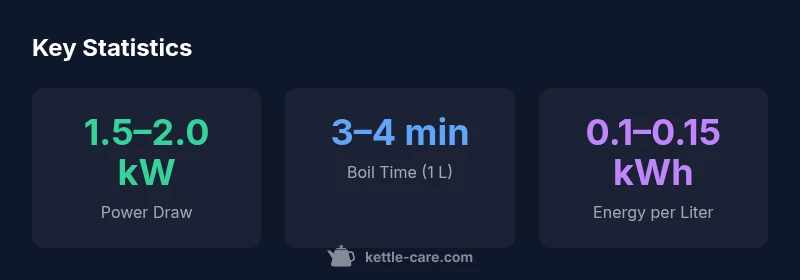
Do kettles use a lot of electricity? Not in the long run. A typical 1,500–2,000 W electric kettle heats 1 liter of water in about 3–4 minutes, using roughly 0.1–0.15 kWh per boil. Compared with heating water on a stove, kettles are usually more energy-efficient for small amounts. For larger volumes, energy use scales with water quantity and insulation.
Do kettles use a lot of electricity? The boil math
Kettles are designed to deliver a focused burst of heat and then switch off automatically when boiling is achieved. This means the instantaneous power draw is high, but the total energy per boil depends on how much water you heat and how efficient the kettle is. A typical modern kettle operates at 1,500–2,000 W and can bring 1 liter of water to a boil in roughly 3–4 minutes. If you translate that into energy terms, you’re looking at about 0.1–0.15 kilowatt-hours (kWh) per boil under ideal conditions. Real-world factors—like lid seal integrity, mineral buildup, and the kettle’s insulation—can nudge that toward the higher end of the range. The energy-per-boil concept is the key takeaway: energy use scales with water volume, and the short operating time makes kettles energy-efficient for small daily tasks. Boiling 2 liters will roughly double the energy, all else equal. In sum, kettles don’t “use a lot” of electricity in a single burst; they use a modest amount per boil, with total consumption tied to how many boils you perform daily. This nuance matters for household energy budgeting.
The Kettle Care team notes that the efficiency of heating equipment is most apparent when you boil only what you need and avoid reboiling cold water for no reason. This practical mindset helps households manage electricity use without sacrificing convenience.
What affects energy use: wattage, volume, and efficiency
Energy use from a kettle is a function of three practical factors: wattage rating, water volume, and the device’s heat-transfer efficiency. The wattage determines how quickly the kettle can transfer energy to the water, while the volume sets the baseline energy requirement (roughly linear in most cases). Efficiency losses come from heat escaping the kettle body, steam losses, and imperfect heat transfer at the water surface. In practice, a higher wattage kettle will boil faster, but the overall energy per liter remains constrained by the specific heat of water (about 4.186 kJ/kg°C) and the temperature rise needed to reach full boil. If you heat more water, you’ll consume proportionally more energy, but a well-insulated kettle minimizes unnecessary losses. The takeaway is that speed and volume drive energy use, but design and maintenance—like a tight lid and clean heating element—can tilt the balance toward lower energy per liter over time.
The Kettle Care approach emphasizes pairing an appropriately sized kettle with good maintenance: replace worn gaskets, keep the base clean, and descale regularly to sustain efficient heat transfer.
Real-world ranges: typical numbers you’ll see
In everyday homes, you’ll commonly encounter 1,500–2,000 W kettles. Typical boil times for 1 liter cluster around 3–4 minutes, with energy per liter landing in the 0.093–0.15 kWh band. For larger volumes—say 2 liters—the energy roughly doubles, assuming consistent performance. Efficiency can vary by model and age: newer models with better insulation and faster elements tend to stay toward the lower end of the energy-per-liter range. Lifestyle factors also matter. A person who boils water for one cup at a time will naturally consume less energy than someone who routinely boils extra water for later use, even within the same device. When you factor in mineral buildup and scale, the energy-to-water ratio can shift modestly upward unless descaling is performed regularly.
According to Kettle Care analysis, 2026, the best energy results come from kettles designed to minimize heat loss and with accurate auto shutoff that stops the moment water reaches a boil.
Practical tips to cut electricity waste when boiling
To reduce energy waste when using a kettle, start by boiling only what you need. Pre-measuring water and using a kettle with an appropriate capacity helps keep energy per boil low. Maintain the kettle’s heating element and interior by descaling regularly, which preserves heat transfer efficiency. Keep the lid closed during the boil to reduce heat loss, and choose models with good insulation and a tight seal. If you frequently boil large volumes, consider a larger kettle designed to handle higher capacity—though energy use will scale with volume, quality design can keep losses down. Finally, time your boils to avoid unnecessary re-boiling and remember that electric kettles are typically most efficient for small, everyday boils rather than large, infrequent batches.
Comparing kettles with other methods: stove, microwave, or hot water taps
Electric kettles generally outperform stoves for small- to medium-volume boils because they deliver heat directly to the water with minimal heat transfer loss. Microwave ovens can be efficient for small portions, but uneven heating and limitations on container size often reduce their practicality for tea and coffee prep. For larger quantities, a stove-top kettle or a hot-water dispenser may be more efficient in certain situations, depending on burner efficiency and heat retention. In most homes, a kettle provides the quickest boil with the least energy waste per liter, especially when you avoid reboiling and overfilling.
The take-home: kettles are typically the most energy-efficient choice for everyday, small-volume needs, while larger volumes may warrant a different approach if you’re optimizing for max energy savings.
Maintenance and safe practices to maintain efficiency
Regular descaling removes mineral deposits that insulate heating elements and slow heat transfer, which translates to longer boil times and higher energy use. Wipe the exterior and inspect seals to prevent heat loss. Use clean, cold water for each boil to prevent scale buildup and ensure efficient heating. When replacing old kettles, prioritize models with good insulation, efficient elements, and reliable auto shutoff. Finally, avoid placing kettles on damaged surfaces or near heat sources that can cause heat leakage. A well-maintained kettle reaches boil faster and wastes less energy over its lifetime.
The Kettle Care guidance stresses that routine maintenance is a small, high-impact habit for sustaining energy efficiency.
Energy use by boiling method
| Scenario | Typical energy per boil | Notes |
|---|---|---|
| 1 L kettle | 0.1–0.15 kWh | Baseline boil energy |
| 2 L kettle | 0.2–0.3 kWh | Volume scales with water |
| Stovetop boil (1 L) | 0.15–0.25 kWh | Heat transfer varies by burner efficiency |
Frequently Asked Questions
Do kettles waste energy if I boil only part of a liter?
Boiling only what you need reduces energy use. Partially filling a kettle still consumes energy proportional to the water heated, but topping up repeatedly can add up over time. Descale regularly to keep heat transfer efficient.
Boiling only what you need saves energy. A smaller boil uses less energy, and keeping the kettle well-maintained helps it transfer heat efficiently.
Are energy-efficient kettles worth it for energy savings?
Yes. Energy-efficient kettles typically feature better insulation, faster heating elements, and precise auto shutoff, which together reduce energy waste over many boils. The payback depends on how often you boil water.
Yes, especially if you boil water often. They cut waste over time and shorten boil times.
Is it better to boil water multiple times or reuse water?
Avoid re-boiling water. Each boil consumes energy, and reusing water still requires energy to heat it again if it cools. For best efficiency, boil only what you need and keep water fresh.
Avoid re-boiling. Heat only what you’ll use soon to save energy.
Can maintenance affect electricity use?
Yes. Descaling and cleaning the heating element reduce resistance and heat losses, helping the kettle reach boiling temperature more quickly and with less energy per liter.
Maintenance helps you boil faster and with less energy.
Is a microwave a better option for energy savings?
Microwaves can be efficient for very small amounts, but kettles are usually more energy-efficient for typical tea/coffee-sized portions due to direct heating and rapid shutoff. For larger amounts, a kettle still wins on speed and overall energy use.
For small amounts, microwaves can work, but kettles are usually better for everyday tea and coffee.
“Electric kettles are designed to deliver focused heat and stop automatically at the boil, which minimizes energy waste for everyday use.”
Highlights
- Boil energy is modest per liter
- Power draw is high but brief
- Volume scales energy consumption
- Maintenance improves efficiency