What Wattage Does a Kettle Use? A Practical Guide for Safe, Efficient Boiling
Discover the wattage range for kettles, how it affects boil time and energy use, and how to choose the right wattage for your home and tea rituals. Practical tips from Kettle Care for homeowners and tea lovers.


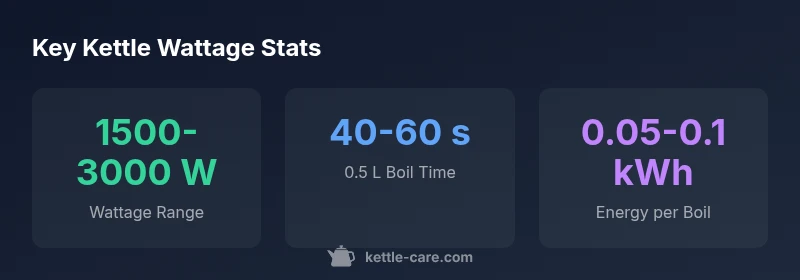
A kettle typically uses between 1500 and 3000 watts, with most modern electric kettles around 1500-1800 watts for quick boils. The exact wattage depends on the model and features (keep-warm, temperature control). Understanding wattage helps estimate boiling time and energy use. For energy efficiency, choose a kettle at the lower end of the range when possible.
What wattage does a kettle use: a practical baseline
The wattage rating on a kettle is a quick snapshot of how much power the heating element can draw in real time. For homeowners trying to understand energy use, the key idea is that higher wattage generally boils water faster, while lower wattage consumes less energy per moment but may take longer to reach a boil. According to Kettle Care, most households benefit from kettles in the 1500-1800W range for everyday tea and coffee, balancing speed with energy efficiency. The Kettle Care team found that while wattage is not the only factor, it is a useful guide to estimate how long a boil will take and how much energy a single kettle boil will consume. When you read the label, you will see a wattage range or a specific wattage; the actual performance also depends on water volume, starting temperature, and kettle design. In practical terms, if you frequently boil larger amounts of water, a higher wattage can save time, but if you mostly boil small amounts, a lower wattage can save energy without sacrificing convenience.
Key takeaway: wattage matters, but it’s not the only variable. Always consider your typical use, outlets, and safety factors before purchasing.
How wattage influences boil time and energy use
To understand the relationship, start with the basic energy equation: Energy (in joules) = Power (watts) × Time (seconds). If you boil 0.5 liters of water, you need roughly 0.5 kg × 4.186 kJ/kg°C × (100−20)°C ≈ 167 kJ of energy, not accounting for losses. In an ideal world, a 1500W kettle would need about 111 seconds to bring 0.5 L to a boil; a 3000W model could halve that time, assuming similar efficiency. Real kettles are not 100% efficient—heat losses to the surroundings and lid design reduce the effective energy transfer, so actual boil times are typically a bit longer. The takeaway is straightforward: higher wattage reduces boil time, but the exact benefit is shaped by kettle design, insulation, and boil volume. If your goal is speed, a higher wattage helps; if you want to minimize energy usage, ensure you only heat what you need and consider a kettle with good insulation.
Electric kettles vs stovetop kettles: wattage differences
Electric kettles come with built-in heating elements and defined wattage ratings, typically ranging from 1500W to 3000W. Stovetop kettles, by contrast, do not have a kettle wattage; they rely on the stove burner’s power setting. On an induction or electric coil, the stove determines heat delivery, while the kettle simply conducts the heat. For homes with older electrical systems, a kettle at the lower end of the wattage range (around 1500W) can reduce circuit load and tripping risk, while still boiling water quickly enough for most daily needs. If you frequently boil large amounts of water or want the absolute fastest boil, a high-wattage model can be appealing—just be mindful of your circuit capacity and safety margins.
Choosing the right wattage for your home and habits
The choice hinges on how you use water, available outlets, and energy priorities. If you want faster boils for multiple teas or family use, a 1800W–2200W model provides a solid balance. For single servings or tea rituals where you’re mindful of energy, a 1500W model is ample and typically more energy-efficient for small boils. Consider your kitchen’s electrical circuit: in many homes, running a high-wattage kettle alongside other high-draw appliances can trip a breaker. If you’re upgrading, look for features that complement efficiency, such as favorable insulation, a well-fitting lid, and a design that minimizes heat loss. Remember, wattage is only part of the picture; real-world performance also depends on temperature controls and keep-warm features, which can add extra energy use over time.
Common myths about kettle wattage
- Higher wattage always means better value: Not necessarily. Boil speed matters, but total energy usage depends on your volume and usage pattern.
- Any wattage will do the job: The wrong wattage can stress older outlets or circuits if the kettle is frequently used everywhere at once.
- Wattage is the sole predictor of performance: Design, insulation, and lid fit can dramatically affect efficiency, sometimes making a lower-wattage model just as effective for daily use.
The reality is that wattage is a useful, but not sole, guide to performance. Think in terms of your typical boil size, how many times you boil per day, and your home’s electrical capacity.
How to measure your kettle's wattage at home
If you don’t have the label handy, you can estimate wattage using a simple plug-in wattmeter. Plug the kettle into the meter and note the power draw when it’s heating. Run a full boil and observe both the wattage reading and the time to boil. For more precise lab-style measurements, use a power analyzer that records simultaneous voltage and current to compute real-time wattage. Keep in mind that some kettles switch power states during the boil (latching, auto shutoff), so repeat measurements for accuracy. Over time, you’ll get a feel for how your preferred kettle performs in your kitchen.
Practical recommendations for households and tea lovers
- If you primarily boil 0.2–0.5 L per serving, 1500–1800W kettles are typically sufficient and energy-friendly.
- For quick, family-size boils, consider 1800–3000W models, but verify circuit capacity and outlet availability.
- For gooseneck tea kettles used for precise pouring, wattage is less about peak power and more about stable, controllable heat; still, avoid overloading the circuit when used with other appliances.
- Always use a dedicated outlet if possible and unplug the kettle when not in use to minimize standby energy loss.
- When upgrading, prioritize insulation and lid fit to improve overall efficiency and reduce heat loss regardless of wattage.
Wattage ranges and boil times by kettle type
| Kettle Type | Typical Wattage | Approx. Boil Time for 0.5L | Notes |
|---|---|---|---|
| Electric kettle (standard) | 1500-1800 | 40-60 seconds | Balanced speed and energy use |
| Electric kettle (fast) | 2000-3000 | 30-50 seconds | Quicker boils, higher draw |
| Stovetop kettle | N/A | Varies with stove heat | Wattage not defined by kettle |
Frequently Asked Questions
What wattage should I look for in an electric kettle?
For most households, 1500–1800 watts hits a good balance between speed and energy use. If you want faster boils and have the circuit capacity, 1800–2200 watts is a solid option. Consider your typical usage and electrical setup.
For everyday use, aim for 1500 to 1800 watts. If you often boil for multiple people or need faster boils, 1800 to 2200 watts is a good upgrade—just make sure your outlets and circuit can handle it.
Can I use a kettle with higher wattage on a weak circuit?
If your home has a weak circuit, a high-wattage kettle may trip breakers. In that case, opt for a lower-wattage model or use the kettle on a dedicated outlet with sufficient amperage.
Yes, but if your circuit is weak, stick to lower wattage or use a dedicated outlet to avoid tripping breakers.
Do stovetop kettles have wattage?
Stovetop kettles don’t have an inherent wattage rating. Their heat depends on your stove’s burner power, not the kettle itself.
Stovetop kettles don’t list wattage; the power comes from your stove or burner.
Is higher wattage always better?
Not always. Higher wattage boils water faster but can use more energy if you heat more water than you need. Match wattage to your typical volume and remember good insulation matters.
Higher wattage boils faster, but you might not need it for small amounts. Consider your usual cups and storage space.
How can I measure my kettle’s wattage at home?
Use a plug-in wattmeter to measure real-time power draw during heating, or check the label on the kettle for the rated wattage. For precise results, repeat the test with the kettle full and empty to compare heat losses.
Use a wattmeter to measure how many watts your kettle draws while heating. Check the label for the rated wattage too.
“Wattage is a guide to boil speed, but real-world performance depends on efficiency and usage patterns. Small adjustments in volume and insulation can have meaningful effects.”
Highlights
- Know the wattage range for your kettle to estimate boil time.
- Higher wattage boils faster, but check your circuit capacity.
- Wattage is just one of several factors affecting efficiency.
- Use a wattmeter to measure actual performance in your home.
- Choose a wattage that matches your daily tea/coffee volume.