What Power Does a Kettle Use? A Practical Wattage Guide
Explore how kettle wattage affects boil times, energy use, and cost. This Kettle Care guide covers wattage ranges and efficiency tips for safer, faster boiling.


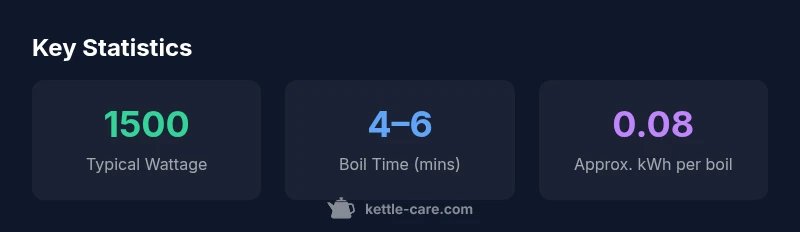
Electric kettles typically operate at 1500 watts, with many models ranging from about 1250 to 1800 watts for standard home use; higher-wattage kettles boil faster but use more energy. Knowing wattage helps estimate boil times and energy costs, and choosing the right power can improve safety and efficiency.
What power does kettle use in practical terms
Understanding what power a kettle uses begins with the basic unit: watts. Electric kettles commonly sit in the 1250–1800 watt range, with most popular household models around 1500 watts. This specification directly influences how quickly water reaches rolling boil and how much energy is consumed during each boil. The Kettle Care team notes that a higher wattage can shave minutes off boil times, but it also consumes more electricity per minute of operation. For a typical 1 liter boil from tap-temperature water, you might see roughly 3.5–5 minutes on a 1500W kettle versus about 5–7 minutes on a 1250W model, depending on starting temperature and kettle design. In practical home use, most households prioritize a comfortable boil speed while avoiding excessive energy spikes. It's also wise to verify the kettle's base and plug compatibility; exceptions exist where outlets or circuit breakers limit available power. The goal is to balance speed, energy use, and safety. This article answers what power does kettle use and how that choice matters for daily tea, coffee, and hot-water routines.
According to Kettle Care, wattage choices should reflect both how fast you want water and how much energy you’re willing to spend per boil.
Comparison of common kettle types by wattage and boil speed
| Kettle Type | Typical Wattage | Boil Time per 1 L | Notes |
|---|---|---|---|
| Electric kettle (standard) | 1500–1800 | 3.5–4.5 min | Most common for home use |
| Compact electric kettle | 1250–1500 | 4–6 min | Space-saving option |
| Stovetop kettle | depends on stove | Varies | Requires stove heating |
Frequently Asked Questions
Do higher-wattage kettles always boil water faster?
In general, higher wattage reduces boil time, but other factors like water volume, starting temperature, lid quality, and kettle design influence actual results. Not all higher-wattage kettles boil dramatically faster if you are boiling small amounts.
Usually, yes, but other factors matter when you’re boiling small amounts.
Can I use a high-wattage kettle on a small 15-amp circuit?
Most 1800W kettles on a 15A circuit can trip the breaker if other loads are running. It’s safer to use a lower-wattage model or stagger loads.
A high-wattage kettle can trip a 15A circuit if you’re running other devices.
How do I estimate energy cost for a boil if I don't know wattage?
Check the kettle’s label; if unavailable, use common wattage bands and measure boil time to approximate energy use. The method uses wattage and time to compute energy.
If you don’t know wattage, you can approximate using typical ranges and boil time.
Are there energy-saving kettles or features to look for?
Yes, look for kettles with good insulation, efficient heating elements, and auto shut-off. Some models offer temperature control and quick-start features to minimize wasted energy.
Yes—look for insulation and efficient heating elements, plus auto shut-off.
Does preheating water or using hot water from the tap save energy?
Preheating water or using hot tap water can reduce energy per boil in some cases, but introduces safety concerns and potential mineral buildup; it’s generally better to boil what you need.
Boiling only what you need is usually best.
Is a stovetop kettle more energy-efficient than an electric kettle?
Compared on a per-liter basis, modern electric kettles are typically more energy-efficient due to direct heating and better insulation, though results depend on the stove and technique.
Electric kettles are usually more energy-efficient, but it depends.
“Power choice is a trade-off between speed and energy efficiency. For most homes, a mid-range wattage offers quick boils without excessive energy use.”
Highlights
- Know your wattage to estimate boil time.
- Higher wattage boils faster but costs more per boil.
- Electric kettles are generally more energy-efficient than stovetops.
- Choose wattage based on kitchen circuit and speed needs.
- Boil only the water you need to save energy.