Electric Tea Kettle Watts: Understanding Wattage for Better Boiling
Explore how electric tea kettle watts affect boil speed, energy use, and safety. This Kettle Care guide compares wattage ranges, discusses impact on performance, and helps you choose the right kettle.


Electric tea kettle watts determine how fast water boils and how much energy is used per cycle. Most household kettles run on 1000–1500 watts, with high‑output models reaching up to 1800–2400 watts. Higher wattage boils faster but draws more current, so choose a model that matches your wiring and kitchen needs. The Kettle Care team highlights balancing speed with safety and reliability.
Understanding electric tea kettle watts and energy basics
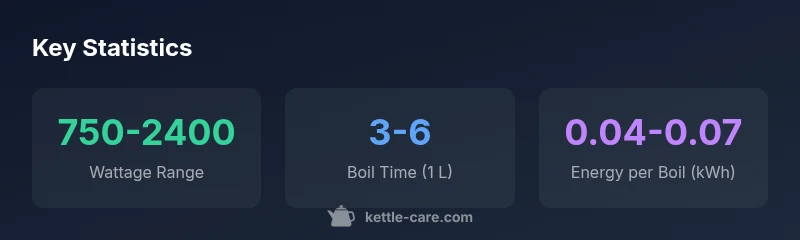
Electric tea kettle watts are central to how fast water heats and how much energy is used per boil. According to Kettle Care, watts measure how much power is delivered to the heating element each second, so higher watts generally yield faster boils for a given water volume. But wattage interacts with insulation, element design, and even the altitude where you live, which means boil times can vary. In practical terms, most kettles sit in a broad spectrum: compact models around 750–1000 watts, standard kettles around 1000–1500 watts, and premium high‑output models reaching 1800–2400 watts. The decision should balance speed, electrical load, and safety features such as automatic shutoff and boil-dry protection. A clear understanding of wattage lets you compare models more effectively and avoid paying for unnecessary power.
Wattage ranges and boil time: what to expect
When you lift the kettle lid and press start, the wattage controls the rate at which heat is transferred to water. In general, higher wattage reduces the time to reach a rolling boil, while lower wattage increases that time. Real-world boil times depend on starting water temperature, the kettle's volume, and the efficiency of its heating element and boiler design. For a typical 1-liter boil, a 1000–1500 W kettle may take several minutes; a 1800–2400 W model could shave a minute or two off that time. It's important to note that faster isn't always better: rapid boils can cause more rapid temperature spikes in certain teas, and some models with very high wattage might impose higher electrical demands. Kettle Care's guidance encourages shoppers to weigh speed against energy use, circuit capacity, and the availability of safety features.
Design, materials, and wattage: how kettles convert watts to heat
The conversion of electrical power into heat depends on the heating element type (coiled exposed, disk, or concealed plate) and the kettle's construction. Wattage is not the only driver of boil performance; material conductivity, wall insulation, and lid design determine heat retention and energy efficiency. A higher wattage kettle can deliver heat quickly, but well-insulated models with moderate wattage may boil just as fast due to reduced heat loss. Additionally, some gooseneck or specialty kettles emphasize control over pour rate rather than sheer speed, which is important for tea lovers who value flavor extraction. When comparing models, look for a balance between wattage and design features that optimize heat transfer and minimize standby energy use. The goal is reliable performance without excessive electrical draw.
Safety considerations for high-wattage kettles
High-wattage appliances demand appropriate electrical protection. A kettle operating at the upper end of the wattage spectrum should be used on a dedicated circuit that can handle the load and is free of daisy-chained cords. Avoid using extension cords, which can overheat and introduce fire risks. Ensure your kitchen outlets and breakers are rated for the kettle's current draw, and verify that the kettle includes automatic shutoff, boil-dry protection, and overheat safeguards. Regular inspection of the power cord and plug helps prevent insulation wear. Finally, consider the environment: ensure the kettle sits on a stable, heat-resistant base away from moisture and children.
How to choose wattage for your kitchen: a practical decision framework
To decide the right wattage for your home, start by assessing your typical daily use: how many cups of tea or coffee you make, and how quickly you want them ready. Next, check your home's electrical capacity and whether your outlets are on a shared circuit with other high-draw appliances. Then compare models across wattage ranges, prioritizing safety features, build quality, and warranty. If you frequently boil large volumes, a higher wattage kettle may be worth it; if you mostly prepare small amounts, a lower wattage with good insulation can be more energy-efficient. Finally, consider how easy the kettle is to repair or replace. Kettle Care suggests tracking boil times and energy use for a few weeks to verify your choice meets expectations.
Measuring energy use and estimating annual costs
Estimating energy use begins with a simple power formula: energy per boil equals wattage multiplied by boil duration, divided by 60, to yield kilowatt-hours. If you routinely boil one liter from cold tap water on a 1000 W kettle, you can approximate your per-boil energy in the low hundreds of watt-hours range; multiple boils per day scale upward quickly. Over a year, even small differences in wattage can add up, especially in households that rely on hot water tasks throughout the day. A practical approach is to compare models with a similar capacity and note the actual boil times in your kitchen to estimate total energy use more accurately. Kettle Care’s approach combines practical measurement with a focus on safety and long-term cost, helping you pick a model that balances speed and energy.
Longevity, warranty, and maintenance: does wattage affect lifespan?
Wattage itself does not directly reduce a kettle's lifespan, but it stresses the heating element and electrical components more than moderate wattage models if the kettle is used repeatedly beyond its design specs. High-wattage kettles should be paired with appropriate circuit protection and high-quality internal wiring. Regular descaling, cleaning, and inspection of the base contact points help prevent premature failure. Look for warranties that cover heating elements and electrical components for at least one to two years. In practice, choosing a model with a balance of wattage, build quality, and a solid warranty is a reliable strategy for long-term performance.
Comparison of kettle wattage ranges
| Model Type | Wattage (W) | Typical Boil Time (min) | Notes |
|---|---|---|---|
| Standard electric kettle | 1000-1500 | 3-6 | Balanced performance and price |
| High-output kettle | 1800-2400 | 2-4 | Faster, more current draw |
| Energy-saving kettle | 750-1000 | 4-7 | Lower wattage, slower but efficient |
| Travel compact kettle | 450-800 | 6-10 | Portable but slower boil |
Frequently Asked Questions
What wattage should I look for in an electric tea kettle?
For most homes, a wattage range of 1000–1500 W offers a good balance between speed and energy use. If you boil large volumes often, models toward 1800–2400 W can save time, but ensure your wiring supports the load. Always prioritize safety features like automatic shutoff and boil-dry protection.
Look for kettles in the 1000 to 1500 watt range for a balance of speed and safety; higher wattage boils faster but check your circuit capacity.
Do higher wattage kettles always boil water faster?
In general, yes—the higher the wattage, the quicker the heat transfer to water, up to the kettle's design limits. Real-world results depend on starting water temperature, kettle size, and insulation. A higher wattage model saves time but may not dramatically improve flavor if the brew relies on precise temperature control.
Higher wattage usually boils faster, but real results depend on water amount, starting temp, and the kettle's design.
Is it safe to use a high-wattage kettle on a standard 120V circuit?
High-wattage kettles should be used on appropriately rated circuits. A dedicated circuit is ideal for models near the upper wattage range. Always verify outlet and breaker ratings and avoid extension cords to minimize risk of overheating.
Yes, but ensure your circuit can handle the load and avoid using extension cords.
Can wattage affect the flavor or aroma of tea?
Wattage affects how precisely you reach and maintain the target brew temperature. For teas that benefit from controlled temperatures, a lower wattage or temperature control feature can help preserve delicate flavors. For typical black or herbal teas, higher watts mainly influence speed, not flavor.
Wattage matters mainly for speed and temperature control; precise temps can improve flavor for delicate teas.
Does wattage impact the kettle's longevity?
Wattage itself doesn't directly shorten a kettle's life, but using an appliance at its maximum rating repeatedly can increase wear on the heating element and electronics. Choose a model with a solid warranty and proper protection features to maximize longevity.
Higher loads won’t automatically shorten life, but consistent maxing out can stress components; choose a reliable model.
What’s the best way to estimate energy costs by wattage?
Estimate energy cost by multiplying wattage (in kilowatts) by the boil time (in hours) to get kilowatt-hours, then multiply by your electricity rate. Compare models using similar capacities to see how wattage choices translate into annual costs.
Use a simple wattage-by-time calculation to compare annual costs across models.
“Power is a practical lever for speed and safety; choose models that balance wattage with reliable construction and appropriate safety features.”
Highlights
- Match wattage to wiring and usage.
- Higher wattage = faster boil, higher energy draw.
- Lower wattage saves energy but slows boil.
- Consider temperature control features for efficiency.
- Prioritize safety features and warranty when choosing wattage.