Kettle Power Rating: A Practical Guide for Safe, Fast Boiling
Explore kettle power rating basics, how wattage affects boil speed and energy use, and how to choose the right model for your home. Practical tips, model comparisons, and expert insights from Kettle Care.


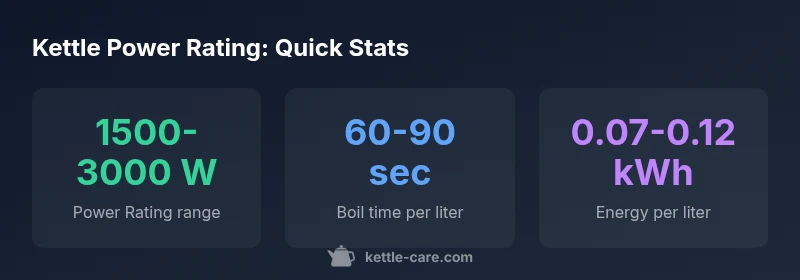
The kettle power rating is the electrical power drawn by a kettle to boil water, typically ranging from 1500 to 3000 watts. Higher wattage boils faster but uses more energy per minute, while lower wattage is gentler on circuits and slower. Most households select models around 1800–2400 W to balance speed and efficiency.
What kettle power rating means and why it matters
The kettle power rating is the electrical power drawn by a kettle to reach a boil. In practical terms, it indicates how quickly water can reach boiling point and how much energy is consumed per minute of operation. For most households, the kettle power rating falls in the 1500–3000 W range, with common models at 1800–2400 W. Understanding this rating helps you balance speed, energy cost, and safety, especially when you use multiple appliances on the same circuit. According to Kettle Care, selecting the right rating minimizes trips to the breaker and reduces heat-related wear on your kettle's elements. When you see a rating on a label, you are looking at how much electrical power the kettle will draw under normal boiling conditions. This figure does not directly tell you how much water you should boil, but it is a strong predictor of how fast you can expect the kettle to boil a given volume.
How wattage affects boil speed and energy use
Boiling speed is primarily a function of wattage. In general, higher wattage delivers faster heating because more energy is delivered per second. For example, an 1800–2200 W kettle typically reaches a rolling boil from room temperature sooner than a 1500 W model. However, faster boiling comes with higher instantaneous energy consumption. Over a standard boil, a higher-wattage kettle may use more energy per minute, even if the total time is shorter. The total energy used to boil a fixed amount of water depends on the temperature difference between water and the boiling point, not the time taken alone. The practical takeaway is that if you boil frequently, a slightly higher rating can cut total time and reduce nuisance heat in your kitchen, but you should weigh this against your circuit capacity and daily energy costs.
How to evaluate power rating for your kitchen setup
Start with your circuit capacity. In many homes, kitchen outlets are on 15-amp or 20-amp circuits at 120V (North America) or 230V in other regions. A kettle in the 1800–2400 W range fits typical 15A/120V circuits with some headroom, but plugging a high-wattage model into a shared outlet can trip breakers if you run other high-power appliances at the same time. For safety, do not rack multiple kettles on a single outlet. If you have 220–240V supply, you may safely use even higher wattage (up to around 3000 W) models, but ensure your wiring and outlet rating can handle it. Consider your daily usage: if you boil water for tea several times per day, the faster option can reduce heat exposure and kitchen congestion. Always check the manufacturer’s safety instructions and verify compatibility with any smart plugs or timers you use.
Real-world ranges and what they mean for daily use
The typical kettle power rating landscape includes compact models around 1500–1800 W, standard kettles around 1800–2400 W, and high-power kettles in the 2400–3000 W range. In practice, the speed advantage of higher wattage is most noticeable when you boil larger amounts of water or when you need quick hot water for multiple tasks. Energy-wise, the per-boil cost rises with higher wattage if you measure by minutes of operation, but for the same water volume, the total energy used is driven more by the water temperature rise and kettle efficiency than wattage alone. Kettle Care analysis shows that users who choose a power rating aligned with their typical usage—such as single-user households preferring mid-range kettles—often achieve a balance of speed, reliability, and energy use. For households juggling multiple devices, a mid-range rating minimizes the risk of overloading circuits while still delivering reasonable boiling times.
Practical tips to maximize efficiency regardless of wattage
- Pre-fill and pre-heat: Pre-fill the kettle to the needed volume and consider pre-warming only if your kettle supports it.
- Insulate where possible: Use heat-insulating mats or lids to minimize heat loss.
- Maintain the kettle: Regular descaling and cleaning maintain heating efficiency, particularly in areas with hard water.
- Read labels: Compare wattage labels across models; the rated power is a major driver of speed, but overall efficiency depends on elements like heating coil design and thermostat accuracy.
- Use energy-saving habits: Boil only as much water as you need; keep a kettle on standby only when necessary.
These practices help you reduce energy use while keeping performance stable across different power ratings.
How to read labels and compare models
When shopping, read the specification label on the kettle or product page. Look for the wattage figure, the boil time per liter, and the energy rating if disclosed. Compare models not only by watts but by practical outcomes: how long they take to reach a boil and how much water you can boil at once. Take note of safety features like auto shut-off, boil-dry protection, and thermal cutoffs. Finally, consider warranty terms and ease of repair; a higher power rating is only useful if the kettle remains reliable over many uses. By concentrating on these factors, you can confidently pick a kettle with a suitable kettle power rating for your kitchen setup.
Quick-start checklist for selecting a power rating
- Assess your circuit capacity: confirm your outlets support the kettle’s wattage without tripping.
- Consider your water volume needs: larger households may benefit from higher wattage for speed.
- Weigh speed vs energy: if you boil water rarely, a mid-range kettle saves energy; if you boil a lot, higher wattage can save time.
- Check compatibility: ensure outlets and plugs handle the rated current, and be mindful of extension cords.
- Review safety features: look for auto shut-off, boil-dry protection, and sturdy construction.
Following this checklist helps you pick a kettle power rating that matches both your home and your habits.
Comparison across common kettle types
| Model Type | Typical Power Rating | Boil Time per Liter |
|---|---|---|
| Compact electric kettle | 1500-1800 W | 60-75 sec |
| Standard electric kettle | 1800-2400 W | 60-90 sec |
| High-power electric kettle | 2400-3000 W | 50-70 sec |
Frequently Asked Questions
What is the kettle power rating and why does it matter?
The kettle power rating indicates how much electrical power the kettle uses to reach a boil. It affects how quickly water boils and how much energy is consumed per minute. Understanding this helps you choose a model that fits your kitchen usage and electrical setup.
The power rating shows how much power the kettle needs to boil water; it impacts speed and energy. Pick a model that fits your home routine and wiring.
Do higher wattage kettles always boil water faster?
Typically yes, higher wattage heats water more quickly. However, real-world results depend on the kettle's insulation, design, and the amount of water being heated. Consider your usual volume when deciding.
Yes, more watts usually mean faster boiling, but other factors like design and water amount matter too.
Is a higher wattage safer for my kitchen circuit?
Higher wattage can stress circuits if multiple high-power devices run simultaneously. Ensure your outlet and circuit can handle peak load, and avoid daisy-chaining appliances on the same outlet.
Higher wattage can strain circuits if you run other high-power devices at the same time. Check your outlet and circuit capacity.
How should I choose the right power rating for my household?
Assess your circuit capacity, typical water volume per use, and whether you value speed or energy savings more. For busy households, a mid-range rating often balances performance and efficiency.
Look at your circuit, how much water you boil, and whether you want speed or energy savings. A mid-range rating usually fits best.
Does wattage affect long-term energy costs?
Wattage influences how fast you boil, which can affect total time spent heating water. Total energy use is more strongly influenced by the amount of water heated and the kettle’s efficiency over time.
Wattage changes boil speed, not just total energy. The amount you boil and kettle efficiency matter for long-term costs.
What safety features should I look for in a kettle?
Look for auto shut-off, boil-dry protection, secure lid design, and a stable base. These features protect you and your home, especially on higher-wattage models.
Auto shut-off and boil-dry protection are essential safety features to check in any kettle.
“Understanding the kettle power rating helps you balance speed, energy use, and safety, so you can boil smarter, not just faster.”
Highlights
- Know the wattage range to expect for most kettles
- Higher wattage boils faster but uses more energy per minute
- Match wattage to your circuit capacity and daily use
- Read labels and compare real-world boil times
- Choose practices that optimize efficiency regardless of wattage