Kettle Watts: A Practical Guide to Power, Speed, and Safety
Explore how kettle watts affect speed, energy, and safety. Expert tips from Kettle Care on selecting wattage, optimizing boiling, and maintaining efficiency for tea lovers and home cooks.


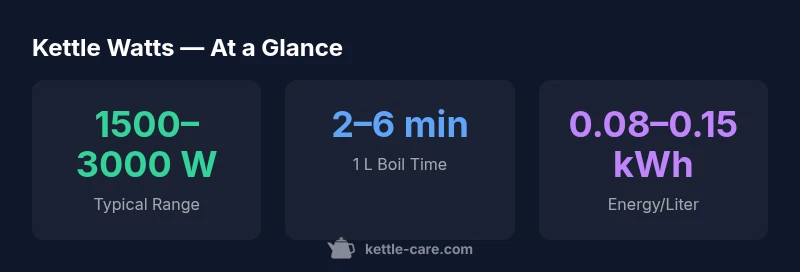
Quick Answer: Kettle watts for typical household kettles usually range from 1500W to 3000W, with common models around 1800–2400W. Higher wattage heats water faster, but total energy use depends on water volume and starting temperature. For energy efficiency, match wattage to your daily needs and keep boil quantities modest. Understanding this helps balance speed versus energy cost, especially when you boil multiple cups or prepare tea and coffee in succession. Consider kettle design and insulation, as these factors influence how efficiently watts convert to hot water.
How kettle watts influence boil speed and energy use
Kettle watts, or the electrical power rating, tell you how much energy the kettle can draw at once. In practical terms, a 2000 W kettle can supply more heat per second than a 1500 W kettle, so it generally boils water faster for the same starting temperature. However, the total energy used to boil a given amount of water depends on the weight of water and the temperature rise, not watts alone. If you start with cold water, a high-wattage kettle will still end up using roughly the same energy as a lower-wattage model boiling the same volume, because energy required equals mass × specific heat × temperature rise. The energy per cup decreases only when you reduce the amount of water boiled. In other words, wattage affects speed, not the fundamental energy requirement; the rate of heat transfer and the kettle’s insulation determine how efficiently that energy is delivered. For example, boiling two cups (0.5 liters) in a 1800 W kettle versus a 2400 W kettle may yield near-identical energy consumption if you turn off the kettle as soon as the water reaches a boil. This is why many households prioritize operator habits alongside wattage when evaluating kettle efficiency. According to Kettle Care, your choice should be guided by your typical usage: how many cups per session and how often you boil water in quick succession. Kettle watts become a lever to optimize speed, but only when matched to real-world patterns.
Matching kettle wattage to your daily routine
Choosing the right kettle wattage starts with a clear picture of your daily habits. If you mostly boil one cup for tea in the morning, a compact, mid-range kettle (about 1800–2100 W) can deliver quick results without overdoing energy use. Families or office setups that frequently prepare multiple hot drinks or meals with hot water may benefit from kettles in the 2200–3000 W range to minimize wait times during peak hours. When evaluating models, consider typical volumes you boil, not just the maximum capacity. In practical terms, if most boils are under 0.4 liters, a 1500–1800 W kettle may be perfectly adequate. For those who routinely fill to full capacity, prioritize higher wattage for speed, but balance against pantry space, cord length, and outlet availability. The Kettle Care analysis suggests testing boil times with your normal water volume to gauge whether the extra wattage meaningfully saves time in your kitchen.
Real-world scenarios: single user vs family kitchen
In a single-person household, a 1500–1800 W kettle often delivers ample speed for daily tea or coffee without excessive energy use. For someone who makes several cups in quick succession, a 1800–2400 W model reduces wait times and can feel more convenient, especially during morning rushes. In a family kitchen, where multiple people may boil water for pasta, hot drinks, or soups, a higher wattage (2200–3000 W) can dramatically cut total kitchen downtime. However, this comes with higher upfront cost and slightly higher standby draw. The energy impact varies with how you manage the kettle: if you boil large quantities and reheat later, you may not gain energy savings despite faster boils. The key is to align wattage with your typical practices and to use mindful boiling habits.
Practical tips to optimize energy efficiency
To squeeze maximum efficiency from any wattage, follow a few simple practices. First, boil only the amount of water you need; heating extra water wastes energy. Second, always keep the lid closed while boiling to reduce heat loss. Third, preheat your mug or teapot with hot water rather than leaving it to be heated by the kettle for a longer period. Fourth, keep the kettle clean and free of limescale; mineral buildup raises energy use by reducing heat transfer efficiency. Fifth, consider descaling regularly based on your water hardness. Finally, unplug the kettle when not in use if standby power is a concern. These habits, combined with an appropriate wattage choice, provide the best real-world efficiency.
Maintenance and descaling's effect on wattage
Descaling is not just about aesthetics; mineral deposits insulate the heating element and hinder heat transfer, effectively reducing the kettle’s efficiency. Regular descaling restores heat transfer performance, which can slightly reduce the time and energy required to bring water to a boil. Kettle Care’s observations in 2026 indicate that well-maintained kettles retain closer to their rated wattage performance because heat loss is minimized and boiling occurs more predictably. If you notice longer boil times than typical, a descale is a good first maintenance step. In hard water areas, this becomes even more important for consistent performance.
Safety and electrical considerations for high-wattage kettles
High-wattage kettles draw more current, so ensure your outlet can handle the load and avoid daisy-chained adapters. Use a dedicated circuit if possible and avoid placing the kettle near sinks or water spills. Overloading an outlet or using an extension cord not rated for high wattage can pose fire hazards. For households with older wiring, consider a model with wattage in the mid-range to balance speed with circuit capacity. If your kitchen uses smart outlets or energy meters, you can monitor actual energy consumption per boil and adjust habits accordingly. Remember, wattage is only part of safety; correct placement, secure cord management, and regular maintenance matter as well.
Quick-start checklist: choose the right wattage in three steps
- Review your daily boil volume: if you mostly boil 0.3–0.5 liters, an 1800–2100 W model suffices. 2) Consider peak kitchen activity: if you frequently need multiple boils in quick succession, lean toward 2200–3000 W. 3) Verify outlet capacity and safety: ensure you have a dedicated circuit or use a model within your electrical system’s safe operating range. By pairing your routine with appropriate wattage and good maintenance, you’ll optimize both speed and energy use.
Comparison of typical kettle wattage usage by household scenario
| Scenario | Average Wattage Range | Typical Boil Time (min) | Notes |
|---|---|---|---|
| Single-person routine | 1500–1800 W | 2–4 | Best for quick daily cups with small volumes |
| Family use | 1800–3000 W | 4–6 | Larger water volumes increase total energy per boil |
Frequently Asked Questions
What is the typical wattage range for electric kettles?
Electric kettles commonly run between 1500W and 3000W. The exact rating affects boil speed more than total energy for a given amount of water; energy is determined by water mass and temperature rise.
Most electric kettles run from about 1500 to 3000 watts, with speed varying by water amount.
Does higher wattage always mean faster boiling?
Higher wattage generally boils water faster, but the total energy used depends on how much water you boil and how long you keep the kettle on after it boils.
Yes, higher wattage usually boils faster, but the water amount and when you stop the kettle matter.
How can I reduce energy use when boiling water?
Boil only what you need, use the lid, and keep the kettle clean. Descaling helps maintain heat transfer efficiency and lowers energy waste.
Boil only what you need, keep the lid on, and descale regularly to save energy.
Is standby power consumption a concern for kettles?
Standby power is typically very small, often just a watt or two. Unplug or use a switch if you want to minimize even this tiny draw.
Standby is usually minimal; unplug or switch off if you want to eliminate it entirely.
Why do boil times vary between kettles?
Boil times vary due to wattage, heating element design, insulation, and starting water temperature. Test with your typical water volume to understand your kettle’s behavior.
Boil times vary because kettles differ in wattage, design, and the water’s starting temperature.
How often should I descale my kettle?
In hard water areas, descale every 1–3 months; in softer water, every 3–6 months. Adjust based on mineral buildup and taste changes.
In hard water areas, descale every 1–3 months; otherwise, every 3–6 months.
“Kettle watts are only one part of efficiency; match wattage to water volume and kettle design to boil faster without wasting energy. Regular descaling ensures consistent heating performance.”
Highlights
- Match wattage to your daily usage patterns.
- Boil only the water you need to save energy.
- Keep kettles clean; descaling improves efficiency.
- Higher wattage speeds up boiling but may not reduce total energy if you overboil.
- Check outlet capacity and practice safe electrical habits.