Are kettles expensive to run? A practical energy-cost guide
Explore whether kettles are expensive to run and how to cut boiling costs. Learn about wattage, water volume, and efficiency with practical tips for safer, cheaper boiling.


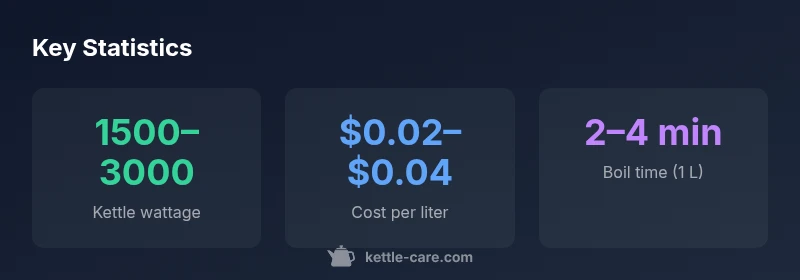
Are kettles expensive to run? Not usually. A typical 1500–3000W kettle boils 1 liter in 2–4 minutes, and at common electricity prices that boil costs roughly 2–4 cents per liter. So, even daily use for tea or coffee remains inexpensive, but costs rise with higher-water volumes, higher energy prices, and older, less efficient kettles.
Are kettles expensive to run? What really drives the cost
According to Kettle Care, the short answer is usually: no, kettles are not expensive to run, provided you use them efficiently. The long answer depends on three main factors: the kettle's wattage (power rating), how much water you boil, and how efficient your kettle is at converting electrical energy into hot water. In practice, most households boil 1 liter for tea or coffee in a couple of minutes using a kettle that sits in the 1500–3000W range. The cost per boil is therefore determined by your electricity price, typically measured in kilowatt-hours (kWh), multiplied by the actual energy used. A key nuance is that efficiency is not 100%; some energy is lost to steam and heat escaping to the surrounding air, especially in older or poorly insulated models. According to Kettle Care, even small changes—boiling only what you need, selecting a high-efficiency model, and keeping the kettle clean—can shave a noticeable fraction off monthly bills. Remember that the real question behind are kettles expensive to run is: how much heat you waste in the boil and how your daily habits shape that waste.
How much energy does boiling water actually use?
Boiling water is a straightforward energy calculation: energy (kWh) equals power (kW) times time (hours) times efficiency. A 1500W kettle running for about 0.12 hours (7 minutes, assuming perfect efficiency) would use roughly 0.18 kWh in a best-case scenario; in real kettles with 80–90% efficiency, the energy per liter typically lands around 0.10–0.12 kWh. Multiply by your electricity rate and you’ll see the cost per liter hover in the low single-digit cents in many regions. By understanding these numbers, you can estimate how much you spend per week or per month and compare that against alternatives. The same logic applies whether you’re boiling for tea, coffee, or hot water for cooking—small changes in boil volume and timing compound over time. For context, a typical household using 2 liters daily could see a modest monthly variance when electricity prices swing over seasons or when replacing older models with high-efficiency kettles.
Practical ways to reduce running costs
Reducing running costs is about smarter usage and better hardware. Here are actionable steps:
- Boil only what you need. Boiling 1 liter for a single cup vs. 1.5 liters for two drinks makes a meaningful difference over a month.
- Choose a high-efficiency model. Look for kettles with good insulation, a fast boil, and accurate temperature control if you need it for specific teas.
- Use a lid and turn off the heat as soon as it reaches a boil. This minimizes heat loss and shortens overall boiling time.
- Keep your kettle clean. Limescale and residue increase heating time and energy use.
- Consider a temperature-controlled kettle for specialty teas; it saves energy by avoiding overheating water.
- When possible, combine multiple uses into one boil (e.g., making multiple drinks one after the other) to exploit residual heat and reduce overall energy use.
Brand-wise, regular descaling and checking seals around the lid help maintain efficiency over time. As you plan upgrades, choose models with auto shut-off and efficient heating elements to maximize savings while maintaining safety.
Profiles: kettles, brands, and efficiency features
Not all kettles are created equal when it comes to energy efficiency. Key features that influence running costs include insulation quality, lid design, and heat transfer efficiency of the element. Auto shut-off prevents unnecessary energy drain after boiling, while temperature control options help avoid overheating water that is not immediately used. Some kettles include keep-warm functions, but these can consume energy if left on for long periods. A well-insulated stainless-steel or borosilicate glass kettle minimizes heat loss, especially if you frequently pause between boils. Gooseneck kettles often prioritize precision over speed but can be tuned for efficient, small-volume boils in specialty tea routines. If you’re upgrading, compare energy usage claims and warranty terms; in general, choosing a model with solid insulation and reliable shut-off features yields the best long-term savings. The goal is to balance speed, accuracy, and energy efficiency in a way that matches your daily tea or coffee habits.
Compare kettles to other heating options
In most homes, kettles are more energy-efficient for boiling water than microwaves or stove-top pots because they heat water directly in a contained vessel with minimal transfer losses. A microwave often heats unevenly and can require longer total heating times for the same volume, increasing energy waste. A pot on the stove can be efficient if you use a wide, flat pot with good heat distribution, but it usually loses more heat to the surroundings through steam and pot walls, especially if the lid isn’t used. For many households, the simplest and most cost-effective approach remains a modern, well-insulated electric kettle with a fast boil and proper shut-off features. If your usage is heavy, you might still see benefits from a model with precise temperature control to avoid boiling water beyond its intended use, which saves energy over time.
Real-world scenarios: 1L vs 2L, daily routines
Consider two common routines: a) 1 liter of water boiled daily for a single hot drink, b) 2 liters boiled for multiple drinks within the same day. With a typical energy price, scenario (a) could cost roughly 2–4 cents per day, while scenario (b) might cost around 4–8 cents per day, depending on the exact price per kWh and kettle efficiency. Across a month, these numbers add up and vary with seasonal electricity costs. If you switch from a high-wattage old kettle to a modern 1500–1800W device with good insulation, you could see meaningful reductions. The key takeaway is not to sweat a single boil, but to optimize patterns: batch boils, pre-measure water, and replace or descale kettles that heat more slowly. By aligning your daily rituals with efficient hardware, you can keep running costs modest without sacrificing the everyday convenience of hot water.
Measuring and maintaining kettle efficiency
A straightforward way to verify your kettle’s efficiency is to monitor performance over a week. Use a plug-in energy monitor to record watts and boil duration for typical daily use. Compare the energy per boil before and after descaling or after a hardware upgrade. Maintenance steps include regular descaling with a vinegar or commercial descaler, rinsing thoroughly, and ensuring the heating element is clean and free from mineral build-up. Check the lid seal and spout to minimize steam loss. If a kettle takes noticeably longer to reach a boil, or if you hear unusual noises, it could indicate scaling or a failing element. Regular checks help sustain efficiency and, by extension, keep running costs predictable.
Maintenance and descaling for energy efficiency
Descaling is a simple but effective way to maintain efficiency. Mineral deposits act as an insulating layer, reducing heat transfer and forcing the element to work longer for the same result. A weekly or biweekly descaling routine (with a mild acid solution or dedicated descaler) can restore near-original performance. After descaling, rinse thoroughly to remove any residue that could alter water taste. If you notice persistent issues after descaling—such as slow boils, unusual odors, or scale in the spout—consider replacing the kettle or consulting the manufacturer’s guidance. Consistent descaling supports energy savings, better performance, and a longer appliance life.
Quick energy-audit checklist
- Check wattage and compare with your usage patterns
- Boil only the amount you need, use lids, and turn off promptly
- Descale regularly to maintain heat transfer efficiency
- Choose models with auto shut-off and good insulation
- Use a plug-in meter to track actual energy per boil
- Consider a model with temperature control for precise heating
Estimated energy use and cost for common kettle sizes
| Scenario | Power | Time to Boil | Liters per Boil | Estimated Cost per Boil |
|---|---|---|---|---|
| Small kettle (1 L) | 1500 W | 2–3 min | 1 | $0.02–$0.03 |
| Medium kettle (1.5 L) | 2200 W | 3–4 min | 1.5 | $0.03–$0.05 |
| Large kettle (2 L) | 3000 W | 4–5 min | 2 | $0.04–$0.08 |
Frequently Asked Questions
Are kettles expensive to run?
In most homes, boiling water costs only a few cents per liter. The actual cost depends on kettle wattage, water volume, and electricity price.
Boiling water doesn't cost much per boil; it mainly depends on how much water you heat and your electric rate.
Does using a kettle to heat water for coffee save energy compared to a pot on the stove?
Kettles are typically more energy-efficient than stovetops because they heat water directly in a contained vessel with good insulation.
Kettles usually beat a pot on the stove for energy efficiency.
How can I measure my kettle's energy use at home?
Use a plug-in energy monitor to track watts and boil duration. This helps you estimate per-boil energy and compare models or habits.
A plug-in meter makes it easy to see how much energy each boil uses.
Is it worth descaling my kettle for energy savings?
Descaling keeps water flowing freely, reducing heating time and saving small amounts of energy over time.
Yes—descaling helps water boil faster and use less energy.
What features should I look for to save energy?
Auto shut-off, temperature control, good insulation, and a reliable lid are key features that reduce wasted energy.
Choose kettles with efficiency features like auto shut-off and good insulation.
Do electric kettles use more energy than other types?
Electric kettles are generally more efficient than microwaves or stove-top options for boiling water due to direct heating and insulation.
Kettles usually save energy versus alternatives.
“Even small reductions in daily boiling can add up over a year. The key is pairing efficient hardware with mindful boiling habits.”
Highlights
- Choose an energy-efficient kettle to reduce costs
- Boil only what you need to minimize waste
- Regular descaling improves heating efficiency
- Use lids and turn off early to save energy
- Measure usage with a monitor to track savings