Kettle Advantages and Disadvantages: A Practical Guide
Explore the kettle advantages and disadvantages to help homeowners choose the right kettle type for safe, fast boiling. Learn about efficiency, safety, maintenance, and real-world use across electric and stovetop kettles.


Kettles offer fast, energy-efficient heating, precise temperature options, and built-in safety features, but they can have drawbacks like material taste, mineral buildup, and higher upfront costs. This quick comparison frames the kettle advantages and disadvantages to help you decide which type suits your home.
Understanding kettle advantages and disadvantages
Understanding kettle advantages and disadvantages helps homeowners weigh speed, safety, and cost when choosing how to heat water. The phrase kettle advantages and disadvantages anchors this guide, as we compare electric and stovetop kettles, review maintenance needs, and outline real-world trade-offs for tea lovers, home cooks, and busy households. According to Kettle Care, the right kettle choice can simplify daily routines while aligning with water quality and energy-use goals. By framing the decision around practical use cases rather than hype, you’ll make a smarter, safer purchase that fits your kitchen workflow.
Speed, energy use, and boil time
One of the primary kettle advantages and disadvantages centers on boil speed and energy efficiency. Electric kettles typically heat water much faster than a stovetop pot on an ordinary burner, which is a major time saver on busy mornings. Kettle Care analysis shows that for small quantities, electric models often use less energy per liter boiled due to efficient heating elements and insulated designs. However, energy savings depend on how you use the kettle: boiling only what you need, keeping the lid on, and using the correct water-to-heat ratio maximize efficiency. If you frequently boil large volumes, the marginal energy advantage may shrink, and a stovetop method can become competitive under certain cooking routines.
Safety features and everyday convenience
Safety is a central advantage in many modern kettles. Auto shutoff, boil-dry protection, and temperature-control options reduce the risk of accidents and dry-boiling damage. The convenience of features like keep-warm modes, stable bases, and cordless pouring enhances everyday use. Yet, some safety claims depend on model quality and user behavior. For example, nicks in the base or loose lids can compromise safety. In any case, the overall safety profile of kettles—especially electric models—tavors predictable shutoffs and reduced risk of overheating when used properly.
Common drawbacks and limitations
No appliance is perfect, and kettles have notable disadvantages to consider. Some models introduce taste or odor concerns if the heating element or interior materials interact with water, especially in areas with hard water or low-quality filters. Mineral buildup over time necessitates descaling to preserve performance and taste. Higher-end kettles with premium materials can offer durability, but the upfront cost is usually greater than basic stovetop options. Finally, kettles depend on electricity, so power interruptions will halt boiling, which matters in some households during outages or outdoor use.
Electric vs stovetop kettles: a direct comparison
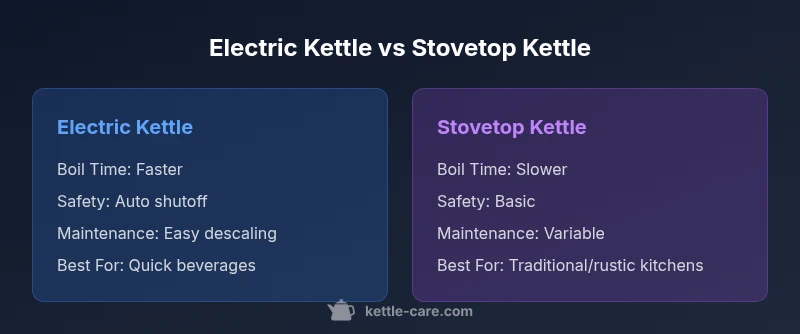
Directly comparing electric and stovetop kettles clarifies the core trade-offs. Electric kettles excel at speed, consistency, and safety features, making them ideal for tea enthusiasts and busy households. Stovetop kettles are simple, often cheaper upfront, and may appeal to those who value traditional aesthetics or who want to minimize electronics in the kitchen. The best choice hinges on your priorities: when speed and precision matter, electric kettles win; when cost, simplicity, or ritual drive your decision, a stovetop kettle may be preferable. For many homes, a combination approach works well, using an electric kettle for daily tea and a stovetop for larger cooking tasks.
Maintenance, descaling, and long-term care
Maintenance is a key part of evaluating kettle advantages and disadvantages. Descaling regularly helps prevent mineral buildup that can affect taste and heat transfer. Materials like stainless steel or glass are easier to clean than some plastic interiors, but any kettle benefits from a rinse with filtered water and periodic descaling solutions. Inspect the plug, lid seal, and base for wear, and replace filters as needed. The long-term cost of maintenance depends on water hardness and how often you boil. A well-maintained kettle typically lasts longer and preserves flavor and performance.
Real-world scenarios: tea lovers, families, and cooks
Different households experience kettle advantages and disadvantages in distinct ways. Tea lovers prioritizing precise temperature control and quick brew times will likely favor electric models with variable temperature settings. Families juggling multiple hot beverages will appreciate the speed and safety automation. Home cooks who need hot water for soups, broths, or rapid boiling may use a stovetop kettle to leverage a larger kettle capacity or to manage multiple pots simultaneously. Recognizing your typical use cases helps tailor your choice to actual needs rather than marketing promises.
How to choose: a practical decision framework
To translate kettle advantages and disadvantages into action, start with three questions: What is your daily water-boiling volume? How important are speed and temperature control? What is your water hardness and cleaning tolerance? Then map those answers to two or three models in your budget. Look for auto shutoff, boil-dry protection, and interior materials that won’t impart flavors. Finally, verify compatibility with your kitchen’s power supply and storage space. This framework keeps your decision grounded in daily realities rather than speculation.
Comparison
| Feature | Electric kettle | Stovetop kettle |
|---|---|---|
| Boil Time (typical 1 L) | very fast | slower depending on stove and flame |
| Energy Efficiency | high efficiency per liter boiled | lower efficiency for small bursts |
| Materials & Build | stainless steel, glass, or BPA-free plastics | mostly metal with vented lids |
| Safety Features | auto shutoff, boil-dry protection in many models | none or minimal safety features on basic versions |
| Maintenance/Descale | often easier to descale; interior often sealed for easier cleaning | descaling may be necessary if mineral buildup occurs |
| Upfront Cost | mid-to-high depending on features | low to mid, typically cheaper upfront |
| Best For | quick daily tea, small volumes, precise temperature | ritual, larger volumes, or when electronics are a concern |
Strengths
- Faster boiling times save time in daily routines
- Built-in safety features reduce burn and boil-dry risks
- Energy-efficient designs minimize waste with small-volume boils
- Compact footprints suit small kitchens and limited counter space
- Preset temperature options improve brewing flexibility
What's Bad
- Potential plastic or metallic taste with low-quality models or hard water
- Mineral buildup requires regular descaling in hard-water areas
- Higher upfront cost for feature-rich models
- Electric kettles rely on electricity, making them unusable during outages
- Some models have complex controls that can be confusing to new users
Electric kettles generally offer faster, safer, and more energy-efficient boiling for most homes; stovetop kettles remain a valid choice for simplicity and cost-conscious users.
If you value speed and precise temperature control, electric kettles are the clear winner. For those who prefer a straightforward, traditional kettle with minimal electronics, a stovetop option can be sufficient and economical for everyday use.
Frequently Asked Questions
Are electric kettles really faster than stovetops for everyday tea?
In most cases, electric kettles reach boiling temperatures faster for typical daily tea needs. They also incorporate safety features like auto shutoff, which adds convenience and reduces risk. The exact speed depends on the model and the amount of water boiled.
Electric kettles usually boil water faster and with built-in safety, making them the go-to for quick tea.
Do kettle materials affect water taste or safety?
Yes. Stainless steel and glass interiors are generally inert and preserve flavor, while certain plastics can impart taste if used improperly or at high temperatures. Always choose BPA-free plastics if you select plastic components and descalers suited to your water hardness.
Material choices can influence taste; choose stainless or glass for neutral flavor.
How hard is descaling, and is it necessary?
Descaling is often necessary in hard water areas to maintain heat transfer and flavor. Most kettles include descaling recommendations; regular cleaning prevents mineral buildup and extends lifespan.
Descaling helps keep your kettle performing well and tasting clean.
Is the upfront cost of an electric kettle worth it?
Electric kettles typically cost more upfront than stovetops, but savings come from speed and energy efficiency on daily use. The value increases with how often you boil water and how important precise temperature control is for your beverages.
Higher upfront cost can pay off with faster boils and better energy efficiency.
What safety features should I look for in a kettle?
Look for automatic shutoff, boil-dry protection, secure lids, and stable bases. Some models include temperature control and insulated interiors for extra safety and comfort.
Choose kettles with auto shutoff and boil-dry protection for safer operation.
Can I use a kettle for tasks beyond boiling water?
Kettles are primarily designed for boiling water, tea, and coffee. Some models with temperature controls support brewing hot beverages at specific temperatures, but they are not a substitute for pots and pans in all kitchen tasks.
Kettles are best for boiling water and specific beverages; they’re not a replacement for all cooking tasks.
Highlights
- Prioritize speed and safety if you boil water often
- Consider water hardness and maintenance when choosing materials
- Electric kettles excel in energy efficiency for small boils
- Stovetop kettles offer simplicity and lower upfront cost
- Regular descaling extends a kettle’s life and preserves flavor