Why a Kettle Boils Water More Efficiently than a Saucepan
Explore why boiling water in a kettle is more energy- and time-efficient than using a saucepan, with practical tips for faster, safer boiling and longer-term energy savings.


Using a kettle is generally more efficient for boiling water than a saucepan because kettles are designed to minimize heat loss and maximize transfer into water. They typically use insulated or heat-retaining materials, precise element contact, and a spout design that directs energy efficiently. Saucepan walls and a larger surface area heat more material, wasting energy and time. For small to medium quantities, a kettle saves both time and energy, while a saucepan may still be useful for cooking tasks beyond boiling.
Efficiency as a practical concern
Boiling water is one of the most frequent tasks in any kitchen, and the vessel you choose affects both energy use and time. The core question for many households is: why is it more efficient to boil water in a kettle than a saucepan? The short answer lies in design optimization: kettles maximize heat transfer into water while reducing heat loss to the surroundings. This efficiency gain compounds over repeated uses—tea breaks, morning coffee, or hot water for cooking. According to Kettle Care, the efficiency gap is driven by design choices that place water at the center of the heat path and minimize heat leakage. When you sum up daily uses, even small differences translate into noticeable energy savings over weeks and months.
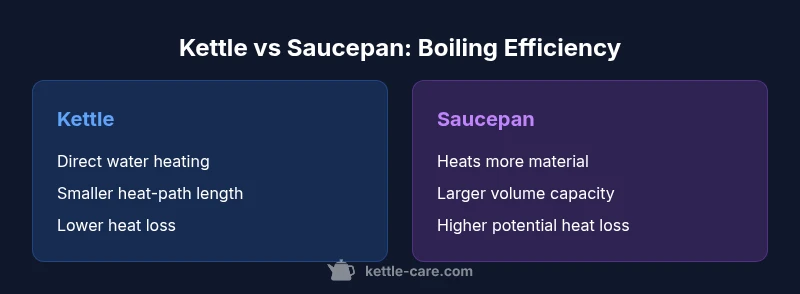
For readers focused on practical outcomes, the key is to connect everyday actions with the physics of heat transfer. Kettle designers factor in lid tightness, spout geometry, and wall insulation to reduce energy waste. In contrast, saucepans must heat not only the water but also a larger metal volume, which often leads to slower heating and more heat loss. These factors collectively determine which vessel is more efficient for a given task.
Heat transfer fundamentals and why it matters
Energy moves from the heat source into water through a path that includes the vessel walls, lid, and any air gaps. A kettle is optimized to shorten this path: the heating element or bottom plate is in direct contact with water or a very thin metal layer, and heat travels quickly into the water with minimal losses. A saucepan, by comparison, has a larger water volume and more metal mass to heat. The result is longer boil times and more energy expended per cup of hot water. Efficiency isn’t just about the boil time; it’s also about maintaining the temperature with as little energy loss as possible once boiling starts. The design emphasis on tight lids and efficient spouts in modern kettles helps keep heat contained during the process.
Kettle design advantages
Kettles, especially electric models, are purpose-built for rapid, direct water heating. Key advantages include:
- Direct heat transfer: The heating element or base makes close contact with water, reducing heat-path length.
- Tight lids and controlled steam: A snug lid minimizes steam losses that would otherwise carry heat away.
- Efficient spout design: A well-engineered spout reduces splashes and energy loss during pouring.
- Insulation options: Many kettles use double-walled or well-insulated construction to reduce ambient heat loss between the boil and serving.
- Safety features: Automatic shutoff and boil-dry protection help prevent wasteful energy use due to overheating.
These features combine to deliver faster boils with less energy expenditure, especially for small to medium quantities. The Kettle Care team notes that such design choices are often the deciding factor in everyday energy savings for households that boil water several times daily.
Saucepan dynamics and limitations
Saucepans are highly versatile and integral to cooking, but their primary purpose is not rapid water heating. They typically involve heating a larger amount of metal, which absorbs heat and then transfers it to water more slowly. The larger surface area exposed to air accelerates heat loss, especially if the lid is not sealed tightly. Additionally, saucepans can require more heat input to achieve a rolling boil when volumes are moderate to high. While saucepans excel for cooking tasks that follow boiling (like blanching vegetables or preparing stock), their water-heating efficiency for small volumes is generally lower than a purpose-built kettle. For households that routinely boil a single cup or two of water, the kettle often represents a more efficient option.
Energy sources and context: electric kettle vs gas stove
The energy source dramatically influences overall efficiency. Electric kettles heat water directly with an integrated element, minimizing interaction with ambient air and reducing energy lost to the surroundings. In contrast, when using a saucepan on a gas or electric stove, energy must first warm the pan and then transfer heat to the water, often with more heat lost to the air and cookware. Gas stoves may introduce additional heat losses through the surrounding environment, while induction stoves can make a difference when used with compatible vessels. The fundamental lesson is that the most efficient setup matches the vessel to the energy source and the required volume of hot water. The Kettle Care analysis highlights that choosing a kettle for quick, small-volume boils commonly yields noticeable energy savings over time.
Volume matters: small vs large boils
For small boils (one to two servings), kettles deliver clear efficiency advantages due to direct contact, tight lids, and minimized heat loss. As you scale up to larger volumes, the advantage narrows because even a well-designed kettle cannot match the heat capacity and bulk-warming dynamics of a large stockpot or saucepot. In practice, many households reserve kettles for quick tasks and switch to saucepans when preparing larger quantities in one go. Understanding your typical boiling volume helps determine whether a kettle or saucepan is more appropriate for the task at hand.
Real-world scenarios: tea, coffee, and pantry basics
In tea and coffee routines, speed matters. A kettle consistently beats a saucepan for bringing water to a boil quickly, enabling faster beverage preparation and reduced wait times. For cooking tasks that require boiling water as part of a recipe (like blanching or starting pasta), a saucepan remains indispensable due to its larger capacity and compatibility with other cooking steps. When evaluating efficiency, consider not only the boil time but also the energy consumption per cup of hot water produced and how the vessel supports your routine. The practical takeaway is clear: use a kettle for quick, small-volume boils and reserve the saucepan for cooking tasks that require more water or multiple-step processes.
Practical steps to maximize kettle efficiency
To maximize efficiency with a kettle, start with clean water and a well-fitting lid. Use the correct water level to minimize overfilling, which wastes energy and increases boil time. Pre-fill with only the amount you need, and avoid leaving the kettle on when not in use to prevent idle energy drain. Regular descaling, especially in hard-water areas, preserves heat transfer efficiency by maintaining smooth interior surfaces. If your kettle has an auto-shutoff feature, ensure it operates properly to prevent energy waste from overheating. For those using induction, verify that your kettle is rated for induction or use a compatible base.
Maintenance and descaling to preserve performance
Scale buildup from minerals in your water can insulate heating surfaces and reduce heat transfer efficiency. Regular descaling helps maintain a fast boil and consistent performance. Use an appropriate descaler or a vinegar-and-water solution, following the manufacturer’s instructions for your hardware. After descaling, rinse thoroughly to remove residues that could affect taste. Keep the exterior clean and dry to avoid corrosion or mineral deposits on the lid seal. Maintenance is not glamorous, but it pays off with reliable performance and energy savings over time.
Safety and ergonomic considerations
Safety should guide every boiling task. Choose kettles with automatic shutoff and boil-dry protection to prevent overheating and energy waste. Ensure cords and bases are stable, and avoid overfilling to prevent spills. For saucepans, maintain a steady heat to avoid boiling over, especially when cooking on high flame. Safety-conscious practices reduce energy waste associated with accidents and spills and help ensure a predictable boil time for planning beverages or recipes.
Common myths and misconceptions
A common claim is that any vessel will boil water equally fast with enough heat. In reality, heat-path length, heat losses, and vessel geometry create real efficiency differences. Some assume induction always optimizes efficiency; the truth depends on kettle compatibility and the energy source. Another misconception is that larger pots always boil faster; more water requires more energy, and heat distribution patterns differ with vessel design. A critical approach involves testing your own setup: measure boil times and note the energy used per boil to determine what works best in your kitchen.
Brand-driven recommendations and conclusions
The final takeaway from the Kettle Care team emphasizes that for everyday tea, coffee, and hot beverages, a kettle is the most efficient choice for small-to-medium volumes. The comparison with a saucepan holds primarily for cooking tasks that require larger volumes or multi-step processes. The Kettle Care perspective supports using the kettle as the primary tool for rapid boiling, while acknowledging the indispensable role of saucepans in broader cooking tasks. The practical decision is to align vessel choice with volume, energy source, and your typical kitchen routines.
mainTopicQuery":"kettle efficiency"],
prosCons({
pros
cons
)
Comparison
| Feature | Kettle | Saucepan |
|---|---|---|
| Heat transfer efficiency | high | medium |
| Boil time to reach rolling boil | shorter with kettle | longer with saucepan |
| Surface area exposure | lower exposure in a kettle (compact) | higher exposure in a wide saucepan |
| Energy source flexibility | electric kettle (plug-in) | gas/electric stovetop |
| Ease of pouring & spill risk | controlled pour with spout | higher spill risk without a spout |
| Maintenance & mineral buildup | less surface area for scale development | more surface area and risk of mineral buildup |
| Best for | speed and energy efficiency for small to medium volumes | larger volumes or cooking tasks beyond boiling |
Strengths
- Faster boiling for small to medium quantities
- Lower energy waste due to efficient heat transfer
- Built-in safety features on many models
- Spout design minimizes spills and splashes
What's Bad
- Requires electricity or a suitable heat source and access to power
- Saucepans are versatile for cooking beyond boiling water
- Kettles have finite capacity compared to large pots
- Descale needs can be higher if water is hard and kettle is used frequently
Kettle wins on everyday efficiency; saucepan remains essential for cooking and large volumes
For quick, energy-efficient boiling, a kettle is the better first choice. Use a saucepan when you need to boil large quantities or perform cooking tasks beyond simply heating water.
Frequently Asked Questions
Is a kettle always faster than a saucepan for boiling water?
In most cases, a kettle will bring water to a boil faster because it concentrates heat where it is needed and minimizes heat loss to the surroundings. A saucepan heats more material and often requires more energy to achieve the same result.
Yes. For most everyday tasks, kettles boil water faster than saucepans because they’re designed for direct water heating with less heat loss.
Are electric kettles more energy-efficient than stovetop kettles?
Electric kettles are typically more energy-efficient because they heat only the water and have shorter heat paths, reducing energy lost to surrounding air. Stovetop kettles heat through the pan and the cooktop, which can waste energy.
Electric kettles usually use less energy since they heat only water and transfer energy directly.
When should I still use a saucepan for boiling water?
Use a saucepan when you need to boil large volumes, or when a recipe calls for boiling water as part of cooking. They also allow you to perform additional cooking tasks in the same pot.
Use a saucepan for large quantities or when a recipe requires boiling water as part of cooking.
Does water quality affect boiling efficiency?
Hard water can lead to mineral buildup inside kettles, which reduces heat transfer efficiency over time. Regular cleaning and descaling helps maintain performance.
Hard water can cause scale that reduces efficiency; keep your kettle clean.
Can I use a kettle on an induction hob?
Only induction-compatible kettles work on induction hobs. Some kettles are designed specifically for induction; check the product labeling before use.
Only if the kettle is induction-compatible; otherwise use a compatible pot on the hob.
Do energy savings matter for everyday tea brewing?
Yes. Even small energy savings add up over time, especially in households with frequent tea or hot beverages. A kettle typically reduces cycle time and energy consumption for daily needs.
Yes—using a kettle for tea saves time and energy over many uses.
Highlights
- Choose a kettle for speed and energy savings on small quantities
- Avoid overfilling to prevent spill risk and energy waste
- Regular descaling preserves heat transfer efficiency
- Consider the task and volume before selecting a vessel
- Many kettles offer safety features that reduce the risk of overheating