Are kettle cooked chips better for you? A health comparison
Explore whether kettle cooked chips are better for you than standard chips, with nutrition insights, acrylamide considerations, and practical tips for healthier snacking. A comprehensive, analytic guide from Kettle Care.


Are kettle cooked chips better for you? In general, kettle cooked chips can be marginally better for certain snackers, thanks to thicker cuts and different frying methods that may reduce oil absorption and lower acrylamide formation. But the health impact varies by brand, portion size, and additional ingredients, so the choice isn’t a guaranteed healthy swap.
Are kettle cooked chips better for you? A practical health overview
According to Kettle Care, understanding kettle-cooked chips starts with the cooking method and ingredient quality. Our team notes that portion control and brand choice drive health outcomes as much as the cooking process. Kettle-cooked chips are defined by a batch frying approach that yields thicker slices and a distinctive crunch, which can influence how much oil your body absorbs with each bite and how long flavors stay on the palate. This section uses a health lens to set realistic expectations: kettle cooking alone does not automatically make chips a healthy snack, but it can favor certain dietary goals when combined with mindful choices.
How the kettle cooking method differs from standard frying
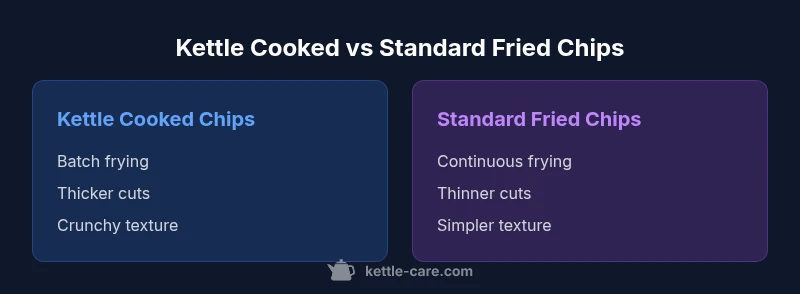
Kettle cooks use a batch frying process, often resulting in thicker-cut chips that spend less time in oil per slice compared to thin-cut, continuously fried chips. This difference can influence surface area, oil uptake, and how evenly heat is applied. The result is a chip with a robust crunch and potentially different flavor-absorption characteristics. However, the health impact depends on oil type, frying temperature, and the duration of fry. The Kettle Care team emphasizes that the method matters, but it is only one variable among ingredients, portion sizes, and total daily intake.
Nutrition and calories: qualitative differences you can expect
Nutrition labels vary by brand, but several qualitative trends emerge. Kettle cooked chips often carry a similar caloric range to standard chips per serving when cooked in the same oil, yet the per-bite experience can affect how quickly a person consumes a serving. Because kettle chips typically have a thicker cut, some people report feeling fuller on a smaller portion, while others snack more greedily due to the crunch. The key takeaway is to treat a serving as a portion rather than a free-for-all, and to compare fat and sodium per serving rather than relying on flavor alone.
Acrylamide risk: what the science suggests
Acrylamide forms in starchy foods when they are heated at high temperatures, including many fried snacks. The kettle cooking process can influence the formation of acrylamide through heat exposure and time in oil. Some batches show modest differences in acrylamide potential compared with standard frying, but the effect is not guaranteed and varies by brand and temperature control. The evidence supports cautious snacking rather than a simple “healthier” label.
Ingredient quality and salt levels
Ingredient quality matters more than the label alone. Many kettle cooked chips use refined vegetable oils and simple starch bases, but flavorings and added fats can vary widely. Salt levels depend on the brand’s seasoning strategy, which can swing sodium exposure per serving. If you’re watching salt, look for chips labeled as lower-sodium or with transparent, minimal-seasoning ingredients. When possible, choose products that disclose oil type and the exact fat content per serving, and be mindful of portion sizes to curb excess sodium intake.
Reading nutrition labels across brands
To compare kettle cooked vs standard chips, start with the serving size and then read calories, total fat, saturated fat, trans fat, and sodium per serving. Look for brands that use clearer ingredient lists and avoid marketing terms that obscure fat sources or added sugars. Consider the oil type; some blends use healthier alternatives, while others rely on palm oil or blends high in saturated fats. Also check for artificial flavors or preservatives that might influence the overall health impact beyond calories and fat.
Diet contexts: who might benefit from kettle chips
People seeking structured portions and craved crunch can benefit from kettle cooked chips when consumed mindfully. Those aiming to limit overall fat or sodium may still find kettle chips challenging due to serving-size creep. In mixed diets—where chips are paired with vegetables, fruit, or a protein source—kettle chips can fit as an occasional snack rather than a daily staple. The key is to align chip choices with personal dietary goals and to balance treats with nutrient-dense foods.
Practical tips to snack healthier without sacrificing taste
- Measure out a single serving rather than “snack from the bag.”
- Pair chips with high-protein or high-fiber foods to improve satiety.
- Choose kettle chips with transparent labeling and lower added salt or simpler seasonings.
- Prefer brands that disclose oil type and per-serving fat content.
- Use smaller bowls or plates to visually cue portion control.
How to choose kettle chips you can feel good about
When evaluating options, start with the basics: ingredient list, oil type, and serving size. Prioritize brands with short ingredient lists, unrefined oils if available, and realistic sodium targets. Consider third-party certifications or brand transparency as signals of quality. Remember that “healthier” is a relative term and depends on your overall diet and activity level.
Addressing myths: are kettle chips inherently healthier?
A common myth is that kettle cooking automatically lowers fat or calories. In reality, a kettle-cooked chip can still be high in fat and calories per serving, depending on the oil used and the length of frying. Another myth is that all kettle chips are low-sodium; seasoning choices vary widely across brands. The practical takeaway is to treat kettle chips as a snack option with nuanced health considerations rather than a universal health upgrade.
Trends and consumer guidance in 2026
The snack industry continues to experiment with healthier oil blends, cleaner labels, and portion-centric packaging. Consumers increasingly demand clearer nutrition data, minimal artificial additives, and options that align with specific dietary goals. Brand transparency and responsible marketing remain critical for informed choices in a crowded market.
A mindful snacking framework for kettle chips
- Start with a single-serving approach and portion-aware packaging.
- Read the label for oil type, fat, and sodium per serving.
- Compare brands on ingredient quality, not just taste or price.
- Balance chips with nutrient-dense foods to avoid patterning unhealthy snacking habits.
- Use chips as a treat within a broader, varied diet, not a daily staple.
Comparison
| Feature | Kettle Cooked Chips | Standard Fried Chips |
|---|---|---|
| Cooking Method | Batch fry via kettle process (thicker cuts) | Continuous fry (thinner cuts) |
| Oil absorption (qualitative) | Potentially lower per bite due to thicker cuts | Typically higher due to thinner cuts and longer oil contact |
| Acrylamide risk | Variable; can be reduced with temperature control | Variable; often depends on fry conditions and brand |
| Sodium levels | Similar ranges depending on seasoning | Similar ranges depending on seasoning |
| Texture preference | Thicker, crunchier bite | Crisper, lighter bite |
| Best for | Health-conscious snacking with portion control | Classic chip lovers seeking crunch |
Strengths
- Potentially lower oil uptake due to kettle processing
- Thicker cuts can be more satisfying in smaller portions
- Wide variety of flavors to choose from
- Crispier, robust texture appeals to many
What's Bad
- Still high in fat and calories per serving
- Acrylamide risk persists and varies by brand
- Brand variability can affect healthfulness
- Sodium levels can be high depending on seasoning
Kettle cooked chips can be a better option for some, but they are not inherently healthier.
Choose kettle cooked chips when you value portion control and texture, but verify ingredients and nutrition per serving. The overall health impact depends on oil, salt, and brand choices, not just the cooking method.
Frequently Asked Questions
Are kettle cooked chips healthier than standard chips?
Not automatically. The health impact depends on oil type, salt, and portion size, as well as brand specifics. Kettle cooking can offer practical advantages, but it does not guarantee a healthier snack.
Kettle cooked chips aren’t automatically healthier; read the label and watch portions to decide.
Do kettle cooked chips have less fat or fewer calories?
Nutrition varies by brand. Some kettle cooked chips may absorb less oil, but per-serving calories and total fat can be similar to standard chips depending on formulation.
Fat and calories per serving vary by brand, so check the label rather than assume a lower count.
What should I look for on nutrition labels?
Look for oil type, saturated fat, sodium, and the per-serving amounts. Prefer simple ingredient lists and transparent disclosures over vague marketing terms.
Check the oil, fat, and sodium per serving to gauge health impact.
Is acrylamide a concern with kettle chips?
Acrylamide forms during high-heat frying. Kettle cooking can affect its formation, but results vary by brand and temperature control. It’s wise to snack in moderation.
Acrylamide can form in fried foods; kettle chips may differ by brand, so moderation helps.
Can I make healthier choices with kettle chips?
Yes—choose lower-sodium options, watch portion sizes, and pair chips with nutrient-dense foods to balance the snack.
Yes, pick lower-sodium options and keep portions small for a healthier snack.
Highlights
- Compare per-serving nutrition, not just taste
- Prioritize brands with simple ingredients and known oil types
- Portion control matters more than chip type for health outcomes
- Balance snacks with nutrient-dense foods to maintain overall diet quality