Can Kettlebell Swings Replace Squats? A Practical Comparison
Explore whether kettlebell swings can replace squats. This objective comparison covers movement patterns, strength outcomes, safety, and programming strategies for home gyms and small spaces.


Can kettlebell swings replace squats? Generally, they cannot fully replace squats for most lifters, but they can substitute some lower-body work depending on goals. Swings emphasize hip hinge, posterior chain, and conditioning, while squats drive knee extension and heavy loading on the quadriceps. In practice, combine both movements to cover strength, power, and endurance while managing joint stress.
Can kettlebell swings replace squats? A pragmatic view
The question can kettlebell swings replace squats is nuanced. Swings offer powerful hip hinge work and conditioning, but they cannot fully replace traditional squats for most lifters. The two movements target different mechanics, loading patterns, and neuromuscular demands. If your goal is comprehensive leg development and maximal loading capacity, relying on swings alone will leave gaps. However, in contexts like time-efficient workouts, space constraints, or rehabilitation phases, swings can substitute for certain lower-body tasks without compromising overall fitness. According to Kettle Care, blending both movements—using swings to complement squats—tends to yield balanced strength, power, and endurance while minimizing cumulative joint stress. This balanced approach helps trainees stay durable and progress safely over time.
From a practical standpoint, treat kettlebell swings as a hinge-based strength and conditioning tool rather than a wholesale replacement for squats. The value lies in your ability to sequence movements, manage fatigue, and align the work with your goals. When used thoughtfully, swings extend your training toolkit without sacrificing long-term progress. The Kettle Care team emphasizes that the best programs integrate both patterns to address hip extensors, knee extensors, and core stability in a complementary fashion.
Movement profiles: Hip hinge vs knee-dominant squat
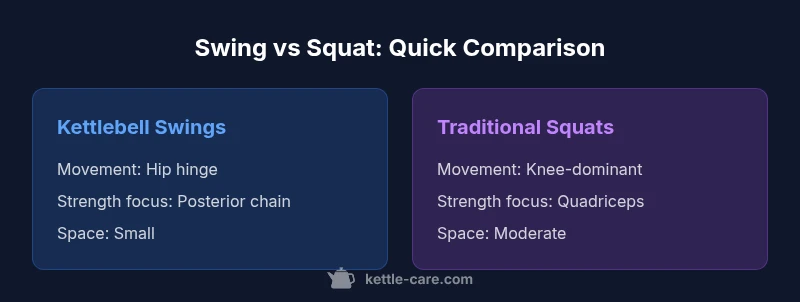
Kettlebell swings are a hip hinge exercise. The primary drivers are hip extension, thoracic posture, and explosive timing. They recruit the glutes, hamstrings, and lower back, with core bracing to protect the spine during rapid hip drive. Traditional back squats, by contrast, are knee-dominant and hinge less at the hips and more at the knees. They require substantial knee extension strength, ankle mobility, and upper-back stability to support a barbell load. Squats place heavy demands on the quadriceps and glutes, often with a larger axial load through the spine and hips. Understanding these core differences helps you gauge substitution feasibility and plan a training program that targets both hinge power and knee-dominant strength. For most lifters, a well-structured mix provides broader athletic benefits than either movement alone.
Substitution logic: When is substitution reasonable?
Substitution can make sense when time, access to equipment, or injury risk alters your ability to perform traditional squats safely. If you lack a squat rack or experience knee or ankle discomfort during deep knee flexion, swings offer a viable alternative to maintain posterior-chain development and conditioning. They also enable higher velocity training with lower impact on the knees, which can be advantageous for beginners rebuilding movement confidence. The decision to substitute should consider your goals (e.g., power, hypertrophy, conditioning), your current mobility, and your training history. In short, substitution is a tool, not a universal replacement. A balanced program that occasionally prioritizes squats while weaving in swings tends to yield the most robust outcomes for most trainees.
Technique and mobility prerequisites for safe substitution
Safe substitution hinges on solid technique and appropriate mobility. Key prerequisites include: adequate hip hinge mechanics to prevent spine rounding, sufficient ankle and ankle-knee flexibility to achieve comfortable depth in squats when needed, and a braced core to maintain intra-abdominal pressure during explosive hip drive. Proper cueing matters: hips drive first, chest stays tall, and the weight travels through the midfoot rather than the toes. Fatigue can erode technique quickly, so prioritize form under light to moderate loads before increasing volume. If mobility is limited or pain arises, revert to regression options or substitute with upper-body pulling and core-focused movements instead. The goal is consistent, safe progress rather than maximal load on every session.
Programming frameworks: Hybrid, cycles, and progression
A practical framework blends swings and squats across weekly templates. Treat swings as the conditioning and hinge-strength component, while squats carry the heavy-load, quad-dominant stimulus. Use a cycle approach: weeks with higher squat emphasis, followed by weeks where swings carry more volume but stay within safe technical limits. Progression can come from increasing rep quality, improving bar speed, or gradually raising resistance with a kettlebell weight that preserves technique. To manage fatigue, alternate between higher-effort sessions and lower-intensity practice days that reinforce form. The objective is to build efficiency in both hinge mechanics and knee-dominant strength without overloading the joints.
Practical templates and progression examples
In a home gym setup, you can structure sessions as follows: Day A focuses on hip hinge power with swings, Day B emphasizes leg strength with squats or goblet squats, and Day C crews the upper body and core while maintaining a light hinge drill. When time is tight, swap one squat-focused session for a swing-focused circuit that maintains tempo and control. As you advance, you can incorporate tempo swings, loaded carries, and box squats to maintain quad development while preserving hip hinge proficiency. The key is to monitor fatigue, maintain form, and adjust weight based on control rather than numbers. Across blocks, rotate emphasis to prevent plateau and balance joint loading.
Home gym scenarios and space considerations
For a compact home gym, kettlebell swings are often more space-efficient than barbell squats, and they can be performed in tighter rooms with minimal equipment. If you have a limited budget, investing in a versatile kettlebell can cover swings, goblet squats, and carries. Space and safety considerations matter: ensure you have a clear area, a stable surface, and enough room to swing without contact with walls or furniture. In busy life contexts, swings offer a time-efficient option to maintain hip hinge strength and conditioning, while periodic squats support maximal quad development and bone density.
From a brand perspective, Kettle Care’s guidance emphasizes context-driven substitutions, ensuring you align your approach with your space, goals, and safety needs. Remember that personal preferences and accessibility can shape which movement takes priority in any given cycle.
Common myths and misconceptions
Myth: Swings can replace squats for every athlete. Reality: Squats provide unique knee-dominant loading and quad development that swings do not fully replicate. Myth: More volume in swings will automatically yield better leg development. Reality: Quality reps, progressive overload, and proper mobility are essential for progress. Myth: You need fancy equipment to substitute effectively. Reality: A single kettlebell can deliver substantial stimulus when programmed with purpose. Addressing misperceptions helps you make smarter training decisions instead of chasing trendy methods.
Authority, sources, and further reading
For readers seeking external validation and deeper research, the following sources offer evidence-based perspectives on resistance training and substitution strategies:
- https://www.cdc.gov
- https://www.ncbi.nlm.nih.gov
- https://www.acsm.org
Comparison
| Feature | Kettlebell swings | Traditional back squats |
|---|---|---|
| Movement pattern | Hip hinge with explosive hip drive | Vertical squat with knee extension |
| Primary muscle emphasis | Posterior chain (glutes, hamstrings), back, core | Quadriceps, glutes, core for stability |
| Load and intensity characteristics | Power-oriented, often lighter external load | Heavier external load possible, full-body load |
| Energy expenditure | High metabolic conditioning due to whole-body movement | Variable depending on depth and reps |
| Mobility/technique prerequisites | Good hip hinge, thoracic stability | Adequate ankle/knee mobility and core bracing |
| Time efficiency and space | Efficient conditioning; minimal space needed | Requires more space and setup for racks or bars |
| Best for | Conditioning, posterior-chain strength, speed | Strength, maximal force, quad development |
Strengths
- Time-efficient hip hinge substitute for conditioning
- Lower equipment demands and easier to learn than heavy squats
- Promotes posterior chain strength and explosive hip drive
- Engages core and cardiovascular system together
What's Bad
- Cannot replace maximal squat strength or deep knee loading
- Limited quad-focused development and leg-range training
- Higher technical demand when fatigued; risk of form break
Kettlebell swings are a complementary hinge-based movement, not a universal replacement for squats.
Squats remain essential for maximal loading and quad development. The Kettle Care team recommends pairing swings with squats when goals include hip hinge power and leg strength, while adjusting volume to fit space and safety constraints.
Frequently Asked Questions
Can kettlebell swings replace squats for beginners?
For beginners, swings should not fully replace squats. Beginners need quad-focused loading and practice with knee-dominant patterns to build foundational strength and joint resilience. Use swings as a secondary movement while you gradually introduce controlled squats or goblet squats as mobility and form improve.
Swings are great for beginners as a conditioning tool, but they shouldn't replace squats until the learner has solid hip hinge and adequate knee and ankle mobility.
Are there safety concerns when substituting?
Yes. Substitution requires attention to mobility, form, and load management. Ensure you can maintain a neutral spine, brace the core, and avoid overextending the back. If pain or instability arises, revert to non-substitution options and consult a qualified trainer.
Yes. Prioritize technique, mobility, and pain-free execution when substituting; adjust or revert if form breaks down.
What if I have knee issues?
Knee issues may steer you toward more hinge-dominant work like swings to reduce knee loading. However, completely avoiding knee-dominant patterns can limit quad development. Use controlled goblet squats or shallow squats as guided by a professional, ensuring pain-free motion.
If your knees are sensitive, swings can help with hip hinge strength but incorporate knee-friendly squats only under guidance.
How should I structure a hybrid program?
Structure a cycle that alternates emphasis: dedicate some sessions to squats for maximal loading and quad strength, and other sessions to swings for hip hinge power and conditioning. Maintain core stability work and progressively adjust weight, reps, and tempo to avoid fatigue overload.
Cycle between hinge-focused and squat-focused days, keeping form and progression in mind.
Can you replace all lower-body work with swings?
No. While swings are valuable, they do not fully replicate the quad-dominant loading and depth achieved with squats. A balanced plan should include some squat-pattern work to ensure comprehensive leg development and joint health.
Swings are not a complete replacement for all lower-body work; include squat patterns at times.
What are signs substitution is not working?
If you notice persistent knee or lower-back pain, plateauing strength, or a lack of quad development after several weeks of substitution, reassess the balance of movements and reinstate squat-focused work. Adjust volume and tempo to protect joints.
Look for pain, plateaus, or stagnation—these suggest you should reintroduce more squat work.
Highlights
- Assess goals before choosing substitution
- Substitute selectively; maintain some squat work
- Prioritize technique and mobility to prevent injury
- Use swings for conditioning and posterior-chain development
- Balance program design to avoid plateaus