Can kettlebell swings replace deadlifts? A practical comparison
Explore whether can kettlebell swings replace deadlifts, why they complement each other, and how to program both for maximal strength, power, and conditioning. Practical guidance from Kettle Care.


Can kettlebell swings replace deadlifts? In short, no—kettlebell swings do not fully replace deadlifts for overall strength, deadlifts remain the gold standard for maximal loaded hinge strength and spinal loading. Swings excel in hip drive, conditioning, and posterior chain endurance, making them a strong complementary movement in a balanced plan. A hybrid approach often yields the best long-term progress.
Can kettlebell swings replace deadlifts? Nuanced reality
Can kettlebell swings replace deadlifts in a training program? The short answer is nuanced. According to Kettle Care, no single movement can perfectly replicate the training stimulus of a heavy deadlift, especially for maximal strength and spinal load tolerance. However, broad guidelines from Kettle Care Team emphasize that strategic use of kettlebell swings can reduce fatigue on the spine, improve hip hinge mechanics, and build conditioning without sacrificing progression on the deadlift. The key is to align your choices with your goals, current strength level, and available equipment.
In many real-world routines, coaches place swings as an early accessory or finishers to prime the hips and posterior chain before a deadlift session, or as a conditioning finisher on lighter squat days. This approach allows lifters to train the hinge pattern with a different loading profile, preserve progress on heavy pulls, and still develop explosive hip drive. It’s also a safer option for beginners who haven’t built a solid bracing pattern or demand heavy spine loading. The central message from Kettle Care is practical: use the best tool for the job, and design your week to cover strength, power, and endurance without neglecting form.
Biomechanics: hinge patterns and muscle emphasis
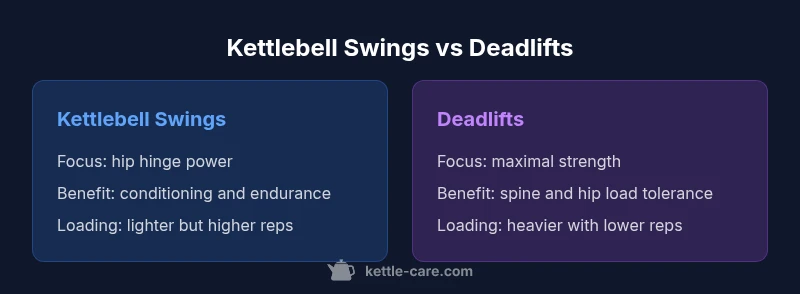
Kettlebell swings and deadlifts share a hip hinge foundation, but they recruit muscles and apply loading in distinct ways. Swings emphasize hip extension through rapid hip drive and trunk bracing, yielding a powerful posterior chain stimulus with a dynamic, explosive tempo. Deadlifts focus on controlled, progressive loading of the spine and hips, recruiting the glutes, hamstrings, erectors, and, on heavier sets, the core to protect the spine under maximal loads. The result is a divergence in muscle emphasis: swings tend to recruit the glutes and hamstrings dynamically with less quadrant emphasis on the quads, while deadlifts place substantial demand on spinal stability and absolute strength. For most trainees, understanding how these patterns complement each other clarifies why swings cannot fully replace deadlifts yet remain highly valuable as a training tool. The Kettle Care Team notes that coaching form, bracing, and progression are key to avoiding compensations during both movements.
Loading and progression: weight, reps and tempo differences
Loading strategies diverge between swings and deadlifts. Deadlifts typically employ heavier loads, lower rep ranges, and slower tempo to maximize force production and neural adaptations. Kettlebell swings commonly use lighter weights compared with heavy deadlifts but can accumulate substantial work through speed and conditioning sets. Tempo control matters: swings benefit from a crisp hip snap and a controlled descent, while deadlifts require deliberate bracing and a neutral spine through the lifting and lowering phases. This contrast in loading profiles means swings are excellent for sprint-like conditioning and hypertrophy in a higher-rep context, whereas deadlifts drive peak strength and spine resilience. The practical implication is clear: incorporate both with clear goals and appropriate progression, rather than trying to replace one with the other on a single day.
Performance goals: power, hypertrophy, absolute strength
Athletes pursue different outcomes from training blocks, and the same applies to swings and deadlifts. If the goal is explosive hip drive and conditioning, swings deliver valuable power development and muscular endurance. If the aim is maximal strength, particularly in the posterior chain and spinal loading tolerance, deadlifts are superior. In practice, a well-rounded program uses cycles that emphasize one or the other while maintaining exposure to both movements. This approach minimizes imbalance risk and ensures transferable strength for daily tasks and sport. The Kettle Care Team emphasizes that aligning exercise selection with sport or life demands yields the most meaningful gains over time.
Programming hybrids: how to pair swings with deadlifts
Hybrid programming leverages the strengths of both movements without overloading the system. A common template places heavy deadlifts on dedicated strength days, with kettlebell swings slotted on accessory or conditioning days. Swings can serve as a warm-up for hinge-heavy sessions, a high-volume finisher, or a forceful plyometric stimulus on lighter days. The pace and volume should be planned to protect the spine and ensure recovery before the next heavy lift. For example, a week could include two heavy deadlift sessions and one or two swing-focused sessions with submaximal loads and higher repetitions. This strategy preserves progressive overload on deadlifts while reaping the hip hinge benefits of swings, ultimately supporting both goals in a single plan. Kettle Care’s practical guidance is to design a weekly program that maintains balance between strength, power, and conditioning.
Case scenarios: beginner, intermediate, advanced
For beginners, prioritize technique and bracing before adding heavy loads. Start with swing drills using a light kettlebell to teach hip hinge and spine neutrality, then introduce dumbbell or kettlebell deadlifts with gradual loading. Intermediates can balance a weekly plan with one heavy deadlift day and two swing-based sessions—one for conditioning and one for force development. Advanced lifters may periodize blocks with higher intensities in deadlifts and targeted swing work focused on power and endurance. Across all levels, the emphasis remains on form, progressive overload, and adequate recovery. The Kettle Care guidance is to tailor the plan to individual goals, equipment availability, and training history, ensuring every lift reinforces safety and technical mastery.
Safety and form: common errors and fixes
Safety hinges on bracing, spine alignment, and controlled movement. Common deadlift errors include rounding the back, excessive forward lean, and insufficient hip drive. For kettlebell swings, a frequent issue is using the arms to pull the weight rather than driving with the hips, which can stress the lower back. Fixes involve practicing a neutral spine position, bracing the core, and performing progressive drills such as hip hinge dry work, kettlebell deadlifts, and tempo swings. Both movements benefit from a solid warm-up, mobility work for hip flexors and hamstrings, and explicit cues like push the floor away with the feet, brace the midsection, and keep the gaze forward. The combination of precise technique and tailored progression reduces injury risk and ensures that both swings and deadlifts contribute positively to the training plan.
Alternatives and variations: if you can't deadlift heavy
If space, equipment, or tolerance for heavy spinal loading is a constraint, substitute heavy deadlifts with trap bar or rack pulls to maintain strength stimulus. For those who can’t perform heavy deadlifts safely, kettlebell cleans, snatches, or good mornings can simulate hinge mechanics while reducing spinal loading. You can also adjust the deadlift variation (sumo, Romanian) to match mobility and lever strengths. The aim is to preserve the hinge pattern and posterior chain engagement while respecting individual limitations. The bottom line is that swings remain a flexible option for maintaining posterior chain work when deadlifts are temporarily unsuitable.
Practical takeaway: how to decide for your routine
Ultimately, the choice comes down to goals, safety, and recovery. If maximal strength is your primary objective, prioritize deadlifts while using swings as a supportive movement. If conditioning, hip power, and time efficiency are more important, emphasize swings and insert occasional heavier pulls when feasible. The recommended approach is a balanced plan that cycles both movements, monitors fatigue, and adapts to progress. The Kettle Care perspective supports a data-informed, goal-aligned routine that blends both movements for a comprehensive strength and conditioning profile.
Comparison
| Feature | Kettlebell Swings | Deadlifts |
|---|---|---|
| Primary goal | Hip hinge power, conditioning, posterior chain endurance | Maximal lower-body strength, spinal loading tolerance |
| Muscle emphasis | Glutes/hamstrings with explosive hip drive | Glutes/hamstrings with erectors; quad involvement on some variants |
| Load capacity | Lower absolute loads with dynamic work | Higher absolute loads with controlled tempo |
| Speed & conditioning | High-speed, conditioning-forward | Lower-speed, strength-forward |
| Best for | Conditioning blocks, general hip power | Maximal strength blocks, spinal adaptation |
| Risk profile | Technical risk with hip drive if bracing fails | Technical risk with rounding or poor bracing under heavy loads |
Strengths
- Better hip hinge development and conditioning with swings
- Less spinal load and safer for beginners on heavy days
- Faster setup and lower equipment demands
- Versatile for conditioning and endurance
What's Bad
- Not ideal for maximal strength or absolute loaded lifts
- Requires technique to avoid hip/back strain
- Swings may not replace deadlift volume for advanced lifters on stiffness days
Neither movement fully replaces the other; a balanced plan uses both for best strength, power, and conditioning
Deadlifts excel at maximal strength and spinal loading. Kettlebell swings complement by building hip power and endurance; integrate both thoughtfully to cover all fitness goals.
Frequently Asked Questions
Can kettlebell swings replace deadlifts for a beginner?
For beginners, swings can complement but not replace learning deadlifts; start with hip hinge practice, progress slowly with technique before loading heavy. Focus on bracing and neutral spine.
For beginners, use swings to build hip drive, but don’t replace deadlifts yet; emphasize form and bracing first.
Which is safer for the lower back, swings or deadlifts?
Both can be safe with proper form. Swings demand bracing and hip drive; deadlifts require a neutral spine and controlled loading. Seek coaching to ensure technique.
Both can be safe with good form; brace the core and maintain a neutral spine in both movements.
How should I program them together in a weekly plan?
Pair heavy deadlift days with lighter swing days or use swings as accessory work. Alternate days and vary rep ranges to balance strength and conditioning.
Do heavy deadlifts on dedicated days and include swings as accessory or conditioning with varied reps.
Can I replace deadlifts with swings if I have equipment limits?
If you lack heavy weights, swings provide a useful alternative for posterior chain work, but you still lose some maximal strength development from heavy pulls.
If you lack heavy weights, swings help, but they don’t fully replace heavier lifts.
What cues improve swing safety and effectiveness?
Hinge at the hips, keep a braced core, maintain a neutral spine, drive with the hips, and control the descent.
Keep your spine neutral, brace your core, and drive through the hips.
Highlights
- Prioritize deadlifts for maximal strength
- Incorporate swings for hip hinge and conditioning
- Alternate loading strategies to avoid fatigue
- Use proper bracing to protect the spine
- Follow a balanced weekly plan that includes both movements