Kettlebell Swing vs Deadlift: A Practical Comparison
Analytical comparison of kettlebell swing and deadlift, covering biomechanics, muscle targets, programming, safety tips, and how to choose the right move for your goals.


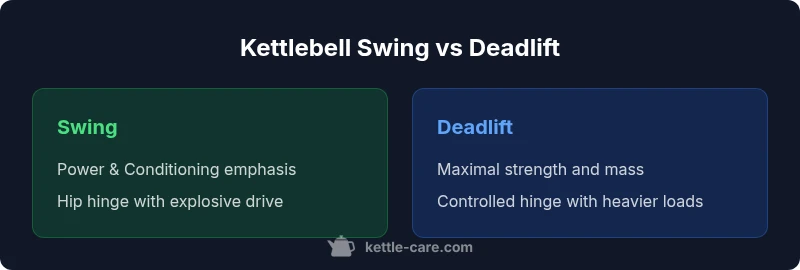
The kettlebell swing vs deadlift debate centers on purpose and outcome. The kettlebell swing emphasizes explosive hip drive, power, and conditioning, while the deadlift prioritizes maximal strength and posterior-chain development. Both moves share a hinge pattern, but selecting one (or both) should hinge on your goals, available equipment, and training age.
Overview: kettlebell swing vs deadlift
Understanding kettlebell swing vs deadlift is essential for building a safe, efficient home workout plan. Both movements hinge at the hips and recruit the posterior chain, but they serve different aims. The swing is a ballistic hip-dominant lift designed to improve power, conditioning, and movement economy, while the deadlift is a loaded, controlled hinge that maximizes force production and muscle mass. According to Kettle Care, integrating both lifts into a balanced program often yields faster progress and safer gains by distributing loads across different movement speeds and tempos. For most homeowners, starting with the basic double-handed swing and a conventional deadlift progression can establish a solid foundation before expanding to variations.
Biomechanics: hip hinge dynamics
The hip hinge is the cornerstone of both movements, yet the mechanics diverge in tempo, range, and intent. In a kettlebell swing, the hips powerfully extend to propel the bell into a vertical trajectory, followed by a controlled deceleration through the hip and glute complex. The spine stays neutral, and the power comes from hip drive rather than upper-back strength alone. In a deadlift, the hinge is more restrained and loaded through a longer range of motion with heavier absolute loads. The spine remains neutral, the hips and knees coordinate to lift the weight from the floor, and the velocity is slower. This distinction matters for programming and injury risk management, especially for new lifters.
Muscle targets and movement patterns
Kettlebell swings recruit the glutes, hamstrings, lower back, core, and shoulder girdle as stabilizers, with power generation concentrated in the hip hinge. Deadlifts place greater demand on the posterior chain as a whole, including the glutes, hamstrings, spinal erectors, and lats, with a more substantial upper-body involvement to brace and pull the load. Both lifts recruit grip strength and core bracing, but the swing emphasizes speed and propulsion, whereas the deadlift emphasizes load and control. This contrast makes the swing highly effective for conditioning and athletic carryover, while the deadlift excels at raw strength and hypertrophy development.
Training goals and programming implications
Choosing between swing and deadlift depends on your objective. If your goal is explosive power, metabolic conditioning, and time-efficient workouts, the swing delivers a lot in a short window. If maximal strength, muscle hypertrophy, or rehabilitation of the posterior chain is your aim, the deadlift should be prioritized. A well-rounded program often uses both: the swing for power days and conditioning, and the deadlift for heavy-lift days and strength growth. The Kettle Care approach suggests cycling emphasis across mesocycles to avoid plateau and to maintain joint health through varied loading patterns.
Safety fundamentals and common mistakes
Quality technique is non-negotiable with both moves. In swings, the most common errors are using the arms to lift the bell, letting the lumbar spine hollow or round, and failing to brace the core during hip extension. In deadlifts, rounding the back, a weak brace, or a misaligned grip can lead to back strain. Breathing, bracing, and maintaining a neutral spine are critical. Starting with light loads and mastering hip hinge mechanics before increasing load is essential. The brand guidance from Kettle Care emphasizes controlled progression, especially when integrating both movements into a single session.
Progressions and regressions for learners
For beginners, regress swing mechanics to a two-handed hip hinge with a light bell, focusing on hip drive and swing arc, then progress to a one-handed variation as comfort grows. For the deadlift, begin with a kettlebell Romanian deadlift or a sumo stance with light resistance to refine bracing and hip hip-hinge control. Once technique is solid, gradually increase resistance or volume. Advanced lifters can add variations like single-arm swings or deficit deadlifts to address specific goal-related weak points.
Weight selection, loading, and programming considerations
Weight should be determined by task: lighter loads for technique and conditioning, heavier loads for strength emphasis. For swings, common practice uses moderate weights that permit 8–20 reps with controlled form, while deadlifts use heavier weights in sets of 3–6 reps. Progression should be gradual, with a focus on technique before adding load. In practice, a weekly plan often alternates swing-focused conditioning days with heavier deadlift days to balance performance and recovery. Remember, the goal is sustainable progress, not ego lifting.
Four-week sample programming template
Week 1: 3 workouts focusing on form and light loads. Swing 3x12 (technical tempo), Deadlift 3x5 (moderate weight). Week 2: Increase reps for swings to 3x15; Deadlift 4x4 with a small load bump. Week 3: Introduce tempo work—2–0–1–0 on swings and 2–0–2–0 on deadlifts. Week 4: Deload week with lighter loads and volume. This progression supports safe adaptation and reduces injury risk while enabling strength and conditioning gains. The emphasis remains on technique and consistency.
Variations and substitutions by goal
If conditioning is the priority, prioritize swings with light to moderate loads; for strength, swap some swing work with heavy deadlifts or rack pulls. You can substitute one-arm swings for double-arm swings to address asymmetries. For athletes, incorporate swing-based complexes (e.g., swing to clean to squat) to cultivate power endurance while maintaining joint health.
Integrating swings and deadlifts into a full-body plan
A balanced plan includes pushing, pulling, squatting, and hinge patterns. Pair kettlebell swings with upper-body presses or rows, and schedule deadlifts with lower-body or posterior-chain–focused accessory work. A typical week might include a power/conditioning day (swings), a strength day (deadlifts), a push day (presses), and a pull day (rows). The integration should respect recovery and individual response to loading.
Common troubleshooting and tips for longevity
If you experience back discomfort, recheck your hip hinge, core bracing, and belt or brace usage. Mobility limitations in hips or hamstrings can affect form; address those with dedicated mobility work. Consistency and gradual progression protect longevity, as does coaching feedback to ensure safe technique. Keep the spine neutral and the glutes active during both movements to reduce strain.
Long-term perspective: durability and progression
Treat swing and deadlift mastery as long-term goals. Periodize programming to rotate emphasis across cycles, maintain movement variety, and prevent boredom or stagnation. Prioritizing technique first, then gradually increasing load and complexity, supports both performance and safety over years of training. From a longevity standpoint, a thoughtful blend of swing-based conditioning and deadlift strength sets the foundation for sustained health and functional fitness.
Comparison
| Feature | Kettlebell Swing | Kettlebell Deadlift |
|---|---|---|
| Primary purpose | Power, conditioning, and hip drive | Maximal strength and posterior-chain development |
| Muscle emphasis | Glutes, hamstrings, lower back, core; posterior chain emphasis with explosive hip extension | Glutes, hamstrings, spinal erectors, lats; heavy load through controlled hinge |
| Biomechanics tempo | Explosive, ballistic hip extension with rapid hip-to-bell sequence | Controlled hinge with slower concentric and eccentric phases |
| Load patterns | Moderate to high velocity with lighter to moderate loads | High force with strategic loading for strength gains |
| Typical rep ranges | 8–20 reps per set depending on goal and tempo | 3–6 reps per set for maximal strength, higher with volume work |
| Technical difficulty | Moderate to high; technique and timing are critical | Moderate to high; setup, bracing, and spine control essential |
| Equipment/space needs | Single kettlebell, minimal space, easy to perform in most homes | Kettlebell with stable flooring; more space required for safe setup |
| Best for | Power, conditioning, and fat-loss oriented goals | Strength, hypertrophy, and posterior-chain development |
| Time efficiency | High metabolic demand in short sessions | Longer, slower sets with heavier loads |
Strengths
- Efficient full-body conditioning with swings
- Builds maximal strength and posterior-chain with deadlifts
- Requires minimal equipment and space
- Scalable from beginner to advanced levels
What's Bad
- Swing technique can be compromised leading to back strain if form breaks
- Deadlift requires proper setup to avoid lower back strain if misloaded
- Swing may be limited by kettlebell weight and rhythm for heavier goals
- Both moves demand consistent core bracing and coaching for safety
Swing and deadlift complement each other for balanced training
Use swings to maximize hip power and conditioning, and deadlifts to build raw strength. A combined approach typically yields superior overall posterior-chain development and safer, more durable fitness.
Frequently Asked Questions
What is the key difference between kettlebell swing and deadlift?
The swing is a fast, hip-drive movement focused on power and conditioning, while the deadlift is a slower, heavier lift focused on maximum strength and muscle development. Both hinge at the hips but serve different athletic qualities.
The main difference is speed and load: swings are explosive and conditioning-oriented; deadlifts are strength-oriented.
Which should I learn first as a beginner: swing or deadlift?
Prioritize a solid hip hinge and braced spine. Start with light swings to master form and then introduce a deadlift progression, ensuring safe mechanics before heavy loading.
Start with basic hip hinge and light loads, then add deadlifts as you build technique.
Can swings substitute for deadlifts in a program?
Swings can substitute for conditioning days, but they do not replace heavy deadlifts when the goal is maximal strength or hypertrophy. Use both for complementary adaptations.
Swings complement, but don’t fully replace heavy deadlifts for strength.
Which muscles do kettlebell swings target?
Primarily the glutes, hamstrings, and lower back, with core and shoulder stabilizers playing a supporting role. The deadlift places even greater demand on the posterior chain and lats.
Swings hit hips and back; deadlifts work the whole posterior chain, including the back and hips.
How heavy should my kettlebell be for each move?
Weight should align with your goal and experience. Start light to master technique and gradually increase load as form and confidence improve.
Choose weight based on form first, then slowly progress.
What are common mistakes and how can I fix them?
Common issues include rounding the back in deadlifts and arm-dominant swings. Fix by bracing the core, maintaining a neutral spine, and focusing on hip hinge quality with a coach or video feedback.
Keep a solid spine, brace core, and hinge from the hips.
Highlights
- Define goals to choose swing or deadlift emphasis
- Prioritize technique before increasing load
- Incorporate both moves for balanced posterior chain development
- Progress gradually with weight and reps
- Emphasize hip hinge mechanics and bracing
- Scale with variations to suit experience