Can You Boil Eggs in a Kettle? Safe Step-by-Step Guide
Explore whether you can boil eggs in a kettle, with safety guidelines, equipment tips, and a clear step-by-step method to achieve soft, medium, or hard yolks while protecting your kettle.


Yes, you can boil eggs in a kettle, but it requires careful setup to avoid spills, cracked shells, or scorching. Fill with enough water to fully cover the eggs, place them gently using a spoon, and keep the heat steady to prevent rapid boiling. If your kettle has a keep-warm or boil-dry protection, use it; otherwise switch off after the water returns to a calm boil.
Can you boil eggs in a kettle? A practical overview for home cooks
The short answer is yes—it's feasible to boil eggs in a kettle, but it isn't the default method for most households. The advantage is speed and minimal equipment when you already have a kettle on the stove or at the ready. The challenge is avoiding cracks from rapid temperature shifts and preventing dry runs that can damage the kettle or create safety risks. According to Kettle Care, with the right setup and careful timing, you can achieve consistent results while maintaining the kettle’s longevity.
This detailed guide explains when it makes sense to use a kettle for boiling eggs, how to set up safely, and how to tailor the method to your preferred yolk doneness. We’ll discuss electric kettles with temperature controls, stovetop kettles, and the small accessories that help eggs cook evenly. You’ll learn practical steps to minimize shell cracking, keep water from boiling over, and ensure you finish with ready-to-peel eggs. Whether you’re a tea enthusiast, a busy parent, or someone who wants to free up pots, this technique is a handy option when used correctly.
Choosing the right kettle setup for eggs
Not all kettles are created equal for egg boiling. Electric kettles with accurate temperature control and a wide, stable base tend to be easier to manage than compact gooseneck models designed for pour-over coffee. If you plan to boil eggs regularly in a kettle, consider a model with at least 1.5 to 2 liters of capacity and a lid that closes securely. A kettle that allows you to keep water at a gentle simmer after boiling helps prevent a vigorous boil that can crack shells. Stovetop kettles, while older, can perform similarly when you monitor the rolling boil and switch to a simmer by lowering the flame.
For safety and maintenance, choose a kettle with solid materials (stainless steel over thin aluminum) and a reliable auto-shutoff. If your kettle lacks keep-warm, you’ll need to transfer eggs to a bowl of cold water promptly to stop cooking. The Kettle Care approach emphasizes using gentle heat and avoiding long exposure to high temperatures that can degrade shell integrity and the inner membrane. This makes the method safer and more repeatable across different brands and models.
Preparing eggs and water for kettle cooking
Start with a batch that fits comfortably in your kettle. For most kettles, four to six eggs fit in a single layer with room to move. Bring water to room temperature to reduce shock when the eggs first enter the hot water. Submerging eggs slowly reduces the risk of cracks caused by rapid temperature changes. If you don’t have a mesh insert, use a slotted spoon to lower eggs into the water rather than dropping them in from height.
The water should cover the eggs by at least one inch. If your kettle’s maximum fill is modest, work in batches. Pre-warm the kettle with just enough water to cover your first batch and then top up between batches. A pinch of salt or a splash of vinegar is optional and can help prevent tiny cracks from expanding, but it’s not mandatory. Always inspect eggs for cracks before cooking; cracked eggs can leak, contaminate the water, and cause uneven cooking.
Safety and practical considerations during boiling
Safety first. Never operate a kettle with a damaged cord or lid, and always unplug or switch off before handling hot parts. Boiling eggs in a kettle requires careful attention to avoid boil-overs, which are common when the water volume is high or the temperature is not controlled. If your kettle has a built-in timer or indicator, use it to track time rather than relying on guesswork. For electric kettles, disengage the heat when the water returns to a gentle simmer; this helps maintain a calm temperature that cooks eggs without agitation.
To avoid scorching or mineral buildup, never leave eggs unattended. A short boil followed by a cool-down phase is safer for both eggs and equipment. If you’re using a stove-top kettle, be mindful of the flame’s intensity; a lower flame reducing vigorous boiling reduces noise and helps eggs cook more uniformly. Kettle Care recommends cleaning your kettle after cooking to remove mineral residues that could affect performance.
Doneness, timing, and how to finish the cook
Egg doneness depends on how long the yolk stays creamy versus firm. When done in a kettle, aim for gentle simmering rather than an aggressive boil to reduce shell stress. As a rough guide, soft-boiled yolks often require about 4–6 minutes of gentle simmer after the water returns to a steady temperature; medium yolks usually take 7–9 minutes; hard yolks can take 9–12 minutes. These ranges depend on egg size, initial temperature, altitude, and kettle performance. After the timer rings, transfer eggs quickly to a bowl of ice water to stop cooking and make peeling easier. Leave them in the ice bath for at least 5 minutes before peeling.
If you discover the yolk is not set to your liking, you can adjust the next batch by extending or shortening the simmer time by 1–2 minutes. Recording exact times helps build a repeatable method. Consistency matters for breakfast prep, meal planning, and batch cooking.
Troubleshooting: common problems and fixes
Cracked shells: Temperature shock or rapid changes are the typical cause. Bring eggs to room temp, submerge gently, and avoid sudden drops in temperature. If cracking persists, cool the eggs in a longer ice-water bath after cooking and peel under running water. Water not covering eggs: Add hot water from a kettle or reheat the water to cover, then resume cooking. Water boils over: Use a larger kettle if possible, reduce the heat, or pause to reseed with cooler water to calm the boil. Uneven cooking: Shake or swirl the kettle during the initial simmer to distribute heat, or rotate eggs in the water with a spoon.
Cleanup: After cooking, rinse the kettle with warm water, then use a mild vinegar solution to descale mineral residues. Regular descaling protects heating efficiency and extends the kettle’s life. These steps reduce risk and improve consistency across multiple batches.
Finishing touches: peeling, flavor, and storage
Peeling technique can influence how easily you remove shells. Tap the narrow end of the egg to create a small crack, then peel under cool running water. For flavor variations, you can add a pinch of salt to the cooking water or experiment with paprika or herbs after peeling for a quick taste boost. Store hard-boiled eggs in the fridge, unpeeled, for up to a week. If you’re peeling eggs for a salad, consider peeling them under water so the membrane stays intact and the surface remains smooth.
In the end, boiling eggs in a kettle is a convenient hack when you’re short on pots. The Kettle Care team has found that with proper setup, use of gentle heat, and careful timing, you can achieve consistent, edible results without sacrificing safety or equipment longevity. For most households, this method is a handy backup rather than a daily routine, but it can be a time-saver when used judiciously.
Tools & Materials
- Eggs (large, room temperature)(4-6 eggs depending on kettle capacity)
- Water(Enough to cover eggs by at least 1 inch)
- Electric kettle or stovetop kettle(With a spout; ideally with temperature control or keep-warm function)
- Timer(Kitchen timer or phone timer)
- Slotted spoon(To lower eggs gently into water)
- Bowl of ice water(Stops cooking and eases peeling)
- Tongs or extra spoon(Assist with handling hot eggs)
- Kitchen towel(For spills and drying kettles)
Steps
Estimated time: 25-35 minutes
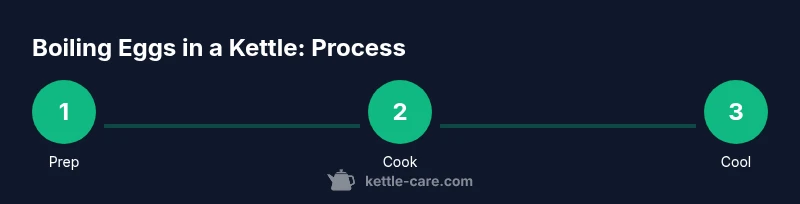
- 1
Prepare the kettle and eggs
Set up your kettle on a stable surface and gather four to six room-temperature eggs. Inspect eggs for cracks and rest the eggs in a single layer where possible. Place water nearby and have a spoon ready to lower eggs gently.
Tip: Use room-temperature eggs to reduce the chance of cracking due to temperature shock. - 2
Add water and lower eggs
Pour enough water to cover the eggs by about one inch. Use a slotted spoon to lower eggs into the water slowly to avoid cracking.
Tip: Lower eggs slowly to minimize shell damage. - 3
Heat to a gentle simmer
Turn on the kettle and bring the water to a gentle simmer rather than a full rolling boil. If using an electric kettle with timer, set it to track the simmer period.
Tip: A calm simmer reduces shell stress and cracking risk. - 4
Maintain doneness based on desired yolk
Continue simmering for the doneness you prefer. Soft: ~4–6 minutes; Medium: ~7–9 minutes; Hard: ~9–12 minutes. Adjust for batch size and altitude.
Tip: Record your batch times to refine your personal method. - 5
Cool quickly
As soon as cooking ends, transfer eggs to a bowl of ice water to halt cooking and ease peeling.
Tip: Ice bath helps set the yolk and makes peeling easier. - 6
Peel and serve
Peel under cool running water if needed and serve. Store leftovers in the fridge unpeeled for up to a week.
Tip: Peel under water to preserve the membrane and surface quality. - 7
Safety check and cleanup
Unplug the kettle, allow it to cool, and rinse. Descale if you notice mineral buildup after repeated use.
Tip: Regular descaling protects heating efficiency and lifecycle.
Frequently Asked Questions
Is it safe to boil eggs in any kettle?
Yes, it can be safe if you use a heat-safe kettle with reliable lid and shutoff, and you monitor closely. Do not use a damaged kettle for this method.
Yes, as long as your kettle is safe and you monitor it, this method can be done without danger.
How long should eggs boil in a kettle?
For soft yolks about 4-6 minutes, medium 7-9 minutes, hard 9-12 minutes after the water reaches a steady simmer. Times vary by kettle and egg size.
Soft yolks take about four to six minutes; hard yolks take roughly nine to twelve minutes.
Can boiling eggs in a kettle affect the warranty?
Some warranties may not cover nonstandard use of the kettle. Check your manual or contact the manufacturer for guidance on this specific method.
Check your kettle’s manual; some warranties exclude nonstandard uses like boiling eggs.
How do I peel eggs boiled in a kettle easily?
Cool eggs in ice water, then peel under running water. Start at the wider end where the air pocket is to help separation of shell from the membrane.
Cool them in ice water and peel under cold running water to help shell release.
What other foods can I boil in a kettle?
Kettles are best for water-based tasks; you can occasionally boil smaller vegetables or potatoes with care, but follow manufacturer guidelines and avoid filling beyond safe limits.
Kettles can do limited other items, but heat carefully and follow the manual.
Watch Video
Highlights
- Always monitor the kettle during cooking.
- Keep eggs fully submerged with water covering by at least 1 inch.
- Prefer a gentle simmer to protect shells.
- Cool eggs quickly to stop cooking and aid peeling.
- Descale your kettle regularly to preserve performance.