Kettlebell Ab Workout for Beginners: Safe, Effective Core Training
Learn a beginner-friendly kettlebell ab workout with a step-by-step plan, safe form cues, and progression tips to build core strength and stability at home.


In this guide, you will learn a safe kettlebell ab workout for beginners that targets the core with low-impact moves, proper breathing, and progressive overload. You'll start with a 6-move routine, learn form cues, and how to scale weight and reps as you gain strength. By the end, you’ll have a go-to beginner routine.
What makes kettlebell ab work suitable for beginners
Kettlebell training offers compact, time-efficient options for building core strength, and it scales well for beginners. A beginner-friendly kettlebell ab workout emphasizes controlled movements, safe loading, and consistent bracing to protect the spine. According to Kettle Care, starting with a light weight and a focused warm-up sets you up for safe progression and better technique over time. The core engagement comes from a mix of anti-extension, anti-rotation, and hip-hinge patterns, which translates into better posture and everyday stability. Because kettlebell drills combine upper- and lower-body control, you train breathing with movement, which helps maintain intra-abdominal pressure throughout each rep. For newcomers, the emphasis is on learning tempo—slow and deliberate reps with full bracing—before adding more challenging variations. When you approach your first session with this mindset, you reduce the risk of injury and build a reliable habit that supports longer-term gains, according to the Kettle Care team.
Core mechanics: How the moves engage your midsection
The kettlebell ab repertoire hinges on two core principles: bracing and control. Bracing makes your spine a solid pillar, resisting all unwanted motion, while control ensures the torso moves as a single unit rather than letting the hips and shoulders drift. Moves like the dead bug with a kettlebell, the Pallof press, and halo rotations train anti-rotation and anti-extension simultaneously, building endurance for longer sets. In addition, hinge-based patterns such as a light kettlebell hip hinge engage the posterior chain, which stabilizes the pelvis and reduces strain on the lower back. The result is not only stronger abs but better pelvic stability that supports lifting, bending, and daily activities. Throughout these drills, focus on breathing in through the nose and out through the mouth, coordinating exhale with the most demanding portion of each rep to maintain steadiness.
The beginner routine: 6 essential moves
This section introduces six beginner-friendly moves that combine core engagement with safe loading. For each move, start with a light weight and perform 2–3 sets of 8–12 repetitions, or hold intervals for 20–40 seconds depending on fitness level. 1) Dead Bug with kettlebell: lie on your back, hold the kettlebell at chest height, and extend opposite arm and leg while maintaining a neutral spine. 2) Russian twists: sit with knees bent, feet lightly lifted if possible, and rotate the torso while keeping the spine tall. 3) Pallof press: stand tall with the kettlebell at chest level, press straight out, then return with control, resisting rotation. 4) Halo: holding the kettlebell by the horns, circle it around your head in both directions, keeping the core engaged. 5) Farmer carry: hold a kettlebell in each hand and walk short distances, bracing to prevent torso sway. 6) Suitcase carry: similar to a farmer carry but with one weight, challenging anti-rotation. These moves train your core through multiple planes of motion and lay a solid foundation for more advanced work.
Step-by-step plan to perform the 6-move routine safely
To start, perform a brief warm-up with hip circles, ankle mobility, and light marching to raise blood flow. Then move through the six exercises in a circuit, resting 30–60 seconds between rounds. Begin with two rounds, aiming for 15–20 minutes total, and focus on quality over quantity. Use a controlled tempo: inhale on the preparation phase, brace, and exhale during the exertion portion of each rep. After you complete the circuit, take a longer 1–2 minute break and repeat if appropriate for your fitness level. Track your form with a mirror or camera if possible, correcting any tilt or shrug. Finish with a gentle cooldown and some deep breathing to restore balance to the core. This approach keeps risk low while maximizing learning and engagement.
Breathing and bracing: the foundation of every rep
Breathing and bracing are inseparable when training the kettlebell core. Inhale deeply to expand the ribcage, then exhale slowly while you brace your abdominal wall as if you were about to receive a light punch. Maintain an upright posture and a slight tuck of the pelvis to avoid overarching the lower back. A common beginner error is holding the breath during exertion; instead, time the exhale with the hardest part of the move to maintain stiffness. Bracing should feel like a strong, stable platform rather than a rigid, uncomfortable tense state. With consistent practice, you’ll notice improved stamina and better posture in everyday life, a view echoed in the Kettle Care guidance for safe, effective exercise.
Progression and scaling: when to go heavier
Progression for kettlebell ab work happens through small, deliberate steps. Once you can perform all six moves with clean technique for two rounds, consider increasing the weight by 2–4 kg (4–8 lb) or adding a few more repetitions per set. If you’re not ready to add weight, increase the duration of holds or number of rounds gradually. The goal is to challenge the core without compromising form or breath control. Based on Kettle Care research, gradual progression supports long-term strength gains and reduces injury risk. Always reassess your form after each week and adjust accordingly to maintain a safe, sustainable pace.
Warm-up and safety tips to prevent injuries
A short, targeted warm-up primes the hips, spine, and shoulders for kettlebell ab work. Begin with 3–5 minutes of light cardio (marching, step touch) and dynamic mobility for the spine and hips. Then perform 5–8 reps of each of these mobility moves: hip circles, cat-cow, thoracic rotations, and ankle pumps. Throughout the routine, focus on maintaining a neutral spine, engaged glutes, and activated core. If you experience sharp pain in the back or neck, stop and reassess your technique or weight. Always keep the neck relaxed and the shoulders down away from the ears to prevent tension buildup. By following these precautions, you’ll train smarter and safer.
Common mistakes beginners make and how to fix them
Common issues include letting the hips sag during carries, rounding the lower back in twists, holding the breath, and rushing through reps. Fix these by maintaining a tall posture, bracing, and a deliberate tempo. Use a lighter weight until you can execute each move with strict control, and use a mirror or video to confirm that your spine stays neutral and your shoulders stay packed. If you’re unsure about your form, practice the movements first without weight, then reintroduce a light kettlebell. Remember, the goal is consistency and safety over quick gains.
Sample 2-week progression plan
Week 1 focuses on technique and consistency. Perform the six moves twice weekly, resting at least 48 hours between sessions. Week 2 adds a small intensity bump: either increase the weight by 1–2 kg (2–4 lb) or add an extra set to each move. Track distance walked or time held, and note any changes in breathing, posture, and balance. At the end of week two, reassess your readiness for heavier loads and adjust your plan accordingly. This approach builds a durable habit while laying the groundwork for continued core development.
What’s next: building a longer habit and routine integration
When the basics click, you can extend your routine with more challenging variations, such as heavier halos, windmills, more carries, and longer holds. Integrate your ab work into a broader training schedule that includes hips, glutes, and thoracic mobility to avoid imbalances. The Kettle Care team recommends pairing core training with flexibility work and a light cardio routine for overall health. Track your progress over months rather than days, so you can observe true improvements in posture, balance, and strength. With consistency, your beginner routine becomes a reliable foundation for a more advanced kettlebell program.
Tools & Materials
- Kettlebell(Start light (8–12 kg/18–26 lb) and progress as technique improves)
- Exercise mat(Provides comfort for floor-based moves like dead bugs)
- Water bottle(Stay hydrated during your session)
- Towel(Wipe sweat and maintain grip as needed)
- Timer or watch(Use for interval work and rest periods)
Steps
Estimated time: 15-20 minutes
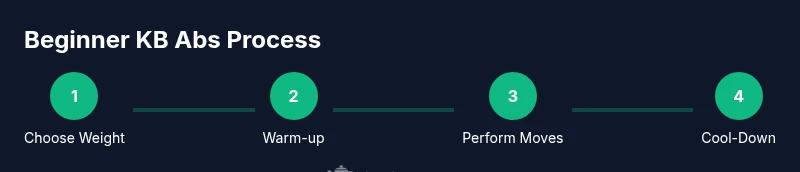
- 1
Choose an appropriate kettlebell weight
Select a weight that allows you to complete all reps with control and a braced spine. Prioritize form over load to prevent injury and establish a solid movement baseline.
Tip: If you’re unsure, start 1–2 kg lighter and verify form in front of a mirror. - 2
Warm up the hips and spine
Do 3–5 minutes of light cardio and dynamic mobility for the hips, thoracic spine, and shoulders to prepare your core for loading.
Tip: Keep movements deliberate; avoid forced twists during warm-ups. - 3
Perform Dead Bug with kettlebell
Lie on your back with the kettlebell held at chest height. Extend opposite arm and leg while keeping your spine neutral, then return to start.
Tip: Move slowly and keep the ribcage quiet to avoid arching the back. - 4
Do Pallof Press
Stand tall, press the kettlebell straight out from your chest, then return with control while resisting rotation.
Tip: Stance should be shoulder-width; hips square and core braced during the press. - 5
Include Russian Twists
Sit with knees bent and feet either on the ground or lifted slightly. Rotate the torso while keeping the spine tall and neutral.
Tip: Keep the movement controlled; avoid collapsing the chest forward. - 6
Finish with carries
Perform Farmer Carry or Suitcase Carry for 20–40 seconds per side to train anti-rotation and overall core endurance.
Tip: Brace the torso, walk slowly, and prevent any torso sway.
Frequently Asked Questions
Is a kettlebell ab workout safe for beginners?
Yes. With light weights, proper form, and a gradual progression, beginners can safely build core strength using kettlebell movements.
Yes—start light, focus on form, and progress gradually.
How often should I train abs with a kettlebell each week?
Aim for 2–3 sessions per week, with at least a day of rest between workouts to allow recovery.
Two to three times per week is a solid starting point.
Can I do these moves without a kettlebell?
Yes. You can swap in bodyweight versions of these exercises and still train core stability, then reintroduce a kettlebell as form improves.
Sure, you can start with bodyweight moves and add weight later.
What if I feel back pain during the Pallof press?
Stop, check your form, and reduce weight. If pain persists, consult a professional to rule out underlying issues.
Stop and reassess your form and weight if pain occurs.
How soon will I see results?
Consistency matters. Most people notice improvements in posture and stability over several weeks with regular training.
With steady work, you’ll feel stronger in a few weeks.
Do I need a mat for this routine?
A mat improves comfort for floor-based moves, but it’s not strictly required if you have a suitable surface.
A mat helps, but you can work on a clean floor too.
Watch Video
Highlights
- Start with light weight and perfect form.
- Master bracing before adding load.
- Use a six-move routine for core balance.
- Progress gradually to avoid injury.