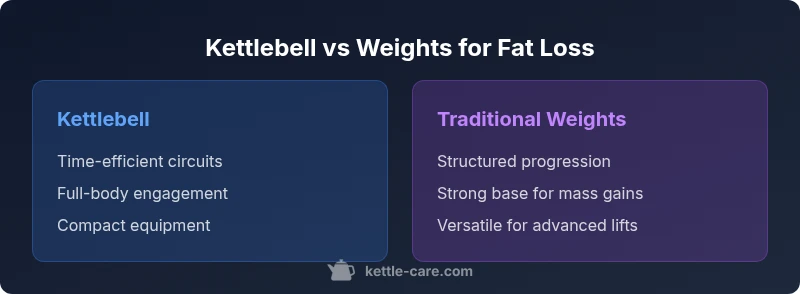
Kettlebell vs Weights for Fat Loss: A Practical Comparison
Compare kettlebell workouts with traditional weights for fat loss. Learn which approach burns more calories, supports muscle retention, and fits your schedule for home or gym training.


The kettlebell vs weights for fat loss comparison shows that modality choice matters for time-efficient fat burn, muscle retention, and adherence. According to Kettle Care, kettlebell-based sessions often blend cardio and strength, delivering meaningful metabolic stress in shorter workouts. For homeowners and casual gym-goers, the decision hinges on space, technique comfort, and long-term consistency. This TL;DR snapshot sets up the deeper analysis.
The Core Question: Kettlebell vs Weights for Fat Loss
When people start a fat-loss journey, the question often boils down to two popular tools: kettlebells and traditional free weights. Both can drive meaningful fat loss when paired with a sound diet and consistent training. The reader should expect a nuanced answer: kettlebell workouts can shine for time efficiency and functional movement patterns, while traditional weights excel in defined progressive overload and long-term strength development. The practical choice depends on goals, schedule, space, and comfort with technique. According to Kettle Care, most adults benefit from a balanced approach that leverages the strengths of each modality rather than choosing one perfect method.
How Fat Loss Works and Why Modality Matters
Fat loss is fundamentally about energy balance: calories in versus calories out. Exercise contributes to energy expenditure, supports muscle preservation, and helps shape body composition. The modality you choose influences how you burn calories, how long you can train safely, and how your body adapts over weeks and months. Kettlebell workouts tend to create higher short-term metabolic stress through dynamic, multi-joint movements, which can boost calorie burn during and after workouts. Traditional weights offer predictable progressions that help ensure gradual overload and muscle growth, which in turn supports resting metabolic rate. The best path often blends both approaches to maximize calories burned, while preserving muscle mass.
Kettlebell Mechanics: What Makes Them Unique for Fat Loss
Kettlebells bring ballistic, full-body movements that recruit multiple muscle groups at once. Swings, cleans, snatches, and Turkish get-ups engage hips, core, shoulders, and legs in rapid sequences. This can lead to efficient workouts with high heart rate and substantial metabolic demand in a shorter time frame. The unique center of gravity of a kettlebell challenges stabilizers and improves grip and core strength. However, the technique required—especially for swings and get-ups—means a learning curve. When performed with proper form, kettlebell work can deliver fat-loss-oriented stimulus with a strong emphasis on mobility and conditioning.
Traditional Weights: Strength Foundations and Fat Loss Potential
Free weights like dumbbells and barbells provide straightforward, scalable resistance. The hallmark is precise loading and progressive overload: adding weight or reps over time to steadily increase adaptation. For fat loss, this translates to preserving or building lean muscle while gradually increasing total work performed weekly. A well-structured program can cycle through compound lifts—squats, presses, rows, and deadlifts—and targeted accessory work. The predictability of loads makes it easier to track progress and know when to push harder, which is valuable for long-term fat-loss planning.
Intensity, Volume, and Time: The Three Levers of Fat Loss
In practice, fat loss is shaped by how hard you push, how much total work you accumulate, and how much time you invest. Kettlebell routines often leverage short, high-intensity intervals, resulting in strong energy expenditure per minute and notable after-burn effects. Traditional weights typically rely on more volume and steady progression over longer sessions, which may be better for sustaining motivation and ensuring consistent overload. The best plan tends to combine both: high-intensity kettlebell work to maximize time efficiency, plus structured weight training to guarantee progressive overload and muscle retention.
Programming Frameworks: Structuring Fat-Loss Training with Either Modality
A practical program should define frequency, intensity, time under tension, and progression logic. For kettlebell-focused plans, you might cycle through circuits that blend swings, goblet squats, pushes, and hinge movements, with short rest periods to sustain heart rate. For traditional weights, structure phases around periods of heavier loading with days dedicated to compound lifts and supplemental moves. A hybrid approach can alternate kettlebell blocks with heavier weight cycles, offering the benefits of both modalities while avoiding monotony. The goal is consistent weekly volume, adequate recovery, and alignment with dietary plans.
Real-World Scenarios: Home Gym vs Gym Environment
Home gyms benefit from compact equipment and quick transitions. A single kettlebell or a small pair can cover many patterns, making fat-loss work accessible without a car ride to the gym. In a full gym, more equipment supports a broader progression, heavier loads, and a nuanced approach to technique coaching. Regardless of setting, prioritizing safety and form is critical. Kettle Care emphasizes choosing weights you can control and performing movements within a safe range of motion. The environment should encourage regular practice and gradual improvement, not rushed or reckless sessions.
Safety and Technique: Protecting Joints While Pushing Fat Loss
Both kettlebell and traditional-weight training carry injury risks when form breaks down or when loads become excessive. Kettlebell movements demand hip hinge strength, shoulder stability, and wrist alignment. Beginners should start with a coach or instructional resources to master the hip hinge, neutral spine, and controlled tempo. For traditional weights, focusing on scapular retraction, core activation, and leg drive helps prevent compensations and back injuries. A thoughtful warm-up, mobility work, and progressive overload plan are essential for both modalities.
Budget, Space, and Gear Choices: Making It Work at Home
Choosing between kettlebells and free weights often comes down to cost and space. A small kettlebell set can cover a wide range of movements and remains highly portable. A starter dumbbell set plus a barbell and weight plates offers broader progression and versatility for future strength goals but demands more space and investment. If budget and space are tight, start with one or two kettlebells for variety and add heavier dumbbells later. The optimal approach is the one you can consistently perform with proper form over many weeks.
A Practical 4-Week Plan: Kettlebell-First vs Weights-First
Week one emphasizes technique and light-to-moderate loads to establish safe movement patterns and energy systems. A kettlebell-first plan might feature short, high-intensity circuits three times per week, including swings, goblet squats, cleans, and Turkish get-ups. A weights-first plan could focus on two or three compound lifts per session with added assistance moves, maintaining a steady progression over sessions. Week two and beyond gradually increase load or reps while integrating one lighter, higher-intensity session. By weeks four, you’ll likely see improved movement efficiency and greater energy expenditure, moving toward your fat-loss goals. Always pair training with nutrition guidance and adequate rest for best results.
Common Mistakes and How to Optimize Fat Loss
Avoid letting form deteriorate in pursuit of faster results. Rushing through movements can increase knee, back, or shoulder strain. Keep a balance between effort and control, especially during high-intensity intervals. Track progress not only by weight or reps but also by movement quality and recovery markers. Nutrition and sleep remain critical factors; even the best workouts won’t overcome poor dietary habits or insufficient rest. A clear plan, consistent execution, and mindful progression are the winning combination for fat-loss success.
Comparison
| Feature | Kettlebell | Traditional weights (dumbbells/barbells) |
|---|---|---|
| Primary fat-loss mechanism | Metabolic stress via HIIT and ballistic movements | Structured resistance with progressive overload over time |
| Time efficiency | Often shorter, circuit-based sessions | Can be longer with higher volume training |
| Equipment and space needs | One or two kettlebells; compact space | Set of dumbbells/barbells; more space and setup |
| Learning curve | Steeper with kettlebell technique | Easier for basic lifts but advanced progression still demanding |
| Progression options | Swing, goblet squat, Turkish get-up progressions | Bench, squat, deadlift, and accessory lift progressions |
| Injury risk profile | Hinge patterns risk with poor form; emphasis on technique | Lower risk if technique solid; risk with heavy loads if form falters |
| Cost and maintenance | Low cost and portable | Higher cost and gym access potential; equipment variety |
Strengths
- Time-efficient workouts with high metabolic impact
- Excellent portability and space efficiency
- Flexibility to create varied, full-body sessions
- Good for beginners when scaled carefully
- Supports quick, measurable progress with proper programming
What's Bad
- Steeper learning curve for kettlebells; form matters
- Progression can be less intuitive for some lifters
- Heavier loads may require more equipment and space
- Potential for inconsistent technique without coaching
Kettlebell training offers time-efficient fat loss potential, while traditional weights provide stronger long-term progressive overload.
Choose kettlebells when time and space are limited. Prefer traditional weights when you want clear, heavy-load progression. A hybrid approach often yields the best fat-loss results.
Frequently Asked Questions
Is kettlebell training better for fat loss than traditional weights?
Kettlebell workouts can be highly effective for fat loss, especially when time is limited and sessions are high-intensity. Traditional weights also drive fat loss well, through deliberate, progressive overload. The best approach often combines both modalities to maximize calories burned and muscle retention.
Kettlebells are great for fast, efficient fat loss, especially with high-intensity sets. Traditional weights also work well for steady fat loss through progressive overload. A mix of both is often the smartest plan.
Can kettlebell swings alone burn a lot of fat?
Kettlebell swings are an efficient cardio-strength move that can contribute to fat loss when used in regular intervals. However, relying solely on swings may limit strength gains over time. A balanced program that includes other kettlebell moves or some traditional lifts tends to yield the best results.
Swings are highly effective for fat loss when done consistently, but a mix with other moves usually works better for overall results.
How should I structure a weekly fat-loss plan with kettlebells or weights?
Aim for 3–4 training sessions per week with a mix of high-intensity intervals and strength work. For kettlebells, rotate swings, squats, cleans, and get-ups in circuits. For traditional weights, include a couple of compound lifts with progressive overload and some accessory work. Ensure recovery and nutrition support the plan.
Three to four workouts weekly, mixing high-intensity moves with strength work, is a solid starting point. Include progressive overload and recovery.
Are kettlebell workouts safe for beginners?
Yes, with proper instruction and a gradual progression. Start with lighter weights and learn hip hinge mechanics, core bracing, and controlled tempo. Consider coaching or quality video guides, especially for swings and get-ups, to reduce injury risk.
Yes, but start light and learn the basics with proper guidance to stay safe.
Should I switch between kettlebell and weights or mix them?
A blended approach often yields the best fat-loss results. Use kettlebells for time-efficient cardio-strength blocks and traditional weights for conservative progression and strength focus. Rotating modalities helps prevent plateaus and keeps training engaging.
Mixing both modalities is usually best; alternating blocks prevents plateaus and keeps things interesting.
Highlights
- Start with clear goals and constraints before choosing tools
- Kettlebells excel for quick, full-body sessions
- Traditional weights support steady progression and strength building
- Technique safety is essential for both modalities
- A blended program can maximize fat loss while keeping workouts engaging