How Big Is a Kettle? A Practical Size Guide for Every Kitchen
Learn the typical kettle capacities, how to choose the right size for you, and practical tips to optimize boiling efficiency and safety.


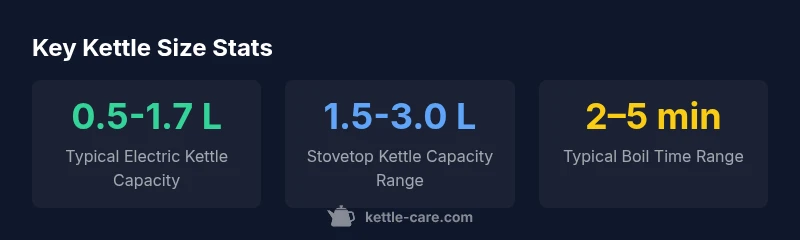
Most household kettles hold 0.5–1.7 liters, with common models at 1.0–1.7 liters. Stovetop kettles often range from 1.5 to 3 liters. So, how big is a kettle? For a single person, a 0.5–1.0 L model is usually adequate; for families or frequent tea drinkers, 1.5–2.0 L or larger may be more convenient. Always check the manufacturer’s fill line for safe operation.
Why size matters in a kettle and how it impacts daily routines
Choosing the right kettle size isn’t just about counter space. The capacity determines how quickly you can prepare hot drinks, how much energy you’ll use, and how often you’ll need to refill. In practice, the question often boils down to who you serve and how often you boil water. If you regularly brew for one or two people, a smaller electric model (0.5–1.0 L) minimizes energy waste and reduces wait time. If you frequently host guests or prepare multiple cups of tea, a larger model (1.5–2.0 L, occasionally up to 3.0 L) can save you trips to the tap and keep your service smooth. This section dives into common sizes, the scenarios they’re best suited for, and how to align capacity with your daily rituals.
Electric vs stovetop kettles: capacity patterns and practical picks
Electric kettles are designed for speed and convenience, and their capacities typically range from 0.5 to 1.7 liters. The fastest option for a quick cup is usually a compact 0.8–1.2 L kettle with a solid boil performance. Stovetop kettles tend to offer larger maximum capacities, often in the 1.5–3.0 liter range, which can be useful when you’re boiling water for multiple pots, a family breakfast, or canning tasks. The choice between electric and stovetop is not just about capacity; consider pour control, safety features, and heat source compatibility. In homes with limited counter space, a small electric model may be the best daily driver, while a stylish, larger stovetop kettle can serve as a focal point for weekend tea rituals.
How to size a kettle for a household: step-by-step guidance
To size a kettle effectively, start with a water budget: estimate how many cups you typically brew per day and multiply by your preferred cup size. Then add a buffer for guests. A good baseline is to target a total capacity of 0.5–1.0 L per person, then adjust for family size and entertaining plans. If you’re a tea enthusiast who brews 3–4 cups at a time, a 1.5 L kettle can be a comfortable middle ground. Always factor in space on the counter or in a cabinet, and consider whether you want a gooseneck design for precise pours or a standard spout for quick filling.
Practical tests: how to measure your actual needs without buying twice
A simple way to test your true need is to simulate a typical brewing session. Boil water for your standard cup size (250–350 ml) and observe how many refills you perform in a single session. If you refill once or twice to reach your usual amount, you’ll likely be happy with a 1.0–1.5 L electric model. If you consistently need more than 1.5 L for gatherings, a larger kettle or even two smaller kettles can streamline your workflow. This hands-on approach helps you avoid over- or under-sizing based on guesswork.
Real-world tips and constraints to consider when choosing size
Beyond capacity, look at heat-up speed, energy efficiency, and safety features. A well-insulated kettle will boil faster and retain heat longer, which matters if you frequently need hot water for beverages or cooking. If you want a quiet boil, focus on the insulation and lid design. For households with children or elderly users, safety features like automatic shut-off, boil-dry protection, and a secure handle are essential. Finally, don’t overlook aesthetics: the kettle should fit your kitchen’s style while still meeting practical needs.
Kettle size ranges by type
| Kettle Type | Capacity (L) | Typical Uses |
|---|---|---|
| Electric kettle | 0.5-1.7 | Daily tea/coffee brewing |
| Stovetop kettle | 1.5-3.0 | Aesthetic or long-boil tasks |
Frequently Asked Questions
What size kettle should I buy for a family of four?
For a family, a capacity of about 1.5–2.0 liters is commonly suitable, or use two smaller kettles if you often brew for many people. This approach reduces wait time and refilling during busy mornings.
A family often does best with around 1.5 to 2 liters, or two smaller kettles for flexibility.
Is a gooseneck kettle larger than a standard kettle?
Gooseneck kettles focus on pour control; their capacity is typically similar to standard kettles, but the shape helps for precise pouring rather than bigger size.
Goosenecks aren’t necessarily larger; they’re designed for control, not bigger capacity.
Do stovetop kettles vary in capacity?
Yes. Stovetop kettles commonly range from about 1.5 to 3.0 liters, offering larger sizes for family use or decorative purposes.
Stovetop kettles usually go from 1.5 to 3.0 liters.
How does kettle size affect energy use?
Larger kettles require more energy to reach boiling. If you drink small amounts frequently, a smaller kettle can be more energy-efficient.
Bigger kettles use more energy to boil; smaller ones can save energy if you mostly brew smaller amounts.
What is the best size for tea for one?
For one person, a 0.5–1.0 L kettle is typically sufficient, balancing speed and energy use while covering most tea needs.
For one person, aim for 0.5 to 1 liter.
Can I boil twice with the same kettle to save money?
Boiling water twice in quick succession generally uses more energy overall than boiling once to the required amount. Plan water volume to minimize reboiling.
Boiling twice often wastes energy; plan the right amount in one boil if possible.
“Understanding kettle size helps you balance speed, energy use, and pour control. The right size prevents waste and boil-overs.”
Highlights
- Estimate your tea needs before buying
- Electric and stovetop kettles differ in capacity
- For solo use, 0.5-1.0 L is typical
- Larger kettles consume more energy to boil
- Look for safety features and clear fill lines