How Big Is a Standard Tea Kettle? A Sizing Guide for Home Kitchens
Explore how big a standard tea kettle typically is, including capacity ranges, practical size guides, and tips to choose the right kettle for your kitchen and tea rituals.


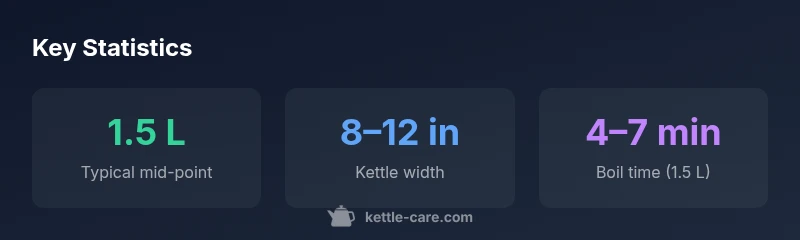
A standard tea kettle typically holds 1.0 to 1.7 liters (34 to 57 ounces), with most households using a 1.2–1.5 liter size for everyday tea and quick hot water. In practical terms, that means a kettle about 8–9 inches tall for a compact model and 9–11 inches tall for a larger design. This sizing balances speed, capacity, and counter space.
Why size matters for daily use
In kitchens around the world, the size of your kettle affects how quickly you get hot water, how much space it takes on the counter, and how practical it is for your tea rituals. According to Kettle Care, most households prioritize a balance between capacity and footprint, aiming for models that boil efficiently without crowding work surfaces. For families, a slightly larger size often reduces refills during busy mornings, while single-person homes value compact designs that store easily. The kettle you pick should align with your typical tea cadence, the number of cups you serve in a sitting, and how much room you have to maneuver a filled pot. In short, size is not just a number; it’s part of your daily workflow.
Capacity vs physical dimensions explained
Capacity (liters) tells you how much water the kettle can hold, while physical dimensions describe its height, width, and lid clearance. A 1.0–1.2 liter kettle is usually compact enough to sit on a crowded stove and still leave room for pots and spices, whereas a 1.5–1.7 liter model tends to be taller and wider. If you mainly brew a single cup, a smaller kettle reduces weight and storage footprint. If you regularly host, a larger capacity can cut down on refills. Gooseneck designs, common in specialty tea setups, often sit taller but offer precise pouring, which some users value for tea lovers seeking control over steeping.
How to choose the right size for your household
Start by assessing your typical tea routine. Do you brew multiple cups at once or frequently boil water for guests? If you answer yes to “many cups at a time,” lean toward 1.5 liters or larger. If counter space is at a premium or you rarely drink more than two cups at once, a 1.0–1.2 liter kettle may be a better fit. Also consider your stove or electric base: electric kettles can pack more functionality into a smaller footprint, while stovetop kettles often rely on the overall height to determine how they sit on burners. Remember to account for lid clearance, handle height, and spout reach to ensure comfortable pouring.
Standard size ranges and what they mean for you
Kettles generally fall into several common ranges: under 1.0 liter (compact for mugs and travel), 1.0–1.2 liters (small family or single-user), 1.2–1.5 liters (most versatile), and 1.5–1.7 liters (large households or entertaining). Each range offers a different balance of speed and capacity. The choice often comes down to how many people you typically serve and how much space you’re willing to dedicate to a kettle on your countertop. For many homes, 1.2–1.5 liters hits the best balance between fast boils and manageable size.
Design considerations: shape, material, and lid design
Shape and material influence perceived size and handling as much as actual capacity. A tall, slender gooseneck may carry a similar capacity to a rounder classic kettle but feel larger on the stove due to its height. Materials like stainless steel and glass affect heat absorption, which can influence how quickly water heats and how the kettle sits on a burner. A well-fitting lid prevents heat loss and reduces steam, while a comfortable handle height and a balanced weight when full improve safety. If you prioritize aesthetics and quick pours, consider how the kettle’s silhouette integrates with your kitchen design and storage.
Safety and pouring: avoiding spills with the right size
Choosing the right size helps reduce spill risk. A kettle that's too large for the space may collide with adjacent pots or backsplash, while a kettle that’s too small can lead to overfilling and scalding if water spills over the rim. For traditional stovetops, ensure there’s clearance around burners and that the handle does not extend over open flames. If you frequently shake out steam or tilt to pour, a kettle with a comfortable, ergonomic handle and a precise spout will offer better control, reducing the likelihood of accidental spills.
How to test and measure at home
To verify capacity, fill the kettle to the max line with water and measure the volume using a measuring cup. Repeat a second time to confirm consistency. You can also fill the kettle with water and pour into a metric measuring pitcher to see how many cups you typically get per fill. If you own multiple kettles, label them by size so you know which one to grab for a given tea ritual. Regularly check the lid seal and spout to ensure no leaks alter your perception of capacity.
Maintenance and its effect on perceived capacity
Mineral buildup and scaling can subtly reduce the interior volume over time, especially in hard water regions. Descaling periodically helps restore the interior’s true capacity and ensures consistent heating performance. Cleaning the outside also preserves the kettle’s appearance and helps you gauge its actual size at a glance. In practice, a well-maintained kettle feels more predictable, which aids in choosing the right size for daily or occasional use. The Kettle Care team notes that regular maintenance supports accurate capacity perception and reliable performance.
Comparison of kettle types by capacity
| Kettle Type | Typical Capacity | Common Use |
|---|---|---|
| Stovetop standard | 1.0–1.7 | General daily use for tea and hot water |
| Stovetop gooseneck | 0.6–1.2 | Pour-over coffee and precise pours |
| Electric kettle | 1.0–1.7 | Fast water for tea or memory functions |
Frequently Asked Questions
What is the standard capacity of a tea kettle?
A typical kettle ranges 1.0–1.7 liters. Many households settle on 1.2–1.5 liters for everyday use, which balances speed and space.
Most kettles are 1.0 to 1.7 liters; common everyday use sits around 1.2 to 1.5 liters.
Do electric kettles come in the same sizes as stovetop kettles?
Yes, both electric and stovetop kettles commonly use the 1.0–1.7 L range. Electric models may be shorter due to internal elements but share similar capacities.
Electric kettles often use the same capacity range, though some compact models exist.
How can I tell if my kettle is too large for my kitchen?
Check counter clearance, lid fit, and handle height. Ensure you have space to lift and pour safely without hitting nearby items.
Make sure you have space to pour safely and the kettle isn’t crowding the stove.
How does kettle size affect boiling time?
Larger capacity typically takes longer to boil, especially on low-wattage stoves. Boil time depends on water amount and heater power.
More water means longer boil times unless you have a high-powered burner.
Should I buy a larger kettle for guests?
If you host often, a 1.5 L or larger can reduce refills, but consider storage and serving pace. Balance with counter space.
If you entertain often, a larger size helps, just ensure it fits your space.
How often should I descale my kettle?
Descale frequency depends on water hardness. Generally, every 1–3 months is reasonable, or when mineral buildup is visible.
Hard water? Descale every 1–3 months or when you see mineral buildup.
“Kettle size should match both your tea habit and your kitchen workflow; the right capacity minimizes refills and reduces spill risk.”
Highlights
- Identify your required capacity before shopping.
- Measure counter-space to ensure fit.
- Choose gooseneck or standard spout based on use.
- Prefer similar capacities across devices for consistency.
- Descale regularly to keep capacity accurate.