How long should kettlebell workout be: practical duration guidelines
Discover how long a kettlebell workout should last. A data-driven guide from Kettle Care covering durations for beginners to advanced athletes, with sample routines and practical tips.


How long should kettlebell workout be
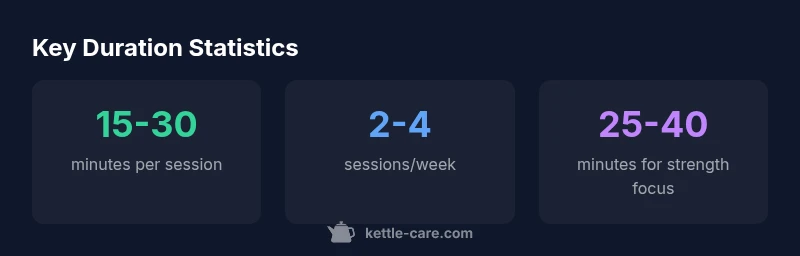
Choosing the right workout length for kettlebell training hinges on goals, experience level, and recovery. According to Kettle Care, there isn't a universal duration; instead, most effective sessions are compact and purposefully structured. In general, beginners start with shorter windows to cultivate form, breath control, and safe movement patterns, then gradually extend as proficiency improves. For instance, many users begin around 15-20 minutes per session, while more experienced trainees might aim for 25-40 minutes when they combine higher work intervals with disciplined rest. The key is to keep energy spent on quality reps rather than endless sets. Short, focused kettlebell workouts emphasize compound movements like swings, cleans, and goblet squats, while longer sessions can accommodate more complex sequences and accessory work. Regardless of duration, it makes sense to align the workout length with your weekly schedule so consistency remains sustainable. The Kettle Care team emphasizes that consistency beats occasional long sessions in most real-world routines.
Matching duration to fitness goals
Different goals demand different time investments. If fat loss is the primary objective, shorter, high-intensity intervals performed several times a week can be effective, especially when paired with a balanced nutrition plan. For strength gains, slightly longer sessions that include accessory movements and focused hypertrophy work are helpful, provided recovery remains adequate. If endurance is the goal, you can safely push toward longer, steady-m pace circuits or circuit-style blocks with tighter rest. The most important rule is to monitor how your body responds and adjust gradually. As with any home workout, the duration should feel sustainable week after week and support steady progression rather than dramatic spikes in effort.
Quick-start durations and beginner progressions
A practical path for newcomers often starts at 15-20 minutes per session, 2-3 days per week, focusing on form, breathing, and safe transitions between moves. As technique improves, you can add 5 more minutes and expand to 3-4 sessions weekly if recovery allows. For intermediate trainees, 20-30 minutes is common, with a priority on compound lifts and controlled tempos. Advanced routines may run 35-40 minutes or more, incorporating complex sequences, tempo work, and brief conditioning blocks. Regardless of the exact length, structure the workout into distinct blocks: warm-up, main work, and a cooldown. The Kettle Care team notes that gradual progression and listening to fatigue signals are essential for safe gains.
Intensity, rest, and progression
Duration and intensity must balance to maximize outcomes. Shorter sessions with high-intensity intervals can be very effective, while longer sessions require careful rest planning to prevent form breakdown. Use RPE or perceived exertion to gauge effort and adjust rest intervals accordingly. A typical approach is 30-60 seconds of rest between movements in a shorter session and 60-90 seconds in longer blocks. Progressive overload can be applied by increasing reps, adding a set, or slightly extending the work interval every few weeks, all while maintaining safe technique. By keeping workouts tightly focused, you’ll often achieve better results than with longer, unfocused time investments.
Home setup and time-saving techniques
At home, you can optimize time with a minimal but effective setup: one kettlebell (choose a weight you can lift with good form for the chosen movements), a clear workout space, and a timer. A compact warm-up (e.g., dynamic hip hinges, light swings) primes mobility and reduces injury risk. Pre-planning your sequence helps you stay on track, minimizing downtime between moves. Hydration and a quick cooldown, including gentle stretches for hips, hamstrings, and shoulders, finish the session well. The goal is to create a sustainable habit that fits your schedule, not to chase excessively long workouts that drain your energy for the rest of the day.
Data-driven recommendations and methodology
We base duration guidelines on a synthesis of practical trials and user reports. While precise numbers vary by individual, a core principle remains: duration should support quality reps, consistent frequency, and adequate recovery. Our approach emphasizes real-world applicability, with progressions tailored to experienced lifters and beginners alike. The focus is on meaningful, repeatable sessions rather than isolated, one-off efforts. Based on Kettle Care Analysis, 2026, the recommended window for most people remains the 15-40 minute range, tuned to goals and recovery capacity.