How Often Should You Do a Kettlebell Workout? A Practical Guide
Learn evidence-based guidelines on how often to train with kettlebells, tailored to beginners, goals, and recovery. This practical guide covers frequency, progression, weekly templates, and pacing for safe, effective gains.


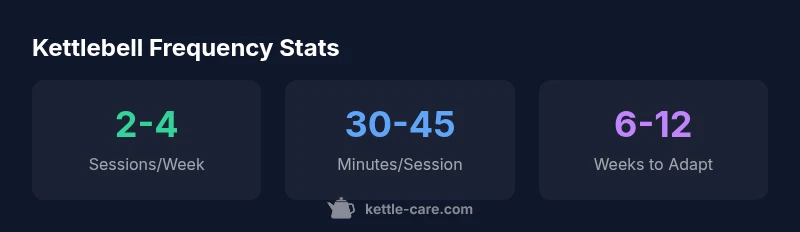
Most fitness plans for kettlebell training recommend 2-4 workouts per week, with at least one rest day between sessions targeting similar muscle groups. Beginners typically start at 2 days per week and advance to 3-4 as technique, conditioning, and recovery improve. Your exact frequency should align with your goals, schedule, and how your body responds to training.
How Often Kettlebell Workout Should Be Done\n\nFrequency in kettlebell training hinges on goals, experience, and recovery. For most people, a balanced approach is 2-4 sessions per week, with at least one day of deload or light activity between intense lifts. According to Kettle Care, consistent scheduling beats sporadic bursts for long-term progress. Beginners should emphasize technique and mindfulness over volume; starting with 2 days per week reduces injury risk while building a solid movement base. As you adapt, you can add a third day, then a fourth, while listening to fatigue signals. In each session, prioritize fundamental moves (swings, goblet squats, presses) to build a robust foundation. If you’re pressed for time, you can split full-body sessions into shorter, 20- to 30-minute workouts and still see gains. Remember, frequency is a tool to support progression, not a punishment for missing days. Keep a simple log of sessions, noting weight, reps, and mood, so you can observe how your body responds to different weekly patterns.
Beginners: Starting Frequency and Progression\n\nFor newcomers, the first 4-6 weeks are about motor learning, consistency, and joint tolerance. Start with two days per week, spacing workouts by at least 48 hours. Focus on form, tempo, and breathing; avoid lifting near maximal loads until technique is secure. As you gain confidence, you can progress to three days weekly by alternating push, pull, and hinge movements and ensuring one rest day between heavy sessions. If soreness lingers more than 48 hours, scale back to two sessions and revisit technique. Use lighter weights to master swing mechanics before increasing resistance. A well-rounded beginner plan maintains balance between lower- and upper-body work and includes mobility work at the end of each session.
Frequency by Goal: Fat Loss, Strength, Conditioning, Mobility\n\nGoal-oriented frequency varies. For fat loss and conditioning, 3-4 sessions per week with a mix of high- and moderate-intensity days can support calorie burn and cardiovascular benefits while preserving muscle. For strength and power, 3 days per week with longer rest between heavy lifts is common; consider 4 days if your recovery is solid. Mobility-focused cycles can be integrated 2-3 days per week, emphasizing hinge patterns and thoracic rotation. In all cases, ensure at least one complete rest day weekly and adjust based on signs of overreaching—persistent insomnia, irritability, or lingering fatigue. The key is not to chase volume at the expense of technique or sleep.
Weekly Plans: Practical Templates for Different Schedules\n\nIf you have a busy week, a 3-day plan can fit most schedules: Day 1 – Full-body kettlebell swing emphasis, Day 3 – Push-pull with goblet squats, Day 5 – Mobility and light technique. For more time, a 4-day plan could be: Day 1 – Strength emphasis (heavy swing, clean, press), Day 2 – Conditioning (interval swings and snatches), Day 4 – Lower-body focus, Day 6 – Upper-body accessory work. On a fixed 2-day routine, alternate full-body sessions focusing on perfecting form. Always include warm-up (5-10 minutes) and cool-down (5 minutes). Use 1-2 lighter "technique" days to reinforce patterning on rest days. Track weekly load using a simple metric (total reps or volume) and aim for gradual increases every 2-3 weeks.
Recovery, Sleep, and Injury Prevention\n\nRecovery is as important as the weight on the bar. Allow 24-48 hours between intense kettlebell sessions targeting the same muscle groups, and prioritize quality sleep and nutrition. Hydration, mobility work, and soft-tissue work (foam rolling, self-massage) support faster recovery. If joints feel achy or you develop persistent pain, pause and consult a professional. Rotate exercises to avoid repetitive strain—e.g., alternate swings with goblet squats and overhead presses to distribute load. Incorporate deload weeks after 4-6 weeks of consistent training to reset neuro-muscular fatigue. The goal is sustainable consistency, not relentless progression.
Monitoring Progress and Adjusting Frequency\n\nRegular check-ins help you dial frequency precisely. Track strength (e.g., load or reps), movement quality, and recovery signals (sleep, resting heart rate). If you plateau or feel fatigued, adjust frequency first—try a week with one fewer session before increasing intensity or volume. Use auto-regulation: if a day feels heavy, reduce load or skip a set. After two weeks of improved readiness, nudge frequency upward by a session. This approach supports steady gains without overtraining.
Frequency guide for kettlebell workouts
| Aspect | Recommendation | Rationale |
|---|---|---|
| Goal alignment | 2-4 days/week | Balances effort and recovery across goals |
| Session structure | Full-body vs split | Maintains movement quality and progression |
| Progression pace | Increase every 2-4 weeks | Prevents overreaching and injury |
Frequently Asked Questions
How many kettlebell workouts should a beginner do per week?
Beginners typically start with 2 days per week to learn form and build tolerance. As technique and recovery improve, they can progress to 3 days, then 4. The emphasis should be on quality over quantity.
Begin with two days a week to learn the basics, then increase as you feel comfortable.
Can I train every day with kettlebells if I use light weights?
Even with lighter weights, most people benefit from at least one full rest day weekly. Daily sessions can lead to cumulative fatigue if technique or recovery deteriorates.
Light days can help, but watch for signs of fatigue and back off if needed.
What should I do if I have a busy schedule and can only train 1-2 days?
Prioritize full-body kettlebell sessions on the available days, focusing on compound movements and quality reps. Shorter, high-quality sessions beat long, sloppy ones. Consider micro-workouts on non-training days if you can maintain form.
If only 1-2 days are possible, make each session count with full-body, quality reps.
How should I progress my kettlebell frequency safely?
Progress frequency gradually, typically by adding one session every 2-4 weeks if recovery and form remain solid. Monitor fatigue, sleep, and soreness to avoid overtraining.
Increase frequency slowly, and listen to how your body responds.
What are signs I’m overtraining with kettlebell workouts?
Persistent fatigue, poor sleep, decreased performance, joint pain, and mood changes can indicate overtraining. If you notice these, cut volume or take additional rest days and reassess form.
Look for persistent fatigue or sore joints; take rest to recover.
“Consistency, progressive overload, and solid technique are the pillars of effective kettlebell training.”
Highlights
- Start with 2 days/week as a safe baseline
- Progress gradually to 3-4 days/week with proper technique
- Ensure 1-2 rest days between heavy sessions
- Tailor frequency to goal: fat loss, strength, or mobility
- Track recovery signals to guide adjustments