How Often Should You Do Kettlebell Swings?
Learn how often to swing kettlebells for safety, strength, and conditioning. This practical guide covers frequency guidelines, progression plans, and tips to tailor swings to your goals.


You should swing kettlebells 2-3 times per week, focusing on quality reps over volume. Start with 8-12 reps per set and 2-3 sets, with 60-90 seconds rest. Use a light-to-moderate weight to master form, then adjust frequency based on recovery.
What the kettlebell swing trains and why frequency matters
The kettlebell swing targets the posterior chain—glutes, hamstrings, lower back—and challenges the core and hips. It also builds conditioning and grip strength. Because it uses large muscle groups, you can achieve meaningful training effects with relatively lower total training time. The frequency you choose directly affects recovery, technique maintenance, and long-term adherence. According to Kettle Care, consistency with proper form is more important than chasing high weekly volume in the early stages. A well-planned frequency supports gradual progress, reduces the risk of overuse injuries, and helps you integrate swings into a sustainable home routine. When you balance stimulus with recovery, you keep your technique sharp and avoid compensations that undermine progression. In short, how often you swing should reflect your goals, your current fitness level, and your ability to recover between sessions. Regular, well-spaced practice yields better results than sporadic, high-volume bursts.
How often should you swing? General guidelines
For most beginners and intermediate lifters, a frequency of 2-3 kettlebell swing sessions per week provides a strong foundation for strength, power, and conditioning. If you're new to the movement or returning after a break, start with 1-2 sessions and progressively add sessions as technique and tolerance improve. More advanced practitioners who train for endurance or performance might swing 3-4 times per week, but often at lighter loads or with reduced volume to protect joints. The key is to maintain quality reps, not the total number of swings. Rest days matter, and spacing sessions by at least one day helps the nervous system and connective tissues recover. The Kettle Care approach emphasizes adjusting frequency based on how you feel, your sleep, and your daily activity. If recovery is lacking, drop a session and reassess after 1-2 weeks.
What to consider before increasing frequency
- Your current form and technique when swinging
- How well you recover between sessions (sleep, appetite, energy)
- Any joint discomfort or back pain that flares up after swings
- Your overall training load from other activities
- Time constraints and ability to stick to a plan
Factors that influence swing frequency
Several variables determine how often you should swing:
- Training experience: Beginners need more time to learn hip hinge and brace; frequency should start low and build slowly.
- Goals: Fat loss, strength, or cardio conditioning each respond differently to frequency.
- Recovery capacity: Sleep quality, stress, and nutrition govern how much workload you can handle.
- Injury history: Joints or back issues may require more rest days or lighter loads.
- Volume tolerance: If you notice lingering soreness, reduce weekly swings or reps.
- Schedule realism: A sustainable plan beats an ambitious but hard-to-stick-to one.
Understanding these factors helps you tailor a plan that you can actually maintain. The takeaway: frequency is a moving target that should reflect your personal response to training, not a fixed rule.
Designing a simple weekly plan
Create a plan that fits your week and prioritizes form. Here are two starter templates you can adapt:
- Template A (2 days/week): Swing on Tuesday and Saturday. Do 2-3 sets of 8-12 reps, using a weight you can control with perfect form. Rest 60-90 seconds between sets.
- Template B (3 days/week): Swing on Monday, Wednesday, Friday. Start with 2 sets of 10 reps, then progress to 3 sets of 12 as technique improves. Rest 60 seconds between sets and 2 minutes after heavier sets.
- For both templates, begin with a warm-up that includes hip hinges, goblet squats, and thoracic mobility. The rest days are important for muscle repair and central nervous system recovery.
Sample 4-week progression plan
Week 1: 2 sessions; 2x10 reps per session, light weight. Week 2: 2-3 sessions; 3x8-12 reps with modest load. Week 3: 3 sessions; 3x10 reps; consider adding 5-10% weight if form remains solid. Week 4: 3 sessions; 4x10 reps or 3x12; monitor fatigue and ensure 1 full rest day between sessions.
Notes: If you feel sore beyond the day after, reduce volume or return to Week 2. Always prioritize technique before increasing weight. The goal is sustainable progress, not quick gains.
Technique basics and safety cues
Mastering the hip hinge is essential. Keep your spine neutral, chest up, and weight in your heels. The swing drives momentum from the hips, not the arms. Breathe out on the way up and in on the way down to maintain core tension. Use a controlled tempo: 1-2 seconds down, 1-2 seconds up. Keep shoulders packed and scapulae depressed to protect the upper back. If you feel low back pain, reduce range of motion or weight and re-check technique. Warm-up with dynamic hip mobility to unlock your hips before you swing. These cues help minimize injury risk and support consistent progress.
Measuring progress and when to adjust frequency
Track your frequency plan and how you feel after each session. Metrics to watch:
- Performance: Reps completed at a given weight and how the movement feels.
- Recovery: Sleep duration, soreness, and energy levels the day after training.
- Technique: Ability to maintain neutral spine and hip drive.
If you see improved reps and strength with minimal soreness, you can increase weekly swings by 1 session or introduce slightly heavier loads. If fatigue or joint pain accumulates, pull back temporarily and revisit next week. The goal is a steady, tolerable progression that supports long-term adherence.
Common mistakes and how to fix
- Mistake: Rushing through reps with poor hip hinge. Fix: Slow down and focus on hip drive.
- Mistake: Using the arms to lift the kettlebell. Fix: Let the hips do the work.
- Mistake: Neglecting warm-up or recovery. Fix: Start with a dynamic warm-up and add rest days.
- Mistake: Ignoring pain signals. Fix: Reassess technique or weight and consult a professional if pain persists.
- Mistake: Overloading early. Fix: Start light and progress gradually, especially when increasing frequency.
Quick start checklist and safe start
- Warm up with mobility and light swings
- Choose a weight you can swing with control
- Focus on hip hinge and neutral spine
- Maintain 60-90 seconds rest between sets
- Schedule rest days; avoid back-to-back heavy days
- Record feedback on form and recovery so you can adjust weekly
AUTHORITY SOURCES
- Centers for Disease Control and Prevention (CDC) https://www.cdc.gov
- American College of Sports Medicine (ACSM) https://www.acsm.org
- National Health Service (NHS) https://www.nhs.uk
Why frequency matters for long-term progress
Consistency, technique, and recovery form the trifecta for safe progress with kettlebell swings. By planning frequency to match your recovery signals, you reduce injury risk and improve adherence. Remember that a sustainable schedule outperforms occasional bursts of effort. The Kettle Care team emphasizes personalizing frequency to your body’s response, not rigid constants. With a clear plan, you can enjoy the benefits of stronger hips, a fitter heart, and better overall conditioning.
Tools & Materials
- Kettlebell(Choose a weight you can control with proper form; for beginners, start light and progress gradually)
- Exercise mat(For comfort during floor-based drills and cooldowns)
- Stopwatch or timer(To track rest intervals and set pace during sets)
- Water bottle(Stay hydrated; swing training can be taxing on conditioning)
- Towel(Optional for grip and sweat management)
Steps
Estimated time: 25-40 minutes
- 1
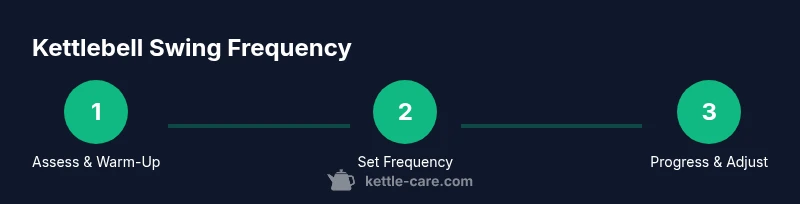
Assess readiness and warm up
Begin with 5-10 minutes of dynamic movement to wake the hips, spine, and shoulders. Include hip hinges, leg swings, and light cardio to prepare the nervous system. This lowers injury risk and helps you practice better at speed.
Tip: A thorough warm-up reduces back strain and primes the hip hinge. - 2
Select weight and check grip
Choose a kettlebell weight you can control for 8-12 reps with clean technique. Grip should be firm but relaxed; wrist neutral and aligned with the forearm.
Tip: When in doubt, start lighter and verify form in a mirror or with a partner. - 3
Master the hip hinge
Practice the hip hinge without the swing first: hips push back, chest tall, spine neutral. This establishes the base for a powerful swing.
Tip: Imagine closing a car door with your hips while keeping your spine long. - 4
Perform the swing with controlled tempo
Use hip drive to swing the kettlebell up to chest height; hips do the work, not arms. Exhale on the way up, inhale on the way down.
Tip: Tempo cue: 1-2 seconds down, 1-2 seconds up to foster control. - 5
Set a safe weekly frequency
Choose a starting plan (e.g., 2 days/week) and place sessions on non-consecutive days to aid recovery. Rest 60-90 seconds between sets.
Tip: Avoid back-to-back swing days in early stages. - 6
Progress gradually
Increase sets, reps, or weight only after technique remains crisp and you recover well between sessions.
Tip: Use a simple log to track reps and perceived effort. - 7
Cool down and assess
Finish with light mobility work for hips, hamstrings, and back. Note how you feel the day after and adjust next week accordingly.
Tip: If tomorrow brings lingering soreness, reduce frequency or volume.
Frequently Asked Questions
How often should I do kettlebell swings per week?
Most people benefit from 2-3 swing sessions per week, with at least one rest day between. Start with 1-2 sessions if new to the movement and build up as technique and recovery improve.
Most people do two to three swing sessions per week; start lighter and add sessions as your technique and recovery improve.
What are signs I’m swinging too often?
Persistent fatigue, joint or back pain, decreased performance, and disrupted sleep are signs you may be overdoing it. Reassess weight, volume, and frequency.
If you feel persistent fatigue or joint pain, pull back and reassess your plan.
Can I swing every day?
Daily swings are generally not recommended for beginners. Allow at least one rest day between sessions to support recovery and technique.
Daily swings can lead to overload; give your body time to recover.
What weight should I start with?
Begin with a weight you can lift with good form for 8-12 reps. Increase only when technique remains solid and recovery is adequate.
Start light and prioritize technique before adding weight.
How soon will I see progress?
With consistent training and good recovery, you can observe strength and conditioning gains over 4-6 weeks.
With consistency, you’ll see progress after several weeks.
Should I get a trainer?
If you’re new to kettlebells or have pain, a qualified trainer can help ensure proper form and safe progression.
A trainer can help ensure safe, effective technique.
Watch Video
Highlights
- Start with 2 sessions per week and prioritize form.
- Increase frequency only after solid technique and good recovery.
- Use light-to-moderate weights to avoid overloading joints early.
- Monitor fatigue, sleep, and soreness to guide adjustments.