What Size Kettlebell for Swings: A Practical Guide
Learn how to choose the right kettlebell size for swings with beginner-friendly weight ranges, form cues, progression tips, and safe testing guidelines. Practical steps and checks to help you scale safely.


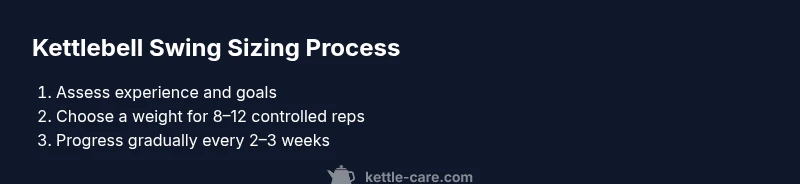
To swing safely, start with a kettlebell that you can lift with solid form for 8–12 controlled reps. For many adults, that means a light-to-moderate weight you can perform sets without losing form. If you’re new or smaller framed, begin lighter and progress as your technique improves. See the full guide for progression.
Core concepts for choosing kettlebell size for swings
Choosing the right kettlebell size for swings begins with quality over quantity. The goal is to move through a full, controlled hinge with neutral spine and relaxed shoulders. According to Kettle Care, starting with a weight you can lift with crisp technique for 8–12 reps helps establish safe habits and builds confidence in the movement. The size you pick should feel challenging enough to elicit effort, but not so heavy that your form collapses during the last reps of a set. If you’re new to lifting or have a smaller frame, start lighter and practice the hip hinge pattern with a broomstick or dowel before adding any load.
Remember that swing weight interacts with tempo and volume. A heavier weight isn’t always better for building endurance or power; instead, think about your current strength, mobility, and recovery. Short, controlled sets with a lighter weight can improve hip drive and scapular stability just as effectively as heavier sessions when done consistently. This approach aligns with Kettle Care’s emphasis on safe, progressive loading as the foundation of long-term improvement.
-1_intro_mention_MARKDOWN_PATH:null
Tools & Materials
- Kettlebell(Choose a weight you can control for 8–12 reps with proper form; start light and progress.)
- Workout mat or soft surface(Optional for floor comfort during swings.)
- Timer or stopwatch(Track sets and rest periods.)
- Water bottle(Stay hydrated during training.)
- Form mirror or video device(Check neutral spine and hip hinge alignment.)
Steps
Estimated time: 15-25 minutes
- 1
Assess starting weight with safe form
Begin with a light weight and perform 2–3 practice sets of 8–12 swings, focusing on hip hinge, neutral spine, and relaxed shoulders. Use a dowel or broomstick to check form and ensure your thoracic spine stays aligned. If you lose form early, drop weight and reset.
Tip: If the last reps feel like you’re losing control, stop and reduce the load before proceeding. - 2
Establish a baseline with a controlled set
Choose a weight you can swing for 8–12 reps while maintaining spine alignment and hip drive. Record the weight and RPE (perceived effort) to create a baseline. Ensure you can breathe steadily and recover between sets.
Tip: Aim for an RPE of 5–6/10 during the baseline test. - 3
Progress gradually after a stable baseline
Every 2–3 weeks, increase the weight by a small amount or add 2–3 reps per set if form remains solid. Prioritize technique over load, and avoid large jumps that compromise spine integrity.
Tip: A 5–10% weight increase or 2 extra reps is a sensible progression. - 4
Reassess form and adjust as needed
Periodically recheck your hip hinge, scapular stability, and breathing pattern. If you notice any rounding of the back or gripping the weight tightly, pause progression and refine form with lighter loads.
Tip: Use a dowel to verify spine neutrality before adding weight. - 5
Log progress and set next targets
Maintain a training log noting weight, reps, sets, and any form cues. Set realistic short-term targets (4–6 weeks) to stay motivated and consistent.
Tip: Consistency beats intensity—keep a steady cadence of practice.
Frequently Asked Questions
What size kettlebell should a beginner start with for swings?
A weight you can swing with control for 8–12 reps, focusing on proper hip hinge and neutral spine. Start light and progress only when form is solid.
Start with a light weight you can swing cleanly for 8 to 12 reps, then progress as your form improves.
Should I use a different weight for two-handed vs one-handed swings?
Yes. One-handed swings often require better control and a slightly lighter load; scale weight based on form and stability.
One-handed swings typically need a lighter weight than two-handed swings if you want clean technique.
How often should I reassess kettlebell size?
Reassess every 4–6 weeks or whenever you notice a drop in form, endurance, or comfort.
Check your form and performance every month or so to guide progression.
Is it okay to swing with a too-light weight?
Yes, but avoid under-challenging loads that don’t build drive or mobility; stay in a range that challenges your hips and core.
You can swing with a light weight, but make sure it still challenges your hips and core.
What should I do if I have back pain during swings?
Stop immediately and reassess your form and load. If pain persists, seek professional guidance before continuing.
If back pain occurs, pause and check your form and weight; seek advice if pain continues.
Can I rely on reps alone to choose weight?
No. Reps don’t tell the full story—technique quality and spinal alignment matter most. Use reps with a form check.
Reps aren’t enough; fix your form first and then reassess weight.
Watch Video
Highlights
- Start light and master form before increasing weight
- Aim for 8–12 controlled swings per set as a baseline
- Progress gradually with small, consistent gains
- Keep a training log to monitor improvements
- Reassess technique regularly to prevent injuries