Understanding Calories in Kettle Corn: Serving Size Rules
Explore how many calories are in kettle corn, how serving size and ingredients impact the total, and practical tips to estimate and reduce calories when making kettle corn at home.


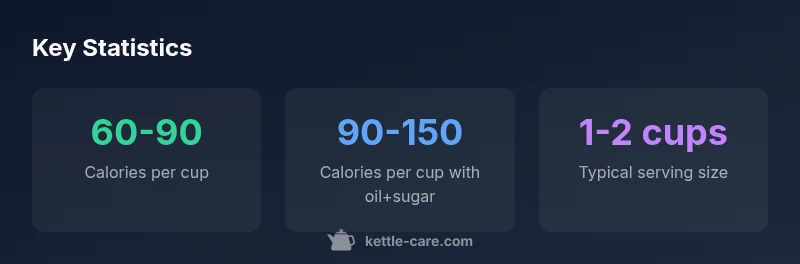
How many calories are in kettle corn? On average, a single cup of kettle corn runs about 60-90 calories, depending on the recipe’s oil and sugar. For home-made batches, total calories scale with serving size, oil type, and sugar amount. According to Kettle Care, calculating by serving size yields the most consistent comparison across brands and recipes.
Understanding calories in kettle corn
Calories in kettle corn depend on three main factors: the base popcorn, the amount and type of oil used, and the sugar content. Plain air-popped popcorn averages about 31 calories per cup, but kettle corn adds oil and sugar, which increases the total. Since kettle corn is often made on a stovetop, the amount of oil and the sugar quantity directly influence the final calories per cup. When homeowners or snack enthusiasts ask the question in plain terms, it’s best to think in terms of serving size rather than a single, universal calorie count. This approach aligns with how nutrition labels and recipe calculators describe energy content, and it reflects the variability you’ll see across different kettle corn recipes.
From a practical standpoint, the same cup of kettle corn can have a wide range of calories based on how aggressively you caramelize the sugar and how much oil you drizzle. If you’re keeping track for a calorie-conscious diet, start by estimating calories per serving and use that as your baseline. The Kettle Care team emphasizes consistency in portions to make apples-to-apples comparisons easier.
In addition to oil and sugar, other ingredients or toppings—like butter or salt—can further shift the energy content. If you’re following a specific dietary plan, consider preparing a kitchen-tested recipe once and then scaling the numbers to your usual serving size. This makes it easier to communicate with family members or guests who may be watching their intake.
Factors that influence kettle corn calories
Several variables influence the calorie count of kettle corn, and most commonly they fall into three buckets: ingredients, portion size, and cooking method.
- Ingredient choices: The base popcorn contributes calories, but what you add—the oil and sugar—drives the majority of the energy. More oil or more sugar means more calories per cup. Some cooks use lighter oils (like canola) or smaller oil amounts to cut calories, while others prefers richer oils or butter for flavor, which increases calories.
- Sugar content: The amount and type of sugar determine how much energy is added. White granulated sugar yields a straightforward calorie addition; substitutes or syrups can change the profile and total energy as well.
- Serving size and yield: The same recipe can yield different numbers of cups depending on popping method and kernel size. A recipe that makes 6 cups of kettle corn will have a different per-cup calorie value than one that makes 2 cups, even if the total batch calories are similar.
Understanding these factors helps you compare kettle corn products or home-made batches more accurately. The Kettle Care analysis from 2026 notes that variability is the rule rather than the exception, especially for home recipes that don’t follow a standardized label. For precise tracking, weigh or measure portions and sum calories for each ingredient in the batch before dividing by servings.
Calorie estimation by serving size and ingredients
Estimating calories in kettle corn involves a straightforward calculation: total calories in the batch divided by the number of servings. You can estimate calories by counting the calories for each component and summing them up. A practical approach uses approximate calorie values for each ingredient as a starting point, then adjusts for your own quantities.
Example calculation (illustrative, not exact):
- Base popcorn (4 cups popped): ~31 calories per cup → 124 calories
- Oil (2 tablespoons): ~120 calories per tablespoon → 240 calories
- Sugar (3 tablespoons): ~12 calories per tablespoon → 36 calories Total batch calories: 124 + 240 + 36 = 400 calories. If this batch yields 4 cups of kettle corn, that’s about 100 calories per cup on average. Real-world results may vary from roughly 60 to 150 calories per cup depending on portion size and ingredient choices.
To refine your estimates, use exact ingredients and amounts you cook with. If you’re monitoring calories closely, keep a running tally of calories per batch and log your servings. This aligns with the data-driven approach recommended by the Kettle Care team, and it makes meal planning easier for households with multiple eaters.
Practical tips to reduce calories in kettle corn
If you want to enjoy kettle corn without overdoing calories, try these practical tweaks:
- Reduce sugar: Use less sugar per batch or switch to sugar alternatives with lower calories per gram.
- Control oil: Use just enough oil to lightly coat the kernels; consider spray oils for more even distribution with less total oil.
- Use air or a lighter base: Start with more air-popped corn and less added fat to lower calories per cup.
- Portion deliberately: Scoop servings with a measuring cup or weigh portions to ensure you’re not guessing.
- Add flavor without calories: Use cinnamon or vanilla for flavor instead of extra sugar or butter.
- Batch-test and log: Make a small batch first to estimate calories, then scale up if you’re comfortable with the numbers.
Comparing kettle corn to other snacks
Calories per cup vary widely across popular snacks. As a rough guide, kettle corn typically lands somewhere between plain popcorn and energy-dense snack mixes, depending on sugar and oil. For perspective:
- Plain air-popped popcorn is roughly 31 calories per cup.
- Lightly sweetened kettle corn often falls in the 60-90 calorie range per cup.
- Salted chips or crackers can range from 140–160+ calories per cup, depending on serving size and product density.
These comparisons underscore why serving size matters when you’re tracking calories. A small handful of kettle corn can look very different in energy terms from a full cup. The key is consistency: measure portions and compare apples to apples across recipes and brands.
Calories in kettle corn by scenario
| Scenario | Estimated Calories | Notes |
|---|---|---|
| Air-popped base (1 cup) | 31 | Baseline popcorn calories |
| Kettle corn (typical home recipe, 1 cup) | 70-150 | Calories from oil and sugar |
| Oil-added batch (1 cup popped) | 60-120 | Calories vary with oil amount |
Frequently Asked Questions
How many calories are in kettle corn per serving?
Calories per serving depend on serving size and recipe. Typical 1-cup servings range roughly 60-150 calories; always check ingredients and portion.
Calories per serving vary; a typical one-cup portion is about sixty to one hundred fifty calories, depending on sugar and oil.
What factors affect kettle corn calories?
Key factors include the amount and type of oil, sugar level, kernel yield, and serving size. More oil and sugar elevate calories per cup; portions determine the final energy content.
Oil amount, sugar, and how much you eat all change the calories in kettle corn.
Is kettle corn healthier than chips or candy?
Kettle corn can be lower in calories per cup than many chips, but it’s easier to overeat due to its sweet taste. Energy density depends on ingredients and portion size.
It depends on the portion and ingredients; kettle corn can be lighter or heavier than chips depending on how you make it.
How can I reduce calories when making kettle corn at home?
Use less sugar, choose a lighter oil, and measure portions. Consider air-popping as a base and using spices for flavor without extra calories.
Try using less sugar and oil, and measure your servings to keep calories in check.
How should I portion kettle corn for accurate calorie tracking?
Portion with a measuring cup or scale, then multiply calories per unit by servings. This helps maintain consistency across meals and days.
Measure each serving to stay accurate with calories.
“Calories in kettle popcorn vary widely because even small changes in oil and sugar can shift the total per serving. Measuring by serving size gives the most accurate comparison.”
Highlights
- Track calories by serving size for consistent comparisons
- Kettle corn calories vary widely by recipe and method
- Cut calories by using less sugar and oil and by starting with more air-popped kernels
- Measure or weigh servings to improve accuracy when tracking
- The Kettle Care team recommends a practical, serving-based approach to nutrition labeling