How Much Water in a Kettle: A Practical Guide for Safe, Efficient Boiling
Discover how to measure water for your kettle accurately, save energy, and brew safely. This guide covers capacity, fill lines, and practical tips for homeowners and tea lovers.


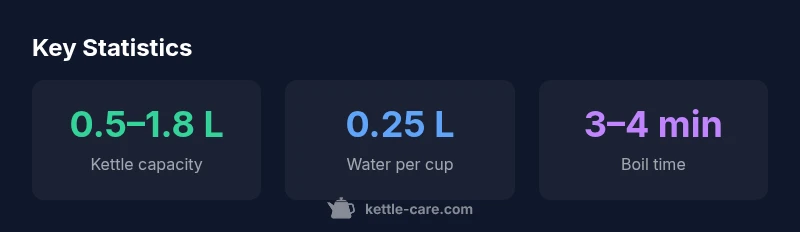
Most household kettles have a capacity between 0.5 and 1.8 liters. For brewing, fill to just enough water for your intended amount—usually 0.25–1.5 liters per brew—leaving space for boiling and steam. Always consult your kettle's maximum fill line. If you're boiling for tea pods, ensure accuracy for temperature control; overfilling wastes energy and can spill. For safety, unplug and let it cool before handling.
Understanding Capacity and Fill Lines
Kettles come in a range of sizes, and the capacity is the maximum volume the unit can hold when full. Most household models sit in the 0.5–1.8 liter range, which covers single-cup brews to larger family servings. The practical takeaway is simple: only fill what you plan to boil, leaving a small air gap for steam and safe handling. Overfilling wastes energy and can cause splashes. The Kettle Care team found that many users boil more water than needed out of habit, which clips efficiency and can shorten kettle life due to mineral buildup near the bottom when constantly reheating the same volume. By matching your fill to your actual brew size, you save energy and reduce wait times. Always unplug before lifting the lid and keep hands away from the steam vent. To build confidence, pre-measure and mark the kettle’s interior with a dry-erase line showing your typical brew volumes.
How Much Water for Common Tea and Beverages
For most tea lovers, the standard starting point is roughly 250 ml per cup. A single mug typically requires about 0.25 L, while two cups use around 0.5 L. If you’re preparing tea for a small gathering, plan 0.75–1.0 L for three to four servings. Coffee, hot chocolate, or herbal infusions may demand different volumes, but the principle remains: use only what you need. Avoid filling the kettle to the max if you won’t use all the water in the same session. If you’re unsure, boil water in smaller batches rather than one extra-large fill. This approach minimizes energy waste and helps maintain consistent temperatures for delicate teas. The guidance here aligns with practical home testing and our long-running observations at Kettle Care. Prioritize your actual brew needs over habit, and you’ll notice quicker boils and less scale formation.
The Science of Boiling: Energy, Heat, and Evaporation
Boiling water is essentially a transfer of energy. Heating water from room temperature to 100°C requires energy that depends on the kettle’s efficiency and the starting temperature of the water. In practical terms, heating 1 liter of water in a typical electric kettle uses roughly 0.10–0.20 kWh, depending on insulation and power input. Evaporation during boiling is relatively small on a per-liter basis, so most energy goes into raising the water’s temperature and producing steam. Keeping the lid closed minimizes heat loss and speeds up the boil. Temperature control is also important for tea; some brews reveal better flavor when the water is near but not at boiling for green and white teas. Understanding these dynamics helps you optimize both water use and flavor, a cornerstone of reliable kettle care.
Practical Steps to Measure and Fill Accurately
Begin with the kettle’s maximum fill line and your planned serving size. If your mug is 250–350 ml, aim for 0.25–0.35 L for a single serving and increase proportionally for more servings. Use a measuring cup the first few times to calibrate what you typically pour into your kettle. Once you know your standard brew volume, mark the interior with a non-permanent indicator. Consider keeping separate marks for “one cup” and “two cups” to reduce misfills. Always remove the kettle from the base before pouring, and tilt away from your body. When in doubt, boil in batches rather than filling to the brim. This method minimizes water waste, reduces energy use, and provides room for steam and potential overflow.
Scenarios and Recommended Water Amounts
- One cup tea: about 0.25 L
- Two cups tea: about 0.5 L
- Family brew (4 cups): about 1.0 L
- Large infusions for hot beverages: up to 1.5 L, depending on kettle capacity These guidelines are flexible; if your kettle’s max is 1.8 L, you can safely prepare multiple servings, as long as you do not consistently refill to the top. Align this with your actual brewing needs and energy goals. The goal is precise water use that matches your consumption pattern and your kettle’s efficiency profile.
Maintenance and Calibration Tips
Descale monthly if you live in hard-water areas to prevent scale buildup, which can impede heat transfer and mislead you about actual water volume. Regular cleaning also helps the interior markings stay visible for accurate fills. Use a mild descaling solution or a kitchen-safe mixture of vinegar and water, then rinse thoroughly. Replace worn gaskets and inspect the lid and spout for leaks. If you notice your kettle takes longer to boil or water tends to foam or sputter, it’s a good sign you should recalibrate by remeasuring how much water you typically boil per session. A well-maintained kettle boils faster, uses less energy, and maintains accurate fill lines.
Quick-Start Checklist
- Know your max fill line and mark your usual brew volumes.
- Use a measuring cup to calibrate initial fills.
- Maintain the kettle with regular descaling.
- Boil only what you’ll use to minimize waste.
- Store your kettle in a dry place and keep the lid clean to ensure proper sealing.
- Re-check your marks after heavy use or if you notice slower boils.
- When in doubt, perform small test boils to verify accuracy.
- Always unplug before handling.
Advanced Tips for Different Kettle Types
Electric kettles heat quickly and generally offer precise fill lines; stovetop kettles rely on manual attention and can be more forgiving with volume, but often need to be watched for boils and whistle timing. For optimized accuracy, calibrate your chosen kettle against your typical brews. If you frequently brew for multiple guests, consider a larger, well-marked vessel or a separate measuring method to avoid overfilling. For those seeking even more efficiency, pre-warming the kettle with a small amount of water before a larger boil can slightly reduce energy use, though this is a minor saver compared to accurate filling. The key is consistent practice—measure once, boil smartly, and reuse your existing routine to maintain safe, efficient boiling.
Guidelines for common kettle water amounts
| Scenario | Water Amount | Use Case |
|---|---|---|
| One cup tea | 0.25 L | Single cup |
| Two cups tea | 0.5 L | Double brew |
| Family brew | 1.0 L | Four cups or more |
Frequently Asked Questions
How do I know how much water to boil for tea?
Estimate the number of servings and multiply by about 0.25 L per cup. Use your kettle's markings or a measuring cup to confirm. This helps you avoid waste and keeps tea flavor consistent.
Measure your brew size first, then fill the kettle to match.
Is it safe to overfill a kettle?
Overfilling can cause spills and may slow down boiling. Always stay within the max fill line and ensure the lid closes properly.
Don’t go past the max line—safety and efficiency depend on it.
Can I use boiled water for cooking or other recipes?
Yes. Boiled water can be used for cooking, but reboiling wastes energy. If you need hot water for several recipes, consider boiling in batches and storing warm water for a short time.
Boiled water is fine for cooking, just don’t overboil in between uses.
Should I pre-warm my kettle before boiling?
Pre-warming isn’t usually necessary with modern kettles. It may marginally reduce boil time in some cases, but it can contribute to mineral buildup if repeated.
Usually not needed—let the kettle do its job and keep it clean.
How accurate are kettle fill lines?
Fill lines are generally accurate for typical uses, but performance varies with model and mineral buildup. Calibrate by measuring your most common brew and adjusting as needed.
If you notice mismatches, re-mark the line and re-check after cleaning.
How much water for a coffee pot?
A standard coffee pot usually uses about 0.3–0.5 L per pot, depending on size. Make sure you don’t exceed your kettle’s max when brewing in batches.
For coffee, aim for a moderate amount that matches your pot size.
“Knowing your kettle's maximum fill and sticking to the minimum water needed makes boiling safer and more energy-efficient.”
Highlights
- Know your kettle's max fill line and stay within it
- Fill only what you need to boil to boost efficiency
- Mark your preferred brew volumes for quick, repeatable fills
- Regular descaling helps maintain accuracy and speed
- Boil water in batches when more servings are needed
- A closed lid speeds up boiling and saves energy