Kettlebell Before and After: A Data-Driven Progress Guide
Analyze how kettlebell before and after progress unfolds with structured training, precise tracking, and progressive overload. This data-driven guide covers baselines, programming, technique, recovery, and practical milestones for safe, measurable gains.


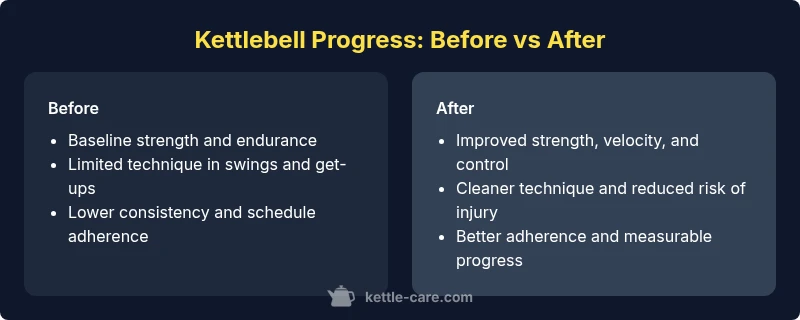
For kettlebell before and after results, consistency with a structured progression beats random workouts. Track objective milestones—reps, load, tempo, and form—and progressively overload every 1–3 weeks. The result is clearer gains in strength, endurance, and technique, delivered with safer, data-driven decisions guided by the Kettle Care approach.
Why kettlebell before and after progress hinges on consistency and measurement
Progress with kettlebells isn’t magical. It’s a function of consistent effort, quality technique, and reliable measurement. The concept of kettlebell before and after captures the idea that most people want to see changes in strength, conditioning, and movement quality after a defined training block. In this analytical guide, we compare outcomes from a structured program versus an unstructured routine, and we discuss how to establish baselines, track progress, and interpret results. By focusing on concrete metrics—reps, loads, tempo, and form—you can quantify improvements more clearly than relying on subjective feel alone. The goal is to turn every training session into data you can review, compare, and learn from. According to Kettle Care, progress that is tracked over time is more reliable than progress that is felt in the moment. The kettlebell before and after story is about turning effort into evidence, not wishful thinking.
Baseline benchmarks: setting a fair starting point for kettlebell progress
Before you start counting days to a dramatic kettlebell before and after, you need a reliable baseline. A practical approach is to test a small, representative set of kettlebell movements at a comfortable weight, emphasizing control and technique rather than maximal loads. Typical baseline drills include a two-handed swing, goblet squat, Turkish get-up, and a light clean and press or snatch on each side. Record reps completed with perfect form, the heaviest weight you can control for a set number of reps, and your tempo (how slowly or quickly you move through each phase). Visual baseline data—timed videos or simple counts—will help you quantify later kettlebell progress after consistent training blocks.
Progressive overload: how to advance safely in kettlebell training
Progressive overload is the engine of kettlebell before and after gains. The simplest method is to increase load or reps gradually while maintaining technique. You can advance by adding weight in small steps (e.g., 2–4 kg), increasing reps per set, or extending time under tension with controlled tempo. Alternate between lighter, higher-volume weeks and heavier, lower-volume weeks to prevent overtraining and reduce injury risk. A key principle is to log every workout and review trends every 2–3 weeks. This way, you can adjust volume, intensity, and exercise selection to keep your kettlebell progress moving forward without sacrificing form.
Program structure: a practical split for visible kettlebell before and after results
A typical mid-length plan uses a three- to four-day-per-week template that alternates between full-body and movement-specific sessions. For example, you might rotate through a swing-focused day, a get-up/press day, and a loaded carry or goblet squat day, with one day dedicated to mobility and recovery. The aim is to balance skill work and conditioning with adequate rest. If you’re evaluating kettlebell before and after outcomes, you should tailor the plan to your current conditioning level, mobility, and available equipment. A structured plan minimizes decision fatigue and makes tracking progress straightforward, which reinforces adherence and better long-term results.
Technique quality and safety: the foundation of any kettlebell before and after success
Technique is non-negotiable when chasing kettlebell progress. Flawed form not only hampers gains but increases injury risk. Prioritize hip hinge mechanics, neutral spine, and controlled breathing. Use video to self-review or enlist a coach for feedback on key movements such as the swing, Turkish get-up, and clean and press. Corrective cues—like “driving the hips,” “stabilizing the core,” and “keeping the kettlebell close to the body”—help fix common errors. Safety also means choosing an appropriate weight, warming up properly, and listening to your body to avoid overreaching too soon in your kettlebell before and after journey.
Measurement tools: what to track for kettlebell progress
Reliable progress hinges on objective data, not vibes. Track quantitative metrics such as set/workout volume (reps × weight × sets), max reps at a given weight, and time under tension. Add qualitative metrics like movement quality scores, error repetitions, and perceived exertion (RPE). Video analysis provides a clear before-and-after view of technique, making it easier to identify the smallest improvements you wouldn’t notice in the moment. By combining quantitative data with qualitative assessment, you create a robust kettlebell progress log that makes kettlebell before and after comparisons meaningful.
Nutrition, sleep, and recovery: enabling kettlebell progress
No amount of training will yield consistent kettlebell before and after gains without adequate recovery. Protein intake supports muscle repair, and carbohydrates fuel high-intensity sessions. Sleep quality matters as much as volume and intensity. For most people, better sleep correlates with smoother technique, quicker recovery, and fewer aches after kettlebell sessions. Plan recovery days with mobility work, breathing drills, and light conditioning. A well-rounded plan that respects recovery will accelerate kettlebell progress without compromising long-term health.
Sample 6- to 8-week progression: a concrete framework for kettlebell before and after
A practical progression balances skill work, strength work, and conditioning. Week-by-week, you can vary load, reps, and tempo to ensure continuous adaptation. For example, weeks 1–2 might emphasize groove and consistency of the swing, weeks 3–4 introduce a steadier tempo and heavier loads in goblet squats, weeks 5–6 build towards heavier get-ups with controlled pauses, and weeks 7–8 mix in shorter rest and higher-volume conditioning. The result is a measurable kettlebell before and after story where each block builds on the last, supported by video reviews and training logs.
Common pitfalls and how to avoid them
Many lifters chase kettlebell progress by adding weight too quickly or skipping warm-ups. Common holes include ignoring mobility limits, sacrificing form under fatigue, and neglecting deload weeks. The fix is simple: implement a consistent warm-up, prioritize technique over load, and schedule regular deloads or easy weeks. Use a simple 4-week macrocycle with a built-in progression, then reassess skills and capacity before moving forward. This approach makes kettlebell before and after progression safer, more predictable, and more sustainable over time.
Beyond numbers: functional and lifestyle outcomes of kettlebell progress
While numbers matter, the broader impact of kettlebell before and after training includes better posture, athletic ability, and daily function. Movements like the get-up translate to real-life stability, balance, and core control. For tea lovers and home cooks, improved conditioning translates to longer, steadier kitchen sessions and reduced fatigue when handling heavy pots or lifting water jugs. Seeing progress in function—happier shoulders, stronger hips, improved balance—often motivates continued adherence more than numeric milestones alone.
How to document and present your kettlebell before and after story
Documenting progress creates a powerful narrative that motivates you and can inspire others. Capture baseline measurements with photos and a simple form score, then retake measurements every few weeks. Create a side-by-side visual—before and after videos or photos—showing swings, get-ups, and carries. Use a lightweight tracker or app to summarize progress in a concise format: starting weight, current weight, reps completed, and notes on technique. A well-documented kettlebell before and after journey helps ensure accountability and clarity for future programming.
Comparison
| Feature | Structured 6-Week Plan | Open-Ended/Unstructured Routine |
|---|---|---|
| Progress consistency | High consistency due to schedule and progression | Lower consistency due to variability and lack of plan |
| Volume progression | Systematic increases in load/reps | Ad-hoc changes without a defined progression |
| Form coaching | Guided feedback, regular check-ins | Often relies on self-assessment or infrequent feedback |
| Time to first visible changes | Faster early gains from structured overload | Slower or irregular gains without overload pattern |
| Best for | New lifters seeking safe, measurable gains | Lifters who prefer flexibility or have irregular schedules |
Strengths
- Clear milestones and measurable milestones
- Improved adherence through scheduled sessions
- Easier to identify which elements drive improvements
- Safer progression with built-in deloads and resets
- Better long-term planning and accountability
What's Bad
- Requires upfront planning and discipline
- Can feel rigid for some schedules
- Tends to demand consistent access to equipment and space
Structured plans generally outperform unstructured routines for kettlebell progress
A structured progression provides clear overload, better form in the kettlebell movements, and a trackable path to the kettlebell before and after improvements. For most trainees, this approach minimizes guesswork and maximizes safe, repeatable gains.
Frequently Asked Questions
How long does it typically take to see kettlebell progress after starting a structured plan?
Most people notice tangible progress within a 4–8 week block when following a structured plan with progressive overload and quality technique. Results can vary based on baseline fitness, mobility, and consistency.
Most people start noticing improvements in about a month or two when they follow a steady plan with progressive overload and good form.
What metrics should I track for kettlebell before and after progress?
Track objective metrics like reps, weight, and sets, plus movement quality scores and tempo. Add subjective metrics such as RPE and sleep quality to understand how recovery affects progress.
Track reps, weights, and tempo, plus form quality and how you feel after each session to understand progress.
Is a split routine better than a full-body approach for kettlebell gains?
Both can be effective. A full-body approach often yields faster overall conditioning and balanced strength for beginners, while a split can allow higher frequency for targeted lifts when you’re more experienced.
Both work. Start with full-body for balance, move to split if you need more focused strength gains.
How can I avoid injury while pursuing kettlebell progress?
Prioritize warm-ups, mobility work, and technique above load. Use smaller steps in progression, and listen to your body to avoid pushing through pain. Seek feedback on form from a coach or video review.
Warm up well, keep technique sharp, and progress gradually to stay safe.
What equipment do I need to start a kettlebell progress program?
A modest range of kettlebell weights appropriate for your level, a reliable floor space, and a timer or app for tracking sets. A mirror or video setup helps with form checks.
Just a couple kettlebells you can lift safely, plus space to move and a way to time your sets.
Highlights
- Set a baseline with key lifts and form measurements
- Progression should be deliberate, not random
- Record both quantitative and qualitative progress
- Prioritize technique to maximize long-term gains
- Recovery and sleep are essential to kettlebell progress