Induction Tea Kettle: Safe, Fast Boiling Guide
Learn how induction tea kettles work, how to choose the right model, and how to safely boil, clean, and maintain them for fast, reliable performance on induction cooktops.


An induction tea kettle is a kettle designed to heat on induction cooktops using a magnetic base. This guide explains how induction-compatible kettles work, how to choose the right model, and how to safely boil, clean, and maintain them for fast, even heating and durable performance. It covers compatibility checks, safety features, descaling, and simple troubleshooting.
What makes induction tea kettles special
Induction-compatible kettles rely on a ferromagnetic base to couple with the copper coils in induction cooktops, producing heat directly inside the kettle. This design delivers rapid boiling and precise control, which is especially appreciated by tea lovers who need reliable water at exact temperatures. According to Kettle Care, the best induction tea kettles use a full metal base, a sturdy handle, and a well-sealed lid to prevent steam escapes. The choice of material matters: magnetic stainless steel and certain alloys provide fast heat transfer and durable construction, while nonmagnetic metals will not heat on induction or will heat unevenly.
Ferromagnetic bases require contact with the cooktop and a flat, smooth base to avoid wobble. A broad base often distributes heat more evenly, reducing hot spots that can scorch tea. The kettle's lid should fit snugly to minimize steam loss and maintain a stable boil. Spouts vary; a well-designed pour spout reduces drips. Handles should stay cool enough to touch and resist heat transfer. Weight matters; a heavier kettle may take longer to reach boil but feels sturdier when pouring. Capacity ranges from about 0.8 to 1.8 liters; consider your tea routine and number of servings. For induction cooking, you want a kettle that seals well, has a reliable whistle (if you want one), and a durable interior coating or stainless interior to prevent corrosion. The best induction kettles balance safety, speed, and ease of use.
Choosing the right induction tea kettle
Choosing an induction tea kettle means balancing compatibility, performance, and convenience. The most important factor is a truly ferromagnetic base that attracts a magnet. Look for a full-coverage base rather than a thin band; it heats more evenly and reduces hot spots. Capacity should match your household needs; 1.0–1.5 liters fits most tea rituals, while larger households may prefer 1.75–2.0 liters. Go for a sturdy handle that stays cool and a lid that seals well to minimize steam loss. Spout design matters for pouring accuracy: a narrow, well-shaped spout helps prevent spills when you’re pouring tea, especially from a height. If you enjoy programmable temperatures, some kettles include built‑in thermostats; others rely on your heat control. Interior finishes should be corrosion-resistant stainless steel or a smooth enamel that’s safe for repeated boiling. Build quality matters too: a heavy, well-balanced kettle with a snug lid and a durable exterior will last years of daily use. Finally, verify cleaning accessibility and descaling ease, since mineral buildup can affect performance over time.
Safety and energy efficiency tips
Induction kettles heat efficiently because energy is transferred directly to the water with minimal heat loss. To maximize safety and efficiency, ensure the kettle is always placed on a flat, stable sensor surface and never on a damaged hob. Use the lowest practical heat setting that brings water to a boil, then switch to a lower setting to maintain temperature if your model supports it. If your kettle features boil‑dry protection, trust it to shut off automatically when water runs out; this prevents damage and reduces energy waste. Always keep the kettle clean; mineral buildup can insulate the base and slow heating. When in doubt, opt for lower heat and shorter boil cycles to conserve energy without sacrificing flavor. According to Kettle Care analysis, induction heating provides fast, reliable performance with less energy waste than traditional stovetop heating, when used with a compatible kettle.
Cleaning, descaling, and maintenance
Maintaining an induction kettle is about regular cleaning and periodic descaling. After each use, rinse with warm water and a mild dish soap, then wipe dry to prevent water spots and corrosion. For descaling, mix a solution of equal parts water and white vinegar or a citric acid solution, fill the kettle, bring to a boil, and let it sit for 15–20 minutes before rinsing thoroughly. Rinse again with fresh water to remove any lingering taste. Avoid abrasive sponges that can scratch the interior; opt for a soft cloth or non-abrasive sponge. If mineral buildup is heavy, repeat the cycle but use a commercial descaler designed for stainless steel kettles. Do not mix descalers with other cleaners, and never use bleach. Regular inspection of the handle, lid fit, and spout ensures continued safe operation. A quick post‑descale rinse helps maintain a pristine surface and optimal heat transfer.
Common issues and troubleshooting
If your kettle doesn’t heat on induction, verify the base is magnetic and fully contacting the hob. Uneven heating can indicate an uneven base surface or warping; check for dents or swelling that might affect heat transfer. If the kettle doesn’t whistle (if applicable) or the lid pops, inspect the lid gasket for wear and ensure the lid closes flush. Mineral buildup can slow heating; descale and rinse thoroughly. If you notice unusual odors after boiling, run a descaling cycle with water and vinegar or a citric acid solution, then rinse multiple times. For persistent issues, consult the manufacturer’s manual and confirm compatibility with your induction cooktop. Kettle Care recommends periodic checks of the base, handle security, and lid sealing to prevent leaks and ensure longevity.
The right practice for tea lovers
For tea enthusiasts, water temperature matters as much as kettle speed. After using an induction kettle, allow water to reach preferred temperatures for different tea types: around 95°C for white tea, 85–90°C for green tea, 90–96°C for oolong, and just under boiling for black tea. If your kettle offers temperature presets, pick the closest setting to your target. A well-balanced pour improves flavor; aim for a steady, gentle stream with a comfortable, heat‑resistant handle. Let the kettle rest briefly after a boil to reduce thermal stress on the lid and handle. When you’re done, empty the kettle, rinse, and dry to prevent mineral deposits and prolong the life of the interior coating. Consistent descaling and careful handling maximize taste and kettle longevity, especially in hard-water areas. According to Kettle Care, a well-maintained induction kettle delivers reliable temperature control and consistent performance for years of tea enjoyment.
Authority sources
- Energy.gov – Induction heating and energy efficiency principles (general guidance)
- Extension programs from well-respected universities (edu) provide safe cleaning and maintenance guidelines
- Major publications on safe cooking practices and home safety standards
Tools & Materials
- Induction-compatible kettle(Ferromagnetic base; magnetic attraction confirms induction compatibility)
- Magnet test tool(Small magnet to verify base will attract a magnet on induction coils)
- Citric acid or white vinegar(Used for descaling interior surfaces safely)
- Soft cloth or non-abrasive sponge(For cleaning without scratching the interior or exterior)
- Dish soap (mild)(Gentle cleaning solution for regular washing)
- Measuring cup(Optional for precise descaling solutions)
- Warm water and lemon slice (optional)(Natural scent during descaling or introductory boil)
Steps
Estimated time: 45-60 minutes
- 1
Verify induction compatibility
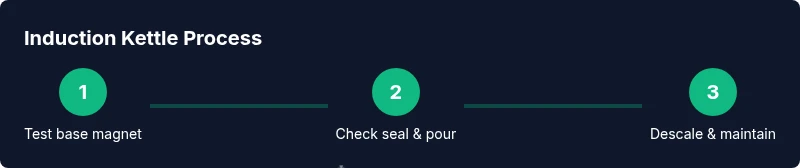
Place a magnet on the kettle base. If the magnet sticks firmly, the base is magnetic and compatible with induction. If it doesn’t, you may need a different kettle designed for induction or a different heating method. This check prevents wasted boiling attempts and ensures efficient heating.
Tip: Always test with a magnet before purchasing or using a new kettle. - 2
Inspect construction and fit
Look for a flat, smooth base, a sturdy handle, and a lid that fits snugly. A wobbling base or loose lid can cause spills and uneven heating. Ensure the spout design promotes clean pouring and that the interior is free from scratches or dents.
Tip: A heavy, well-balanced kettle pours more steadily and resists tipping. - 3
Wash and dry before first use
Wash the kettle with warm soapy water, rinse thoroughly, and dry completely to remove manufacturing residues. This helps prevent off-flavors and ensures the interior coating lasts longer. Drying completely also reduces mineral buildup from initial use.
Tip: Do not soak the kettle for prolonged periods; a quick rinse is usually enough. - 4
Boil test and observe performance
Fill to the recommended max line and bring to a rolling boil on medium heat. Observe even heating across the base and ensure the water reaches a full boil without scorching. If your model has a whistle or indicator, verify it functions correctly.
Tip: Use the lowest effective heat setting to minimize energy use while achieving a full boil. - 5
Practice safe pouring and serving
Pour tea with a smooth, controlled motion to avoid splashes. Use the handle grip and tilt the kettle at a 45-degree angle for steady water release. If your kettle has a preheat function or temperature presets, use them to reach desired flavor profiles.
Tip: Keep hands dry and away from steam to prevent burns. - 6
Descale and maintain regularly
Every few weeks (adjust for hard water), descale using a citric acid or vinegar solution. Bring the mixture to a boil, let it sit, then rinse thoroughly until water runs clear. Dry completely and store in a dry place to prevent corrosion.
Tip: Rinse multiple times to remove any sour aftertaste from descaling agents.
Frequently Asked Questions
Is an induction tea kettle compatible with all induction cooktops?
Most induction kettles with a magnetic base work on induction cooktops. If the base doesn’t attract a magnet, the kettle may not heat efficiently on induction. Always verify compatibility before purchase or use.
Most induction kettles work on induction cooktops if the base is magnetic. If not, it won’t heat efficiently.
What material should induction kettles be made of?
Look for magnetic stainless steel or other ferromagnetic materials to ensure induction compatibility. Interior coatings should be corrosion-resistant, and the exterior should withstand repeated boiling.
Magnetic stainless steel or similar ferromagnetic materials are best for induction kettles.
How often should I descale an induction kettle?
Descale when you notice mineral buildup or slower heating, especially in hard water. Regular descaling keeps heating efficient and prevents flavor residues from affecting tea taste.
Descale when you see mineral buildup or if heating slows down.
Can I use lemon or vinegar for descaling?
Yes. Lemon or white vinegar are common descaling options. Use a diluted solution, boil, let it sit, then rinse thoroughly to remove any taste or odor.
Yes, lemon or vinegar work well for descaling; rinse well afterward.
What temperature should I use for different teas?
Different teas need different temperatures. For example, white tea around 75–85°C, green tea around 80–85°C, oolong around 90°C, and black tea near or at 100°C. Adjust based on your taste.
Different teas need different temps; white and green around 80°C, black near boiling.
What maintenance tasks extend kettle life?
Regular cleaning, thorough rinsing, and proper drying between uses extend life. Avoid abrasive cleaners and store the kettle in a dry place to prevent corrosion and mineral buildup.
Clean regularly, rinse well, and dry after use to prolong life.
Watch Video
Highlights
- Check induction compatibility with a magnet test before use.
- Descale regularly to maintain heat efficiency and flavor.
- Clean and dry after use to extend kettle life.
- The Kettle Care team recommends safe handling and routine descaling for longevity.